
Canada and the UAE Are Talking About Free Trade: A New Cepa is on the Way
- Feb 23, 2026
Canada and the UAE Are Talking About Free Trade: A New Cepa is on the Way
Canada and the United Arab Emirates are laying the groundwork for a Comprehensive Economic Partnership Agreement (CEPA) at a moment when both countries are actively diversifying trade relationships and strengthening investment corridors.
Why Canada and the UAE are working toward a CEPA
For Canada, widening market access beyond North America has become more strategically important as global supply chains re-balance and tariff risks rise in key sectors.
For the UAE, a CEPA with Canada fits neatly into its broader playbook: use high-standard trade agreements to reinforce its role as a global logistics, services, and investment hub—and to secure reliable partners for food security, clean energy, advanced manufacturing, and critical minerals. The result is a negotiation agenda that goes beyond tariff cuts. As per Canada Export Data by Import Globals, a modern Canada–UAE CEPA is likely to combine market access with facilitation measures—customs efficiency, standards alignment, and services rules—so businesses can actually use the agreement, not just celebrate it.
What the Relationship is Like Now: Trade, Services, and Putting Money in
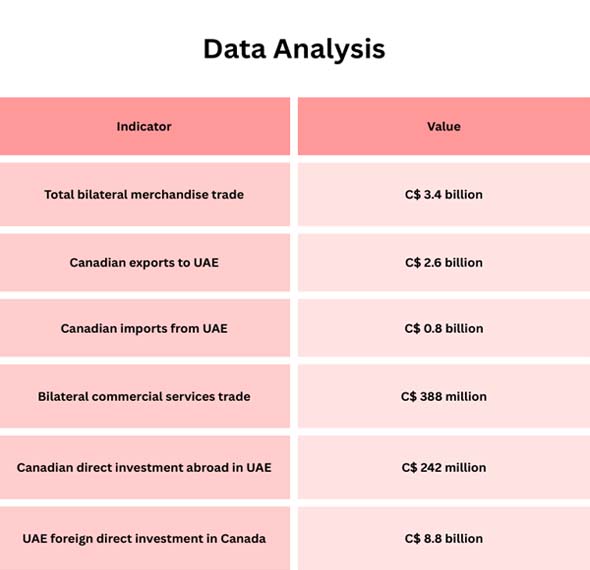
The Canada–UAE commercial relationship is already sizable and accelerating. Merchandise trade has been rising, and the composition shows clear complementarities: Canada exports higher-value manufactured goods and agri-food items, while the UAE exports metals and metal-intensive products—often linked to construction and industrial supply chains.
Services are another important layer. As per Canada Trade Data by Import Globals, the UAE is a regional headquarters destination for finance, logistics, engineering, ICT, and professional services, and Canadian firms increasingly use the UAE as a platform for broader Middle East, Africa, and South Asia operations. Meanwhile, investment momentum is becoming a headline driver, with large pools of UAE capital seeking stable, long-duration opportunities abroad (infrastructure, energy transition, and technology).
What Canada Sells to the UAE—and What the UAE Sells to Canada
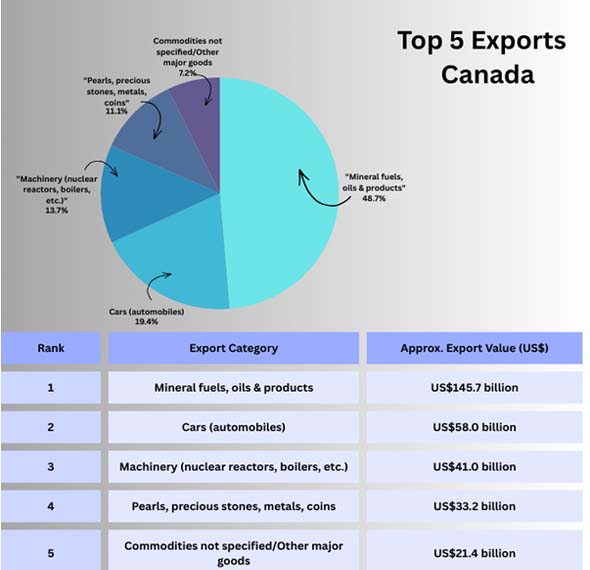
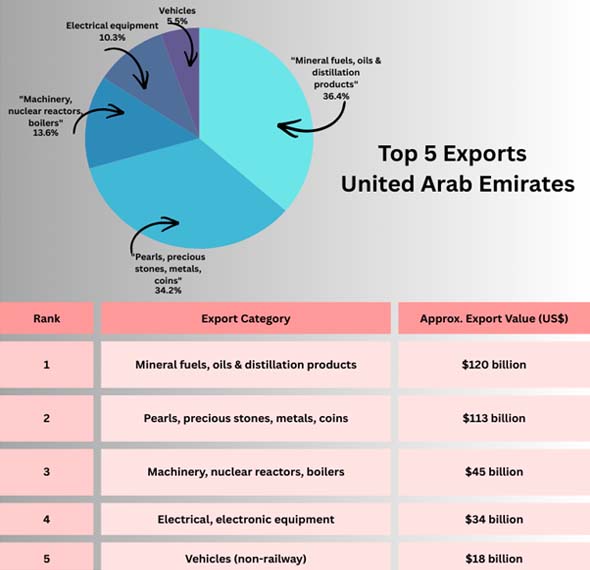
A key reason CEPA talks look practical is that the trade basket is not dominated by one single politically sensitive product line. Instead, it is spread across categories where tariff reductions and smoother procedures can quickly translate into growth. These shares matter because they hint at what each side will prioritize:
As per UAE Customs Data by Import Globals, Canada will push for easier access and faster clearance for high-value manufactured goods (aerospace, auto parts), as well as predictable rules for agri-food.
The UAE will focus on competitive conditions for industrial inputs and semi-finished products (steel/aluminum supply chains), plus improved certainty for investors and services providers operating in Canada.
What "CEPA" Will Probably Entail in Real Life
In the Gulf context, “CEPA” usually signals a comprehensive package: goods + services + facilitation + investment rules. If the Canada–UAE agreement follows modern templates, expect chapters that look like this:
1) Tariff Elimination and Staged Reductions
Most industrial tariffs are typically reduced quickly, while select sensitive items may see phase-ins. As per UAE Import Data by Import Globals, not only do headline tariff reduction help, but making customs processing quick and easy is also very helpful, especially for time-sensitive air freight and high-value exports.
2) Rules of Origin (Roo) That Fit With Real Supply Chains
ROO can help or hurt how much you use something. Because the UAE is a hub for re-export and processing, both sides will want policies that:
- Prevent simple transshipment from third countries, while
- Allow for real regional value addition and modern manufacturing flows.
3) Customs, Making Trade Easier, and "Paperwork Friction"
Companies often feel the benefits of electronic documents, processing before arrival, risk-based inspections, and clearer appeals processes here first. A CEPA that addresses these issues can lower landed costs even when tariffs are already low.
4) Technical Barriers (TBT) and SPS (Food/Agri)
Expect efforts to improve transparency around standards, conformity assessment, lab testing, labeling, and—on the agri-food side—sanitary and phytosanitary procedures. Even modest process improvements can unlock growth for Canada’s food exports and reduce delays.
5) Services: The High-value Frontier
Services commitments may include professional services, engineering, ICT, financial services, education, environmental services, and logistics. For many Canadian firms, the UAE market is not just end-demand—it’s a base for regional delivery.
6) Digital Trade and Data Governance
As per UAE Export Data by Import Globals, a modern CEPA will likely address e-signatures, paperless trade, consumer protection, cybersecurity cooperation, and cross-border data flows (with appropriate safeguards). This matters for fintech, platforms, cloud services, and SMEs exporting digitally.
7) Investment Certainty
Alongside CEPA talks, Canada and the UAE have also been strengthening the “investment rules” layer, which signals that both sides want long-term capital flows to be protected and predictable—particularly in energy transition, infrastructure, and advanced industries.
The Strategic Factors That Will Affect the Negotiations From 2025 to 2026
Canada’s Diversification Push: Canada is actively widening trade links to reduce concentration risk and improve resilience—especially in sectors exposed to tariffs, supply-chain disruptions, or policy swings. The Gulf, with its capital depth and import demand, becomes a natural target.
The UAE aspires to trade with other countries. The UAE is quickly building up its CEPA network to boost trade that doesn't require oil, bring in more money, and make it a better connection between Asia, Europe, and Africa. As per Canada Import Data by Import Globals, a Canada CEPA makes that network stronger by adding a huge G7 economy and a country with a lot of resources and technology.
Investment as the Spark: The tale of investment is very important in 2025–2026. Large UAE investments in Canada (in energy, AI, and strategic areas) are driving political and business momentum. When investment and trade negotiations move in parallel, agreements tend to become more “real-economy” focused.
Opportunities by Sector: Where the Largest Successes Might Happen
Tariffs and other benefits can be important for parts, maintenance environments, and specialized equipment in aerospace and advanced manufacturing. Because of the UAE's aviation industry and its importance in global air cargo, it is more likely to do well.
- Food Security and Farming: As per Canada Import Data by Import Globals, Canada's ability to develop cereals, pulses, and other items that add value is in line with the Gulf's goals for food security. With simpler SPS rules and faster clearance, real growth is conceivable.
- Clean Energy and Important Minerals: Canada's resources and technology, along with the UAE's money and ambition to move to clean energy, make it possible for projects to do more than just sell things (joint ventures, processing, supply chains, and infrastructure).
- Digital, AI, and Data Centers: Both countries want to improve their digital infrastructure. A CEPA that makes it easier for digital products and services to move across borders can help the two countries do more business and invest in each other.
The UAE already sends Canada most of its imports, which are mostly metals and metal-based goods. These supply chains can be more reliable and efficient if the laws are clearer and the border operations are easier. Import Globals is a leading data provider of UAE Import Export Trade Data.
Things to Watch Out for and Risks
Even with strong momentum, a CEPA can slow down if any of these become contentious:
- Rules of origin complexity (especially given the UAE’s hub and re-export role)
- Standards and conformity assessment (testing, certification, and recognition)
- Public policy carve-outs in sensitive services sectors
- Procurement access and transparency expectations
- Labour/environment language and enforceability provisions (common in Canadian trade architecture)
As per Canada Export Data by Import Globals, the most successful agreements usually solve these via pragmatic sequencing: secure early wins (facilitation, transparency, business-enabling rules) while allowing longer phase-ins where political sensitivity is higher.
What Will Happen Next in 2026: A Useful Timeline Perspective
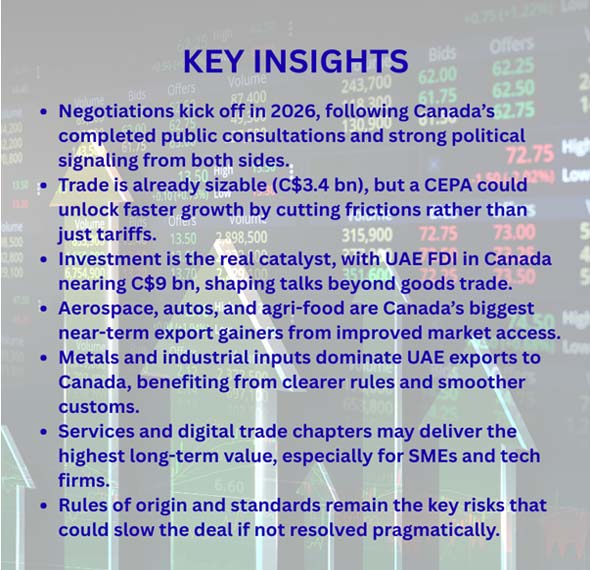
The political signal is clear: both sides have publicly committed to launching CEPA negotiations, with Canada indicating negotiations commencing in 2026 and public consultations already completed. From here, the pace will depend on how quickly negotiating rounds conclude core chapters (goods schedules, ROO, services, digital, and facilitation).
As per Canada Trade Data by Import Globals, if early rounds achieve alignment on “architecture,” the agreement can move rapidly; if ROO and sensitive market access lines become gridlocked, timelines stretch. Either way, 2026 is shaping up as the year the Canada–UAE economic relationship shifts from “growing ties” to “rules-based expansion”—with SMEs and services exporters standing to gain as much as large manufacturers. Import Globals is a leading data provider of Canada Import Export Trade Data.
FAQs
Que. What is a Canada–UAE CEPA?
Ans. A CEPA is a comprehensive trade agreement that typically covers goods, services, trade facilitation, and related rules such as digital trade and investment provisions.
Que. When will negotiations start?
Ans. Canada has indicated negotiations are expected to begin in 2026, following consultations held from December 2025 to late January 2026.
Que. Which areas would benefit the most?
Ans. Aerospace, automobiles and parts, agri-food, clean tech, digital services, logistics, and investment-linked industries like energy transition and infrastructure are all likely to do well.
Que. What could make the deal take longer?
Ans. If not handled practically, complicated rules of origin, standards and certification problems, and sensitive areas of market access might delay progress.
Que. Where to get detailed UAE Customs Data?
Ans. Visit www.importglobals.com.
