
The Trade Data Indicates Where the Most U.S. Goods Will Go in 2025

- Nov 14, 2025
The Trade Data Indicates Where the Most U.S. Goods Will Go in 2025
The way those things are shipped all over the world tells us a lot about the demand for them, the supply chains, and the important market links. Even while the exact numbers are still changing, the top countries for U.S. exports in 2025 will highlight how important partnerships are and how emerging markets are changing. To plan their future export strategy, U.S. businesses, lawmakers, and analysts need to know which countries are buying from the U.S. and which industries are driving those sales. This blog talks about where the U.S. will send goods in 2025, what the data indicates about demand and competition, and what this means for exporters and trade strategy.
The Big Three and Why They Are Important as Top Destinations
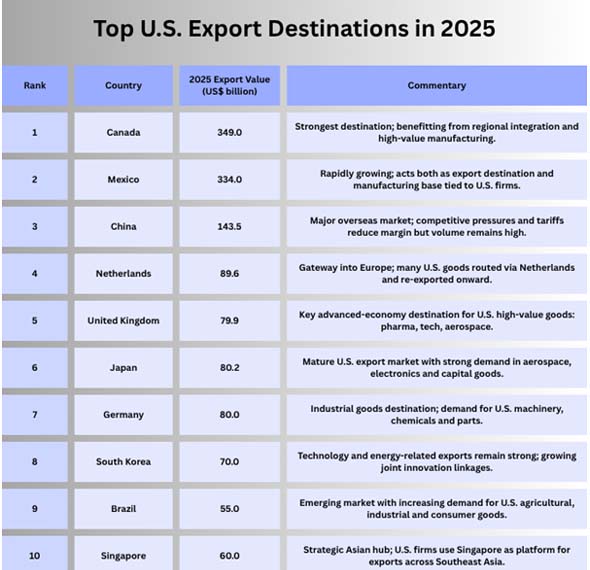
In 2025, the top three places for U.S. exports will still be Canada, Mexico, and China. In terms of geography and economy, these are the U.S.'s nearest neighbors. These three make up a large part of the items that the U.S. sends to other countries. As per USA Import Export Trade Data by Import Globals, this shows that trade between North America and Asia is still highly vital.
Canada's manufacturing, oil, and agriculture sectors all work together with the U.S. in a completely integrated supply chain. On the other side, Mexico has become a major place for making and exporting goods, both to the U.S. and around the world. As per USA Import Custom Data by Import Globals, China is still a big importer of U.S. goods, even though there are tariffs and other trade hurdles. This is because people in agriculture, energy, industry, and technology want a lot of U.S. commodities. U.S. exporters need to make sure their firms are efficient and competitive in North America because these markets are so huge. As per USA Export Data by Import Globals, they need to be smart, able to adapt to changing rules, and able to compete in the long-term global markets.
What the Destination Data Says
1. Most of the Drive Comes from Integrating the Regions
Canada and Mexico combined account for more than 30% of U.S. commodities exports. This shows how effective geographic proximity, shared logistics, and trade frameworks can be. Regional supply chains, especially in the agriculture, electronics, energy, and automobile industries, continue to help U.S. exports in North America. For U.S. companies, the near-neighbor method makes shipping goods cheaper, speeds up delivery times, and makes it easier to meet the requirements.
2. Advanced Economies want High-Value Goods
The fact that the UK, Japan, and Germany are some of the top destinations illustrates that U.S. exports are no longer only about volume goods. As per USA Export Data by Import Globals, they also include chemicals, drugs, planes, high-tech manufacturing, and capital goods. These countries buy from the U.S. because it has the best engineering, new ideas, a good brand name, and follows the rules. To sell to these markets, U.S. exporters need to focus on standing out, being certified, providing good service after the sale, and marketing their products as high-end.
3. New markets and different Ways to Reach them
As per USA import data by Import Globals, Brazil and Singapore are examples of how important it is to have a lot of options, even though the biggest places are still well-known. Singapore is a one-of-a-kind place since it is a hub and re-export point for U.S. goods moving to Southeast Asia. As per USA Importer Data by Import Globals, This suggests that U.S. exporters seek to expand into markets that aren't their normal ones. Brazil's inclusion shows how middle-income countries are buying U.S. goods in the industrial, agricultural, and consumer sectors. By selling to more than one country, U.S. exporters can protect themselves from drops in demand in any one market.
4. The gateway effect and How Global Logistics Work
As per USA Import Trade Statistics by Import Globals, the Netherlands is different from other countries since it is both a direct end-demand market and a logistics hub for Europe. Most of the time, goods created in the U.S. come through Dutch ports. They are then kept, sent back out, or sent to other regions of the EU. This indicates that rankings of destination countries can show both their roles as end users and as transhippers. Smart logistics can help U.S. exporters reach more places through these gateway countries.
5. Strategic Effects on U.S. Trade Policy and Business
Because of these destination trends, U.S. exporters need to change their strategies for each market: Cost-effectiveness, integrated supply chains, and export scale are the most important things for neighbors who live close by. As per USA Import Export Trade Analysis by Import Globals, adding value, having strong technology, and offering premium services are important for mature economies. For new markets, the main things to think about are how to be flexible, how to work with local businesses, how to get into the market, and how well your product fits the market. Policymakers should maintain striving to make trade easier, eliminate non-tariff barriers in key areas, and help exporters discover new markets.
Issues and Strategic Ideas
As per USA import trade analysis by Import Globals, the data illustrates where U.S. exports of goods are going right now, but there are also huge difficulties and strategic issues to worry about. First, long-haul markets have to contend with increased shipping costs, currency risk, and restrictions that are hard to understand. When U.S. companies want to sell to China, Germany, or Japan, they have to deal with tariffs, compliance, localization requirements, and a lot of other companies trying to sell to those countries. Second, markets close by, like Mexico and Canada, may be enormous, but competition, changes in labor costs, and pressure to negotiate pricing in the supply chain can make it hard to earn money. Third, new target nations like Brazil and others often have higher entry risks, problems with their infrastructure, rules that aren't always clear, and slower market growth. Asa per USA Import Data by Import Globals, this means that U.S. exporters need to be patient and engage with reliable local partners. Fourth, the fact that supply chains are growing more global means that U.S. exports could be lost or lose value if inputs from other nations are used instead of U.S.-made ones. This means that U.S. businesses need to provide value and be a part of global value chains even more.
Final Words
The numbers for U.S. commodities shipped in 2025 show that Canada, Mexico, and China are still the best destinations to sell them. As per USA Import Export Global Data by Import Globals, they also show how important European and advanced economies are (the UK, Japan, and Germany) and how important developing markets and global hubs are becoming (Brazil, Singapore, and the Netherlands).
It's clear what U.S. exporters need to do: keep an eye on local markets, compete on value in developed countries, and explore for new areas to do business. What you export is important, but so are where you export, how you handle logistics and services, and how quickly you can adapt to changes in the market. To stay competitive, U.S. exporters will need to focus on making high-quality goods, being able to adapt their global supply chains, and coming up with plans that work for each market. The trade map for 2025 reveals that the U.S. is still a major exporter, but it's becoming more about finding the right spot with the right value. Import Globals is a leading data provider of USA Import Export Trade Data.
FAQs
Que. Which is the main export destination of USA?
Ans. The main place to send U.S. products is Canada, which gets around 16.9% of all U.S. exports.
Que. What makes the Netherlands such a popular tourist destination, even though it's not particularly big?
Ans. The Netherlands is a center for logistics and re-export in Europe, thus U.S. goods can go there and then go to other EU countries.
Que. What kinds of American goods are being supplied to countries with advanced economies like Germany, Japan, and the UK?
Ans. Instead of basic products, these are frequently high-value things like capital equipment, parts for aerospace and defense, pharmaceuticals, specialist machinery, and electronics.
Que. Should U.S. exporters only pay attention to the countries at the top of the list?
Ans. Not all the time. Big places are good for scale, but emerging markets or countries that are logistics hubs can often offer faster growth, less competition, and more chances to diversify. These places should be included in a well-rounded plan for exports.
Que. Where to get detailed USA Export Import Global Data?
Ans. For that you need to visit www.importglobals.com.
