
Argentina's Trade Surplus in 2025: What It Will Be, How It Will Happen, and What Problems It Will Face
- Mar 05, 2026
Argentina's Trade Surplus in 2025: What It Will Be, How It Will Happen, and What Problems It Will Face
Argentina closed 2025 with a merchandise trade surplus of roughly US$11 billion, a headline number that looks even more impressive considering that imports rebounded sharply during the year. For an economy that has struggled for years with foreign-exchange shortages, inflation shocks, and stop-start growth, a positive external balance is more than a macro statistic—it can shape everything from currency stability to investment confidence.
But the story of 2025 is not simply “exports rose, therefore surplus.” As per Argentina Import Data by Import Globals, it’s a more nuanced mix: export growth (especially agriculture and energy) combined with a policy- and cycle-driven import recovery—and, crucially, a structural change in the energy account that is starting to rewrite Argentina’s external constraints.
This blog breaks down what powered the 2025 surplus, why it was smaller than the prior year despite higher exports, and what the balance says about Argentina’s recovery path moving into 2026.
1) One Picture of the Trade Result in 2025
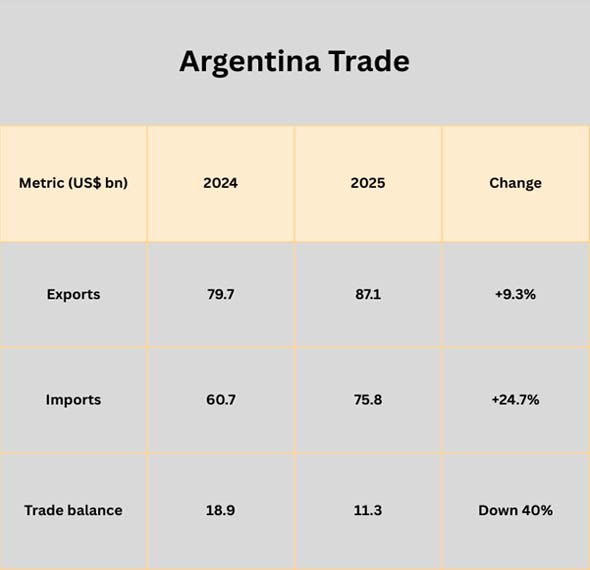
Argentina’s 2025 trade surplus was achieved through two opposing forces:
Exports increased (helped by agriculture, manufacturing linked to commodities, and energy). As per Argentina Export Data by Import Globals, imports increased even faster (as domestic activity, supply chains, and policy stance shifted toward higher import availability). The net effect was still positive—but less “windfall-like” than it can appear at first glance.
2) Why Exports Stayed Strong: The "Two Engines" Story (Agricultural and Energy)
Argentina’s export base is often described as commodity-heavy, but 2025 showed something important: the country is not relying on a single commodity cycle. Instead, the year reflected two export engines working together:
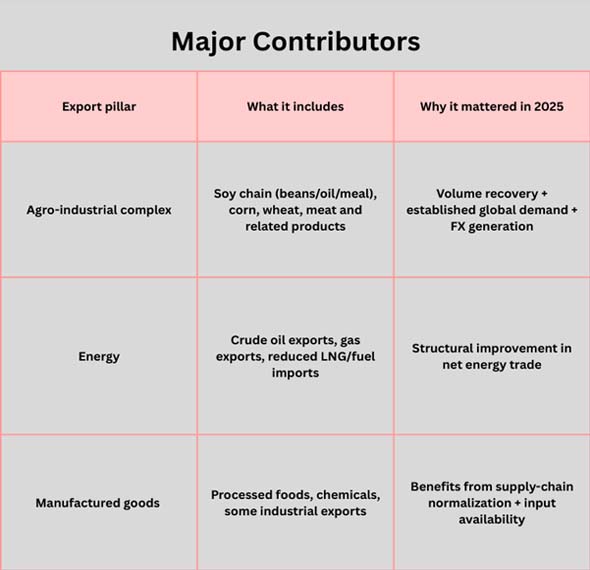
As per Argentina Import Export Trade Data by Import Globals, Agro-industrial exports (grains, oilseeds, livestock-linked chains, and value-added agri products). Energy Exports (oil and gas—directly and via reduced import needs).
A) Agriculture: Recovery Momentum and Scale
As per Argentina Import Custom Data by Import Globals, agriculture remains Argentina’s export backbone because it generates hard currency at scale and supports upstream/downstream industries (inputs, logistics, crushing, ports). In 2025, agroexports rose again, reinforcing external revenues even as global markets stayed competitive.
One useful way to frame the role of agriculture is not just “how big it is,” but how it stabilizes the balance of payments when other sectors are cyclical. In 2025, agroexport earnings were reported at about US$42.2 billion, up year-on-year—supporting the broader export total.
The key point: agriculture provided scale, while energy provided structural relief—and together they made the surplus resilient even as imports surged.
B) Energy: The Structural Shift That Changed the Math
For years, Argentina’s energy account was a source of pressure—when domestic supply lagged demand, the country imported expensive fuels (often at the worst moments). In 2025, the energy story flipped decisively.
As per Argentina Import Trade Analysis by Import Globals, reported figures show an energy trade surplus around US$7.8 billion in 2025, supported by energy exports around US$11.1 billion and energy imports around US$3.3 billion. That surplus is so large that it explains a substantial share of the total merchandise trade surplus.
Why this Matters for Recovery: when energy turns from deficit to surplus, it can reduce FX stress, soften the impact of external shocks, and create room for capital goods imports that support investment.
3) Why Imports Jumped in 2025 (and Why That’s Not Automatically “Bad”)
As per Argentina Exporter Data by Import Globals, at first glance, a ~25% surge in imports sounds like a warning sign: is the surplus “fragile” or “temporary”? The more accurate interpretation is: imports rebounded because parts of the economy were re-opening, re-stocking, and re-connecting to supply chains.
Imports typically rise for several reasons during a stabilization phase:
- Industrial inputs become available (intermediate goods used for production)
- Capital goods imports increase (machinery and equipment for investment)
- Consumer goods recover (if purchasing power and availability improve)
- Policy shifts minimize bottlenecks
In Argentina’s 2025 context, the import rebound also aligned with a policy narrative of greater trade openness and normalization relative to a prior year that had unusually constrained import volumes.
As per Argentina Importer Data by Import Globals, the good news is that if import increase is mostly in capital goods and intermediate goods, it could mean that the economy is recovering and not overheating because of too much consumption.
The risk interpretation says that if imports rise faster than exports for too long without any gains in productivity, the trade balance can fall swiftly, bringing back FX limits.
4) The Increased Money Was Real, Although It Was Less Than in 2024
As per Argentina Import Shipment Data by Import Globals, a trade surplus can shrink even when exports rise. That’s exactly what happened.
- Exports increased to about US$87.1B in 2025.
- Imports increased even more to about US$75.8B.
- Result: surplus around US$11.3B, down from roughly US$18.9B the year before.
When the economy goes from a "compressed imports" phase (tight FX, limits, recession) to a "normalizing imports" phase (restocking, investing, and fewer regulations)
So, the 2025 surplus should be viewed as: the external balance stays positive, but the buffer got thinner, which means that mistakes in policy or shocks from outside sources could have a bigger effect.
5) What the Trade Balance Means for the Economy's Recovery
A good recovery needs three things at once:
- External stability (having enough foreign exchange to prevent crises again and over again).
- Normalizing the availability of inputs and capital goods for domestic production.
- Investment momentum (to boost productivity and exports over time)
As per Argentina Import Export Trade Analysis by Import Globals, the trade numbers for 2025 show that Argentina is trying to move toward the "three-part" recovery model, where exports bring in foreign currency and imports help with production and investment.
But the topic of sustainability depends on the composition:
- If most of the imports are inputs and capital items, they can help the economy grow and increase exports.
- The trade balance can get worse if a lot of imports are for consumption and not for making things better.
6) Issues that can put Stress on the Surplus in 2026
Even with good figures for 2025, there are a few things that could make the external balance worse:
(1) Changes in the Weather and Prices of Goods
- Agriculture is strong, but it is vulnerable to global price cycles.
- Climate shocks,
- And logistical limitations.
- A weaker harvest or softer prices can reduce export receipts quickly.
(2) The Energy Infrastructure and the Seasons
As per Argentina Export Import Global Trade Data by Import Globals, the energy surplus is getting better structurally, but: export capacity relies on pipelines, terminals, and how well investments are made, winter demand can still make it need to import more, and growing LNG ambitions takes years to build.
(3) Imports are Rising Faster Than Exports Can Keep Up With
Imports can keep going up as long as the economy grows faster than the ability to export. The trade balance can stay positive, but the buffer shrinks.
(4) Financing and FX Dynamics
Trade flows are one pillar; financing conditions are another. If external financing remains tight, Argentina may still face pressure even with a surplus—especially when debt service, reserves, and confidence channels interact.
7) What to Watch for in the Future: The "Quality" of the Surplus
For 2026, the most useful lens isn’t only the headline surplus number. It's the quality of the extra:
- Energy balance trend: does the energy surplus get bigger when exports go up and imports go down?
- Are capital goods and intermediates the most important parts of imports?
- Are value-added exports expanding together with commodities as part of export diversification?
- Monthly consistency: does the extra stay the same through the seasons?
If energy continues to deliver large net FX inflows, Argentina may have more room to import what it needs to grow—without falling back into the old stop-go pattern. Import Globals is a leading data provider of Argentina Import Export Trade Data.
FAQs
Que. How did Argentina get a trade surplus in 2025 even though imports rose a lot?
Ans. The country had a big energy surplus that made up for the rise in imports, thus exports also went up.
Que. Which industries were most important for the surplus in 2025?
Ans. Agriculture (the amount of money made from exports) and energy (the amount of money made from exports minus imports).
Que. Is it a bad omen that the surplus is getting smaller (compared to 2024)?
Ans. Not always. It might be a sign of economic normalization, with imports going up when output and investment start up again. The concern is that imports will keep going up without any future growth in exports.
Que. What is the largest threat to the surplus in 2026?
Ans. A mix of shocks to commodities and the weather, imports growing faster than exports can handle, and problems with infrastructure or funding that affect energy and trade in general.
Que. Where to get detailed Argentina Import Export Global Data?
Ans. Visit www.importglobals.com.
