
How the U.S. Handles Supply Chain Risks for Important Minerals and Rare Earths That It Imports
- Nov 28, 2025
How the U.S. Handles Supply Chain Risks for Important Minerals and Rare Earths That It Imports
A few "critical minerals" and rare earth elements (REEs) are particularly crucial to a lot of businesses nowadays. Things like fighter jets, smartphones, solar panels, and electric cars are some of these.
As per USA Export Data by Import Globals, these inputs are needed for clean energy technologies, modern electronics, semiconductors, drones, satellites, and defense equipment to work.
As per USA Import Export Trade Data by Import Globals, the US still gets a lot of these minerals from other places, though. For some, it gets 70% to 90% of what it needs from other countries. Washington has made getting access to important minerals a major economic and national security goal because of geopolitical conflicts, global supply chains that are too focused, and the rapid rise of green technologies.
This blog talks about how the U.S. needs to import rare earths and key minerals, the risks that come with this, and how the U.S. is protecting its weak supply chains through reshoring, alliances, recycling, and new technologies.
Some Important Facts About Rare Earths and Important Minerals
Critical minerals are minerals that are crucial for the economy or the safety of the country. Make it easier to break supply networks.
The official U.S. list includes lithium, cobalt, nickel, graphite, manganese, gallium, germanium, rare earth elements, and many more important materials for batteries, aerospace, and sophisticated manufacturing.
There are 17 rare earth elements (REEs) that are employed in:
- Permanent magnets for wind turbines and electric car engines
- Guiding systems and other defense technologies
- High-tech electronics, lasers, fiber optics, and sensors
As per USA Import Customs Data by Import globals, scarce earths aren't scarce by nature, but it's hard and expensive to get them out of the ground and purify them. The global processing step has always been run by one country, which makes the supply chain weak.
Why the U.S. Needs to Get Things from Other Countries
As per USA Import Trade Analysis by Import Globals, the U.S. has certain minerals, but it doesn't have a lot of the tools needed to mine, refine, and process them. Because of environmental rules, long wait times for licenses, and high labor expenses, US companies have a harder time creating things quickly.
Because of this, the U.S. gets most of its refined minerals from foreign countries. As per USA Exporter Data by Import Globals, China has been in charge of global supply chains for decades by providing cheap refining and manufacturing clusters that work together.
The table below shows how much the U.S. needs to buy important minerals and rare earths from other countries.
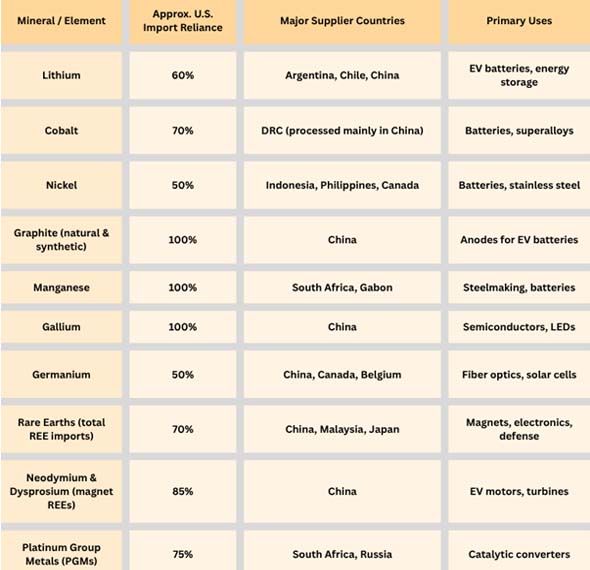
The Amount of Important Minerals and Rare Earths the U.S. Needs to Import from Other Countries
Big Risks of Relying on Imports
1. Weakness in World Politics
As per USA Importer Data by Import Globals, most of the U.S.'s supply chains are in a few places, including China, which puts the country at risk.
- Stress in politics
- Trade disagreements
- Restrictions on exports
Disruptions of any kind can have an impact on whole sectors that come after them, such as electronics and electric cars.
2. The economy is Not Stable
Prices for minerals like lithium, nickel, and cobalt have changed a lot over time. This has raised the cost of making batteries, electronics, and electric cars. As per USA Import Trade Statistics by Import Globals, a supply chain break that you didn't see coming can raise the cost of creating items.
- Late schedules for making things
- Not as good for U.S. businesses
3. Problems in the Supply Chain
Most of the processing and refining takes place in just one or two countries, even though raw minerals come from all over the world. This makes it hard for U.S. businesses to adapt when demand rises quickly.
4. Threats to National Security Defense systems need materials that aren't particularly common, such as rare earth magnets and sophisticated alloys. There could be a risk if these inputs aren't there:
- Building fighter jets
- Systems for defending against missiles
- Weapons that can be directed very accurately
- Systems for communication and radar
So, making sure that supplies never run out is a very important component of preparing for national security.
How the U.S. Is Lowering and Managing Risks in the Supply Chain
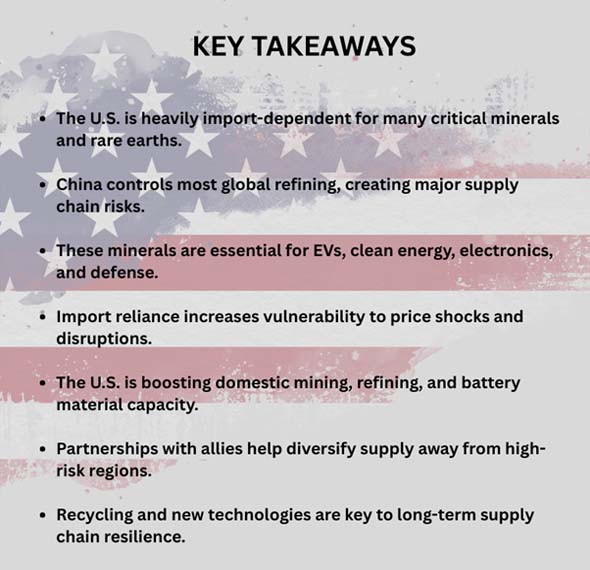
As per USA Import Export Trade Analysis by Import Globals, the U.S. has started to use a multi-layered method to protect against these problems. It includes putting money into the U.S., working with other countries, and using technology to fix problems.
1. Getting stronger Mining and Refining at Home
The U.S. is spending a lot of money to establish new mines and bring existing ones back to life so they can get nickel, lithium, and rare earths. Some crucial things to do are:
- Cash for US processing plants
- Getting permission for important projects quickly
- Helping small refineries sort rare earths
- Investing in American businesses that are searching for new ways to access resources
A lot of new lithium and rare earth projects are starting up in Nevada, California, Texas, and Wyoming.
2. Getting Along with other Countries
As per USA Import Shipments Data by Import Globals, the U.S. and Australia are working together to stop relying on a small number of suppliers for lithium and rare earths.
- Canada: cobalt, nickel, and graphite
- Lithium from Chile and Argentina
- Japan and South Korea (parts for batteries)
- European Union (working together to get essential raw commodities)
These deals help build new supply chains that are both politically stable and up-to-date with technology.
3. More options for Recycling and a Circular Economy
As per USA Export Import Global Trade Data by Import Globals, recycling is becoming an essential part of the U.S. plan for crucial minerals. Here are some of the things that are happening:
- Recycling batteries that use lithium-ion
- Getting back rare earth magnets
- Taking apart old electronics and motors
- Making closed-loop systems for companies that make electric cars
Recycling cuts down on the need for mined resources and makes the supply more stable over time.
4. Strengthening US Manufacturing
- The U.S. is telling companies to build gigafactories to make batteries.
- People that work in the supply chain for electric vehicles
- Plants that use rare earth elements to make magnets
- Fabs for Chips
As per USA Import Data by Import Globals, By creating more products at home, the U.S. enhances its strategic competencies in domains critical to national security. This means that it doesn't have to rely on supply lines from other countries as much.
Last Thoughts
The U.S. economy now relies on critical minerals and rare earth elements. These minerals and elements are what make it possible to develop sustainable energy systems, high-tech electronics, and technologies for the aerospace and defense industries. But relying too heavily on imports, especially from regions where politics are quite unstable, is not a good idea from a strategic point of view.
All of these programs have the same goal: to make the U.S. safer and more competitive in a global economy that is based on technology. They do this by making the supply chain less risky. Import Globals is a leading data provider of USA Import Export Trade Data.
FAQs
Que. Why does the U.S. get so many important minerals from other countries?
Ans. This is because the U.S. doesn't have the resources to mine and process these minerals, and a few countries have been in charge of the global supply chains for them for a long time.
Que. Which country sends the most rare earths to the US?
Ans. China is still the main place to get processed rare earth materials.
Que. Can recycling help the U.S. buy less products from other countries?
Ans. Yes. Recycling lithium-ion batteries and rare earth magnets can cut down on the requirement for new minerals by a lot.
Que. What is the U.S. doing to make its supply chains more reliable?
Ans. By investing in the country, working with other countries, recycling, coming up with new ideas, and making batteries and semiconductors grow.
Que. Where to get detaile USA Import Export Global Data?
Ans. Visit www.importglobals.com.
