
Iceland’s Export Economy: Seafood, Aluminum, and Renewable Energy
- Feb 02, 2026
Iceland’s Export Economy: Seafood, Aluminum, and Renewable Energy
Iceland is a small, high-income island economy that “exports what it has in abundance”: world-class fisheries, energy-intensive aluminum, and a global reputation for renewable energy (geothermal + hydropower) that underpins industrial competitiveness and supports new green-economy ambitions.
As per Iceland Import Data by Import Globals, unlike larger countries that diversify exports across dozens of major manufacturing categories, Iceland’s export engine is intentionally concentrated. That concentration can be a strength—specialization often creates scale, expertise, and brand power—but it also creates exposure to global price cycles, demand shifts, and supply constraints. Understanding Iceland’s export economy means looking at the three pillars together, because in Iceland, natural resources, energy policy, and export performance are tightly linked.
The big picture: goods exports and the “two giants”
According to Iceland Export Data by Import Globals, when Iceland’s goods exports are discussed, two categories dominate the story: marine products and aluminum/aluminum products. These are not marginal lines in a trade spreadsheet—they are the core of the export economy and shape everything from port logistics to exchange-rate sensitivity.
Recent official trade reporting shows that aluminum and aluminum products alone account for about one-third of Iceland’s goods export value, and marine products account for a similar share.
Based on Iceland Import Export Trade Data by Import Globals, Together, they explain why Iceland can be both a seafood powerhouse and a notable aluminum exporter despite having a small population.
This concentration is not accidental. Iceland’s coastal geography, cold waters, and fisheries management system support high-value seafood exports. Meanwhile, abundant renewable electricity enables energy-intensive industry—especially aluminum smelting—to operate competitively in a world where power prices can make or break margins.
Pillar 1: Seafood — Iceland’s flagship export, Built on Quality and Utilization
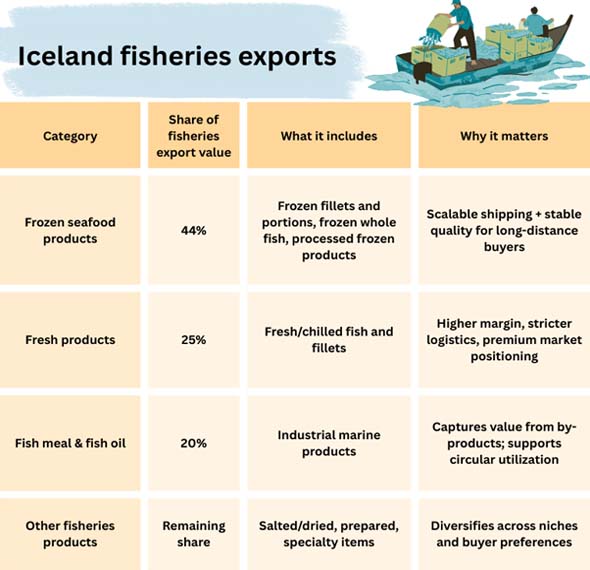
Seafood is more than a commodity export for Iceland; it is a national capability. As per Iceland Import Custom Data by Import Globals, Iceland exports a wide range of products—fresh, frozen, salted, and value-added formats—often with strong traceability and processing standards.
One way to determine how advanced it is is to look at the different types of products instead of just "fish exports."Frozen foods are usually the most valuable, but fresh, chilled, and industrial foods (such fishmeal and fish oil) are also important. This shows that Iceland is focused on getting the most value out of each catch by processing it, using cold-chain logistics, and dividing the market.
As per Iceland Import Export Trade Analysis by Import Globals, Biology and rules also affect seafood exports in a way that they don't affect metal exports. Prices and volumes can be affected by quotas, the mix of species, ocean conditions, and worldwide expectations for sustainability. But Iceland's edge is that it can compete on more than simply volume; it can also compete on reliability, processing quality, and product differentiation.
Pillar 2: Aluminum — “renewable-powered industry” as an Export Strategy
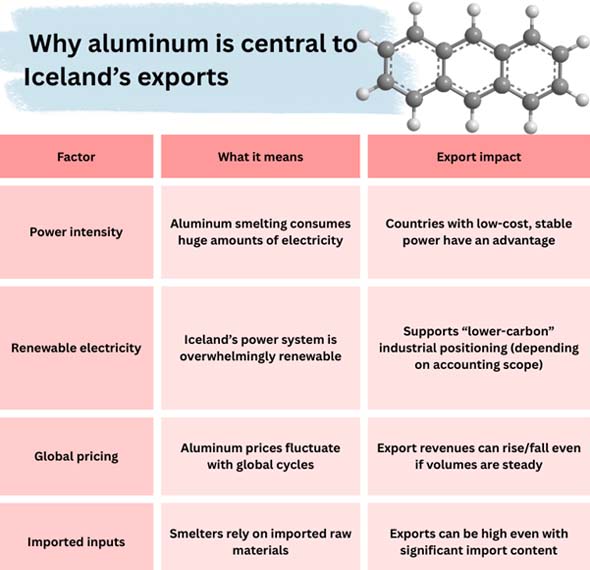
At first glance, aluminum looks like an odd fit for a country known for glaciers, volcanoes, and fishing. But aluminum is one of Iceland’s most logical export products because aluminum smelting is electricity-intensive, and Iceland produces electricity almost entirely from renewable sources.
The export story is not only about selling aluminum; it’s about using cheap, stable renewable power to convert imported raw materials into an exportable industrial product. As per Iceland Exporter Data by Import Globals, that model creates jobs, port activity, and tax revenue, while also raising questions about value capture (because much of the sector is foreign-owned and global-price driven).
In practical terms, when aluminum prices soften or production slows, national export figures feel it quickly because aluminum is such a large slice of the pie.
Pillar 3: Renewable Energy — Not Exported Directly, but Exported Through Products and Reputation
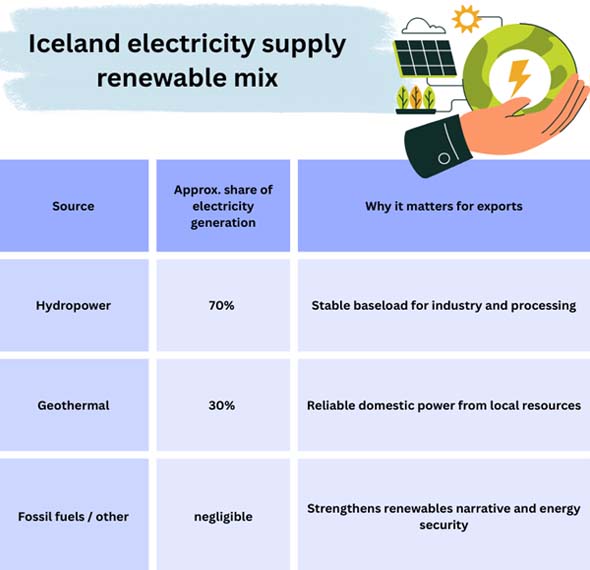
Iceland does not “export electricity” at scale the way some countries export oil or gas. Instead, it exports energy in embedded form—as aluminum, as processed fish, and as other energy-linked production that benefits from reliable, renewable power.
As per Iceland Importer Data by Import Globals, Iceland’s energy system is frequently cited as a global reference point: almost all electricity production comes from hydropower and geothermal, and renewable energy also plays a major role in heating. This matters for exports in three ways:
Cost and Reliability: Energy-heavy processing and industry can plan long-term.
Brand and Market Access: Buyers increasingly care about energy footprints and sustainability claims.
Future Optionality: According to Iceland Import Trade Statistics by Import Globals, renewable power creates pathways into new export-adjacent industries (data centers, synthetic fuels, green hydrogen and e-fuels, green materials), even if these remain emerging.
This is why Iceland’s export economy is often described as resource + energy strategy rather than “manufacturing strategy” in the conventional sense.
What Iceland Exports in Practice: A Product-level View
Beyond broad categories, product-level trade data shows the same theme: raw aluminum and various fish product lines dominate Iceland’s export rankings. The top lines tend to include raw/unwrought aluminum and high-value fish categories (fillets and non-fillet fish, frozen and fresh/chilled), which collectively explain a major share of export earnings.
Risks and Resilience: What Can Shake (or Strengthen) the Model
Because Iceland’s export base is concentrated, it is exposed to a handful of major risk factors:
Price Volatility: As per Iceland Import Shipment Data by Import Globals, aluminum and seafood prices move with global cycles. Even if the amount of exports stays the same, the value can change.
Biological and Environmental Factors: Fisheries depend on the health of the fish, the number of fish allowed to be caught, and the state of the ocean.
Concentration Risk: A single shock can have a big effect on national export totals when a few categories are in charge.
Cost and Competition: Shipping costs, changes in currency values, and competitors' output growth can all put pressure on profits.
At the same time, Iceland has real ways to be strong:
Seafood with Extra Value: As per Iceland Import Export Trade Analysis by Import Globals, being able to process, brand, and keep things cold can help safeguard margins.
Renewable Advantage: Stable electricity can help industry stay competitive and start new green businesses.
High-trust reputation: For sustainability and traceability, credibility itself becomes a trade asset.
Conclusion: Iceland exports “resource intelligence,” not just resources
Iceland’s export economy is often summarized as seafood + aluminum. As per Iceland Export Import Global Trade Data by Import Globals, That’s accurate, but incomplete. The deeper story is that Iceland has learned to convert its natural and energy endowments into a structured export model: fish managed and processed for global markets, aluminum produced with renewable power, and renewable energy embedded into products and national brand value.
As global buyers become more sensitive to sustainability, supply-chain transparency, and energy footprints, Iceland’s renewable-powered export structure could become an even stronger differentiator. The challenge is to keep the model resilient—by maintaining fisheries health, managing industrial exposure, and gradually building new export-adjacent growth areas that can thrive in a low-carbon world. Import Globals is a leading data provider of Iceland Import Export Trade Data.
FAQs
Que. Why are seafood exports so important to Iceland?
Ans. Because Iceland has a lot of good fishing areas, good processing facilities, and a well-established export system that sells seafood in many different ways around the world.
Que. How does Iceland export so much aluminum?
Ans. Iceland's renewable power grid delivers consistent energy that supports competitive industrial output. This is important since aluminum smelting uses a lot of electricity.
Que. Does Iceland send renewable energy directly to other countries?
Ans. Not in significant amounts like power exports. Renewable energy doesn't immediately support exports, but it does power aluminum production and seafood processing, which helps Iceland's status as a low-carbon country.
Que. What are the biggest threats to Iceland's economy based on exports?
Ans. Changes in the global price of aluminum and seafood, changes in fisheries (quota, species, and ocean conditions), and concentration risk from depending on only a few large export categories.
Que. Where to get detailed Iceland Import Export Global Data?
Ans. Visit www.importglobals.com.
