
How to Deal With Supply Chain Risks When Sweden Buys Electronics and Semiconductors

- Nov 15, 2025
- 97 Views
How to Deal With Supply Chain Risks When Sweden Buys Electronics and Semiconductors
As per Sweden Import Export Trade Data by Import Globals, it is very important for the economy of the country that individuals can buy working imported electrical parts. This is true for everything, from creating cars to making medical technologies, telecommunications, renewable energy systems, and more. Because of the COVID-19 pandemic and the semiconductor crisis of 2020–2023, global supply chains are less solid now, thus Sweden has to think about how it acquires critical technical inputs.
This blog talks about how Sweden is growing more dependent on electronics and semiconductors, which are significant trading partners. It also talks about the strategic flaws that recent crises have brought to light and what the government and businesses are doing to lower risks.
Sweden's Imports: Electronics and Semiconductors Are Important
People all across the world know that Sweden's businesses are built on new ideas. Ericsson's communication systems, Volvo's smart automobiles, and ABB's automation solutions are a few examples. But most of the semiconductors, integrated circuits (ICs), and advanced chips that power these systems come from Asia, mainly Taiwan, South Korea, Japan, and China.
As per Sweden Import Custom Data by Import Globals, in the US, the electronics manufacturing base is more concentrated on design, software integration, and final assembly than on making raw semiconductors. Sweden is vulnerable to changes in the global supply chain since it relies on it so much, especially as the need for chips in AI, electric cars, and automation grows.
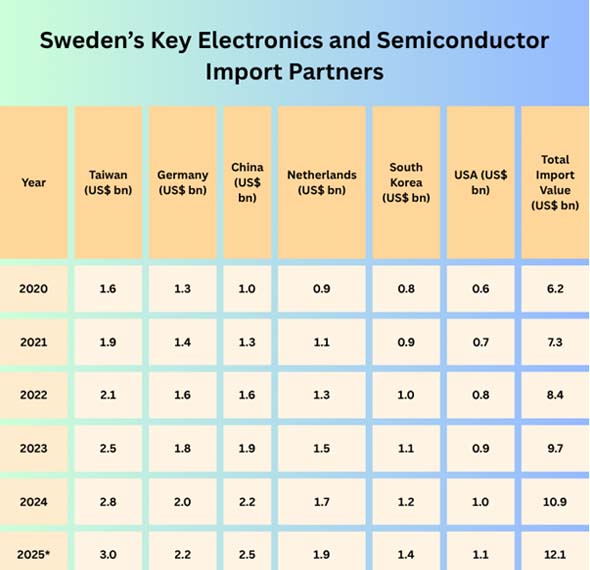
The Structural Factors That Make Us Rely on Imports
1. The country doesn't make Many Chips
As per Sweden Import Trade Analysis by Import Globals, there aren't many semiconductor fabrication (fab) firms in Sweden. Building fabs costs billions of dollars and requires very pure raw materials and very specialized technology. Swedish businesses find it cheaper to buy chips and parts from other countries than to create them themselves because the Swedish market isn't particularly big.
2. Saving money and Specialization Around the World
As per Sweden Export Data by Import Globals, all around the world, the supply chains for contemporary semiconductors are broken. The three main businesses that make lithography and manufacturing technology are ASML from the Netherlands, TSMC from Taiwan, and Samsung from South Korea. Sweden mostly works on the levels of design, testing, and putting things together. This specialization makes things work better, but it also means that the business has to rely on the supply chain that came before it.
3. More demand in Key Areas
Sweden needs more advanced semiconductors because smart manufacturing is growing more popular, 5G is being rolled out, and transportation is using more electricity. As per Sweden Importer Data by Import Globals, for example, Volvo and Scania's electric vehicles (EVs) need power chips and microcontrollers.
Ericsson's 5G base stations need CPUs that are Fast
ABB and SKF use electronics that are already in the machines to figure out when maintenance is needed and do it automatically. These industries are getting bigger, therefore they buy more and more items from other countries.
There could be hazards if the global supply chain has problems.
1. Issues Between Nations
Taiwan and South Korea are both having political problems, and they export a lot of chips to Sweden. If things get worse in the Taiwan Strait, it could halt European companies that need these parts from doing business. As per Sweden Import Trade Statistics by Import Globals, there are also more trade problems between China and Western economies. This might make it harder to get high-tech stuff from other countries.
2. Problems with Logistics
The epidemic revealed how dangerous global shipping networks can be. Shipping delays, busy ports, and delays in producing semiconductors hurt Swedish enterprises a lot. As per Sweden Import Export Trade Analysis by Import Globals, Companies had to wait months for parts, which disrupted manufacturing lines in the automobile and industrial automation sectors.
3. Risk of Concentration
Sweden only buys goods from a small number of other countries. It's tougher to negotiate when there are so many suppliers. If one of them has problems, it might cause industries to fail.
4. Changes in the worth and cost of Money
The price of semiconductors is in US dollars (USD), thus any changes in the value of the Swedish krona (SEK) will affect the cost of imports. As per Sweden Import Shipment Data by Import Globals, when the value of the krona goes down, Swedish companies have to pay more for the same parts. This makes it more expensive to create them and makes them less competitive.
How the Government and Businesses in Sweden Responded
1. Helping EU Countries work together more Easily
Sweden is doing everything it can to make the European Chips Act a law. As per Sweden Import Export Global Data by Import Globals, the goal of this regulation is to build a semiconductor ecosystem in the EU worth €43 billion. Europe's share in the global semiconductor market should grow from 10% to 20% by 2030.
In Sweden, research universities and tech companies are partnering with groups in Germany, France, and the Netherlands to create shared research and manufacturing facilities for semiconductors and photonics.
2. Helping with research and design in the Home Nation
Sweden is putting money on novel techniques to make and test semiconductors, even if it might not be practical to build full-scale fabs. The universities in Lund and KTH Stockholm, as well as research institutions like RISE (Research organizations of Sweden), are producing prototype chips that will be used in green energy, automobiles, and the Internet of Things (IoT). As per Sweden export import global trade data by Import Globals, the objective of these initiatives is to raise Sweden's place in the value chain.
3. Having more than One Provider
Swedish companies are looking for suppliers in places other than East Asia. Germany, the Netherlands, and the United States are the first three countries to get advanced parts. India and Vietnam are also becoming popular areas to acquire devices that are not too cheap.
4. Making Stock Buffers
Companies have learned from the pandemic and are now purchasing up essential chips and parts. Car and telecom firms now have strategic reserves on hand so they don't have to close down all at once. This is a switch from the old "just-in-time" paradigm to a stronger "just-in-case" model.
5. Spending money on Technologies that don't Function
Sweden is exploiting its position as a leader in sustainability to recycle old equipment and obtain back scarce materials like copper, gold, and silicon wafers. Not only does this make the EU less reliant on imports, but it also helps the EU reach its bigger goals for becoming green.
Keeping yourself Protected with Technology
Smart Manufacturing and Automation
AI-powered tools are helping Sweden's factories keep a watch on their supply chains, figure out when they could run out of something, discover problems, and choose the best suppliers. With real-time analytics, businesses may adjust their production plans and get more supplies before they run out.
Digital Twin and Blockchain Together By creating digital twins of their logistical networks and leveraging blockchain for procurement, Swedish enterprises are making it easier to find and keep track of semiconductor sources. This decreases the chance of getting fraudulent items and helps make sure that the sources are authentic.
Places to Work as a Team
Smartare Elektroniksystem (Smart Electronics Systems) is a public-private group that enables businesses and universities work together on research and development. This helps Sweden's electronics industry keep acquiring new ideas and knowledge.
The Road Ahead: How to Be Strong and Smart
As per Sweden Import Data by Import Globals, Over the next ten years, Sweden will definitely keep integrating digital tools, AI, and projects that are good for the environment to its trade strategy.This will help the country deal with the uncertainty and stay one of the most advanced economies in Europe.
Final Thoughts
This reliance has led to a lot of great new ideas, but it has also made problems more visible as the supply chain problems continue. Sweden is working with the EU to prepare for future shocks by spending money on research and development and finding better ways to get goods to people. The country's policy is not to be alone, but to be strategically interdependent, balancing open trade with technological independence. Import Globals is a leading data provider of Sweden Import Export Trade Data.
FAQs
Que. Why does Sweden need so many semiconductors from other places?
Ans. It doesn't have big factories that make semiconductors, therefore it has to buy them from some vendors in other countries, such as Taiwan and South Korea.
Que.What is Sweden doing to cope with risks in the supply chain?
Ans. By getting chips from a lot of different companies, working on semiconductor initiatives in the EU, building up stock, and pouring money into chip R&D.
Que. Which industry is hurt the most by the lack of semiconductors?
Ans. Tools for clean energy, automobiles, phones, and industry.
Que. Is it possible for Sweden to develop its own semiconductors?
Ans. According to Import Globals, Sweden's import data, it's not totally necessary, but it can help with home design, testing, and recycling to make it less necessary.
Que. Where to get detailed Sweden Export Data?
Ans. For that visit www.importglobals.com.
