
Malaysia's Role in the Regional Supply Chain in 2025–2026
- Mar 12, 2026
- 167 Views
Malaysia's Role in the Regional Supply Chain in 2025–2026
"Networked manufacturing" is becoming more and more important in ASEAN's trade ecosystem.
Why Malaysia is Important to the Tale of Asean's Supply Chain
As per Malaysia Import Data by Import Globals, parts cross borders many times, final assembly happens where capacity and incentives are best, and distribution happens through a few well connected logistical gateways. Malaysia has two jobs under that system:
- A center for high-value manufacturing and exporting, especially of semiconductors and electrical and electronic goods.
- A regional connector that connects ASEAN industrial networks to global end-markets through many free trade agreements and well-developed trade logistics.
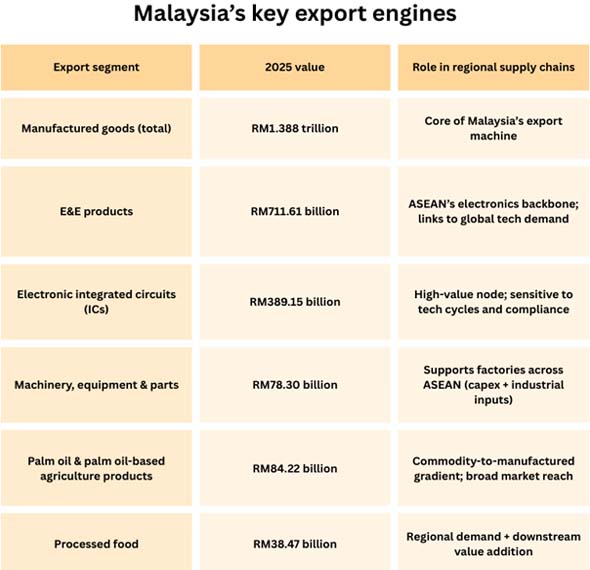
Malaysia's commerce with other countries reached RM3 trillion in 2025, which was a symbolic line that had never been crossed before. As per Malaysia Export Data by Import Globals, at the same time, ASEAN's tools for integration, such as paperless trade, harmonized laws, and stronger trade agreements, made it easier for commodities to move between countries in the region. For both global and ASEAN enterprises, Malaysia's main goal in 2026 is to move high-value commodities across borders while keeping strong, compliant, and competitive.
Malaysia's Trade Performance in 2025: A Record That Shows How Important the Supply Chain is
The trade numbers for Malaysia in 2025 reveal that it is buying a lot of things to keep its factories running and selling a lot of things. This happens in a country where there is a lot of manufacturing.
As per Malaysia Import Export Trade Data by Import Globals, the enormous number of Malaysia's excess shows how the supply chain really works. A lot of manufactured goods are leaving the country, trade financing flows are steady, and the export ecosystem is smart enough to handle tough requests.
Malaysia As a Hub for Manufacturing and Exporting: What It Makes and Why Buyers Select It
Three things that enable Malaysia's manufacturing footprint in ASEAN grow are: (1) a significant electronics industry, (2) a wide range of industrial ecosystems, and (3) strong trade links.
1) Electronics and semiconductors are what make Malaysia's "high-value export identity" strong
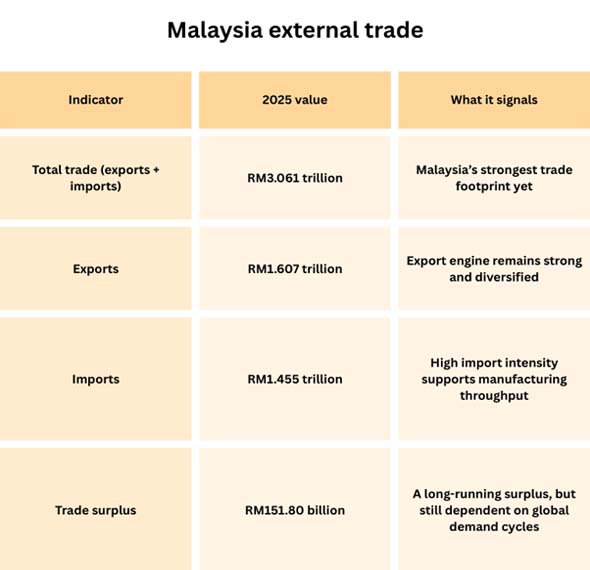
In 2025, manufactured items made up the biggest part of Malaysia's exports, with electronics being the most important. As per Malaysia Import Custom Data by Import Globals, exports of manufactured goods were worth RM1.388 trillion in 2025, or 86.4% of all exports. Electrical and electronics (E&E) exports reached an all-time high of RM711.61 billion, or around 44.3% of all exports.
In the electronics and electrical (E&E) sector, electronic integrated circuits (ICs) grew to RM389.15 billion. As per Malaysia Import Trade Analysis by Import Globals, this was due to demand for sophisticated chips, digitalization, and AI-era compute supply chains.
This is important for ASEAN's supply chain because Malaysia is often in the "middle and upper-middle" of the electronics value chain. As per Malaysia Exporter Data by Import Globals, this includes components, IC-related flows, testing and packaging ecosystems, precise equipment, and high-frequency trading routes to large markets.
In reality, Malaysia's exports are a mix of high-tech manufactured items and value-added products tied to resources. This lets it sell to both advanced industrial clients and mass market networks across Asia.
The Secret Engine Underpinning Malaysia's Export Scale is Its Status as an Importer
Not only do supply-chain hubs export, they also bring in the "inputs of production." Malaysia's 2025 import profile shows that it is not just an exporter, but also a processing and manufacturing center.
Some important things about Malaysia's imports in 2025 are:
- Intermediate products made up the largest part of imports (the fuel for production).
- As per Malaysia Importer Data by Import Globals, there was a considerable rise in imports of capital goods, which means that businesses are still investing in their ability to make things and grow.
- ASEAN is still an important source of imports. In fact, imports from ASEAN made up nearly 22% of Malaysia's total imports, or RM319.99 billion.
- This level of imports is good for regional supply chains because it shows that Malaysia is actively pushing value through ASEAN networks by buying parts, resources, and industrial inputs and then sending higher-value outputs to ASEAN and beyond.
Malaysia in ASEAN Manufacturing Networks: " Factory-to-factory Trade "
A major tendency in ASEAN is that a lot of trade is intermediate trade, when parts go across borders to be processed, put together, and sent back out. This is also true for ASEAN's trade as a whole.
ASEAN's own data shows that trade between ASEAN countries makes up around one-fifth of all trade in products (about 21.4%). As per Malaysia Import Shipment Data by Import Globals, this makes sense for a region where supply chains are intertwined but remain heavily linked to markets outside of ASEAN.
What Malaysia does in this Network
Malaysia's job is often to:
- Supplying parts and ICs to regional electronics chains
- Machinery and industrial tools that help improve production
- Energy and petrochemical-related flows that keep manufacturing and downstream production going
- Value chains for food and palm oil that meet ASEAN demand while also supplying global markets
- Malaysia is also a high-quality manufacturing hub where purchasers may expand compliance, quality systems, and shipments to several markets. As per Malaysia Import Export Trade Analysis by Import Globals, this is vital when product requirements differ across the US, EU, China, and ASEAN.
The effects of ASEAN Integration and Economic Cooperation: Why Tensions Are Steadily Easing
ASEAN integration doesn't do rid of all trade barriers, but it does make "operational drag" less of a problem. This is the daily friction that comes from paperwork, customs procedures, and lack of clarity in regulations. Four integration forces will be most important to Malaysia's involvement in the supply chain from 2025 to 2026.
1) The ASEAN Single Window (ASW) and Trading Without Paper
One of the most useful tools for integration is the ASEAN Single Window, which lets trade paperwork be sent electronically across borders. As of the middle of 2025, ASEAN members were using the ASW to send important papers including the ATIGA e-Form D and the ASEAN Customs Declaration Document.
This cuts down on delays caused by manual paperwork, minimizes the number of mistakes, and speeds up claims for preferential tariffs for exporters and importers in Malaysia. This is especially important for shipments inside ASEAN, where time-to-clear is a crucial competitive factor. Effect on the supply chain: speedier customs clearance leads to higher inventory turns, smaller buffer stock, and better cost competitiveness.
2) FTAs as " Infrastructure for Market Access "
Malaysia's trade strategy is heavily based on FTAs. In 2025, trade with FTA partners reached RM2.005 trillion for the first time, which was around 65.5% of all commerce. Exports to FTA partners were worth RM1.067 trillion, which is around 66.4% of all exports.
This is important because FTAs are not just vehicles for setting tariffs; they are also mechanisms for routing in modern supply chains. They affect where businesses put their factories, how they organize their bills of materials, and the regulations they use to make things.
Effect on the Supply Chain: FTAs make markets bigger and affect sourcing decisions (inputs and compliance with origin rules).
3) The "Regional Production Corridor" and the Improvement of ASEAN–China
ASEAN's economic cooperation is growing to encompass better trade deals with important partners. The ASEAN–China free trade agreement has been moving toward better cooperation in sectors including the digital economy, the green economy, and making supply chains more connected.
This is important for Malaysia in two ways:
- China is a key partner in the supply chain for inputs, machinery, and electronics that are used in the middle of the process.
- Malaysia sells a lot of goods to Asian demand hubs, where networks linked to China affect manufacturing and distribution.
Supply-chain effect: More strict laws and standards in a region can make things run more smoothly, but they can also make competition tougher.
4) Investment and Industrial Clustering (the Integration You Can "Touch")
As per Malaysia Export Import Global Trade Data by Import Globals, the way investment clusters form is another sign of ASEAN integration. Electronics, precise manufacturing, and industrial services tend to be located where there are a lot of skilled workers, reliable suppliers, and good logistics. Malaysia's supremacy in E&E means that investment will continue to flow into semiconductor-related ecosystems.
- Services for advanced manufacturing
- Testing, packaging, and ecosystems for components
- Export production with high reliability for regulated markets
- Effect on the supply chain: investment clusters make capabilities deeper and lower the risk of switching suppliers.
What Malaysia's Involvement Implies for the World in 2026 (Useful Information)
1) For Importers and Sourcing Teams
Malaysia is the best place to get a lot of electronics or industrial goods that are very reliable. But strategies that work in 2026 should include:
- Getting important parts from two different sources
- Strong methods for keeping track of where things come from (particularly when employing FTA preferences)
- Supplier mapping beyond Tier 1 (sub-tier visibility)
2) For Companies who do Business in ASEAN
Malaysia can be a "capability anchor," and other ASEAN countries can provide a large number of workers for assembly. A split model helps a lot of businesses:
- Malaysia for important steps (key parts, testing, advanced procedures)
- ASEAN markets next door for stages that need a lot of labor or space
- Regional logistics planning that makes lead time and customs more reliable
3) For People Who Work in Logistics and Trade Finance
The high trade volumes in Malaysia favor players who can offer:
- Customs and compliance help that works with paperless trade systems
- Routing over several lanes (sea, air, and cross-border transportation)
- Trade finance that fits with electronics cycles (quick inventory turns and high-value shipments)
4) For Teams That Deal With Policy and Risk
Trade in electronics is strong, although it goes in cycles. Planning for risk in 2026 should focus on:
- Changes in global tech demand
- Risk of concentration in important export categories
- Regulatory monitoring and differences in standards across large markets
- Problems with the supply of intermediate inputs
Conclusion
Malaysia's outstanding trade performance in 2025 proves that it is a key manufacturing and export hub in ASEAN. It imports a lot to make food, exports a lot in the E&E and industrial categories, and it benefits from ASEAN integration tools that make it easier for goods to move between countries in the area.
In 2026, Malaysia's advantage isn't just its size; it's also its capability density: the ability to consistently make, qualify, and ship complex items to many markets. For global companies, the path is clear: don't only see Malaysia as a market for your products; see it as a regional hub for ASEAN supply chains, with the help of free trade agreements, better digital trade infrastructure, and strong industrial ecosystems. Import Globals is a leading data provider of Malaysia Import Export Trade Data.
FAQs
Que. What makes Malaysia a major manufacturing center in ASEAN?
Ans. Because it has a substantial, well-established base of manufactured exports, especially electronics and semiconductors, as well as good trade connections and established industry ecosystems.
Que. How much of Malaysia's exports are made up of E&E goods?
Ans. E&E exports made up around 44.3% of all exports in 2025, making it the biggest category of exports.
Que. How can ASEAN integration aid Malaysian exporters?
Ans. It makes things easier by using tools like paperless trade/document exchange systems and streamlined regional procedures, which can speed up clearance and cut expenses.
Que. What is the largest risk to the supply chain that comes from Malaysia's trading structure?
Ans. A lot of reliance on global electronics demand cycles and imported intermediate inputs, which can make things more unstable when things go wrong or slow down.
Que. Where to get detailed Malaysia Import Export Global Data?
Ans. Visit www.importglobals.com.
