
Nicaragua's Main Exports in 2025 Will Be Coffee, Edible Fruits, and the Main Product That Drives Global Trade

- Mar 06, 2026
Nicaragua's Main Exports in 2025 Will Be Coffee, Edible Fruits, and the Main Product That Drives Global Trade
The export profile for Nicaragua in 2025 illustrates a familiar but growing trend: primary goods are still the country's main source of income from outside, but the way those goods are packed, checked, and shipped to buyers around the world is changing.
Why 2025 was Important for Nicaragua's Exports
Coffee is still the most important export, but edible fruits, especially bananas, and other farm-related goods, like peanuts, are helping Nicaragua's footprint grow, especially in Europe, where demand tends to reward regularity, traceability, and compliance. As per Nicaragua Import Data by Import Globals, Gold and other goods also assist raise headline export values, which has an effect on how Nicaragua balances "traditional agriculture" with "high-value extractives."
From a market point of view, 2025 shows Nicaragua working in three different lanes:
- Coffee is the most popular brand to export (because of its quality, niche demand, and ability to identify its origin).
- Fruits and nuts that can be eaten as a reliable export (repeat orders, retail supply chains, and stringent logistics).
- Other important exports include gold, sugar, and seafood. These are big-ticket items that are sensitive to price changes.
The 2025 Export Map: Where Nicaragua Sold, and Why It Matters
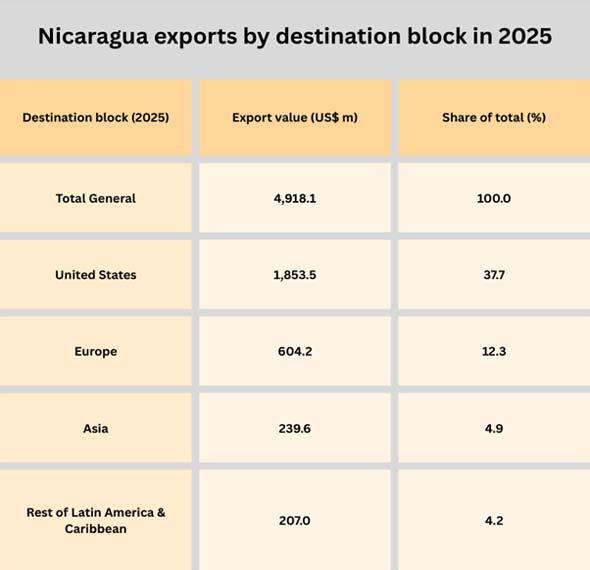
One thing that stands out about 2025 is how the value of exports is spread out across the key destination areas. As per Nicaragua Export Data by Import Globals, the Americas are the biggest, but Europe is important for some products, such as peanuts and coffee.
This structure tells two key stories:
- The U.S. is still the most popular place to go, thanks to a wide range of products (coffee, steak, and more).
- Overall, Europe's share is smaller, but it is very important for high-value agricultural channels, especially coffee, and for "compliance-driven" items where Nicaragua can compete on quality and seasonality.
In 2025, Coffee Will Be Nicaragua's Most Important Export
Coffee is not only one of the most important exports, but it is also one of the most sensitive to reputation. As per Nicaragua Import Export Trade Data by Import Globals, buyers are interested in the altitude, types of coffee, how it was processed, and promises regarding sustainability. That makes coffee a strong "country brand" product, especially in Europe.
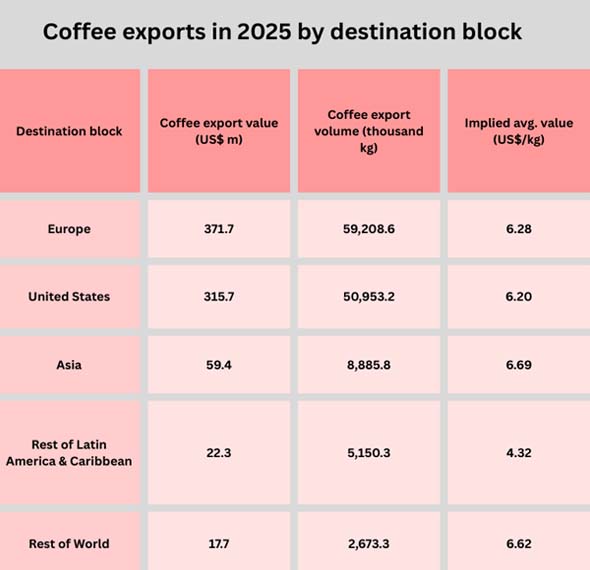
Value of Coffee Exports in 2025 by Key Destination Blocks
The data shows that coffee exports go to several markets, with Europe and the U.S. taking in a lot of money.
What this implies in 2025:
- Europe leads in coffee value among the listed blocks, reinforcing its role as a premium outlet for Nicaraguan origin coffee.
- The U.S. is still a major center of demand, typically taking in large amounts and keeping off-take stable.
- Asia, however smaller, has a clear trend of higher prices per kilogram, which is in line with the increase of specialty demand and re-export routes.
Europe's Part: High-end Market, High-end Expectations
Specialty coffees often find a second home in Europe, where roasters and importers place a lot of importance on certifications, supplier ties, and quality that stays the same. Nicaragua gains when exporters can give:
- Traceable lots (farm, cooperative, region)
- Washed, honey, and natural are all stable processing standards.
- Following buyer sustainability checklists
As per Nicaragua Import Custom Data by Import Globals, planning for production and export is also important in 2025–26 because coffee is seasonal, sensitive to climate, and dependent on input costs. Predictions for the 2025/26 cycle show that output and exports will stay basically the same, which means that European and U.S. buyers will still be able to get what they need.
Fruits that can be Eaten: Bananas as the "Repeat-order Export" to Europe and Other Places
Coffee is Nicaragua's "brand export," and edible fruits are typically the "discipline export." They don't tell stories as much as they do logistics, grading, cold chain execution, and quality that can be counted on.
Bananas in 2025: Not Worth Much, but a Lot of Strategic Wisdom
As per Nicaragua Import Trade Analysis by Import Globals, bananas are not Nicaragua's biggest export in terms of money, but they are important since they connect the country to:
- Standards set by retailers (size, ripeness control, compliance with pesticides)
- Buyer audits (labor standards, traceability)
How Often and Reliably Does Shipping Happens
Why Europe still important even at about $3 million: Europe is a "standards amplifier." When exporters can meet European criteria for documentation, compliance controls, and buyer specs, it frequently makes it easier for them to sell in other high-end or regulated markets as well.
Peanuts are A Major "Edible Export" to Europe, Along With Bananas
As per Nicaragua Exporter Data by Import Globals, Nicaragua doesn't just export fruit that people can eat. Peanuts (maní) are a big food line in Europe, and data from 2025 suggests a strong value channel into Europe.
Peanut Exports to Europe in 2025: About US$53.2 Million
This is a considerably bigger edible-agri value stream than bananas, which shows that Nicaragua's "edible export growth" can be about nuts and processed food ingredients as well as fresh fruit.
Other main Goods That Will Make Up the 2025 Export Mix
Nicaragua's exports include more than just coffee and edible fruits. This wider base determines how competitive and resilient the country is.
Gold: A Big Driver of Value
Gold shipments to important partners, like North America, boost total export revenues and can change the story of "export success." But gold also makes the price cycle more sensitive. This means that the total amount of exports can change even if agricultural performance stays the same.
Sugar: As per Nicaragua Importer Data by Import Globals, Market Access Connected to Quotas and Policies
Sugar exports are important and are typically affected by preferential access agreements and quota systems, especially when they are going to regulated markets.
Seafood, Including Lobster and Other Seafood, is a High-value Niche Export
Seafood is a traditional "high unit value" export line. It is highly affected by restrictions about sustainability, catch management, and buyer compliance, especially in high-end markets.
Why Europe is Crucial for Nicaragua's Main Exports in Terms of Strategy
Europe doesn't have to be the biggest customer to be the smartest buyer.
As per Nicaragua Import Shipment Data by Import Globals, Europe's strategic importance stems from its ability to charge high prices, especially for coffee and food exports that are different from the rest of the world.
- Stable institutional trade architecture (long-term import structures and uniform compliance regimes)
- Signaling Effect: If a product does well in Europe, it usually does well in other places too.
In reality, Nicaragua's ability to sell more goods to Europe rests on whether exporters can deliver:
- Traceability that is documented
- Quality and shipping times that are always the same
- Following stricter rules for products and sustainability
Trade deals also have an effect on how well things work. As per Nicaragua Import Export Trade Analysis by Import Globals, the EU's deal with Central America allows for duty-free treatment of some agricultural goods, such as coffee and some fruits. It also specifies standards that exporters must follow when making plans to sell to Europe.
What Might Happen to Coffee and Food Exports by 2026
Nicaragua's exports will probably depend on a few practical factors as we look ahead to 2026:
- Coffee: As per Nicaragua Export Import Global Trade Data by Import Globals,
- The price will depend on the quality, not just the amount.
- Even if volumes stay the same, export revenues can change with:
- Cycles in the price of coffee around the world
- Specialty premiums (cup scores, demand for microlots)
- Weather shocks that change the quality or timing
- Fruits and nuts that can be eaten: logistics and compliance are what make them grow.
For exports of bananas and peanuts, the limits on growth are usually:
- Reliability of ports and transportation
- How well the cold chain and packaging work
- Documentation of compliance and buyer audits
- Predictable amounts (so buyers can plan)
The Big Picture Risk is Price Cycles and Concentration
Primary-product export models can be weak because of:
- Changes in the prices of goods (particularly coffee and gold)
- Shocks to the climate
- Changes in policy that affect access to markets
- The chance is to use the structure of 2025—coffee, edible exports, and other goods—to establish a stronger export base that adds greater value and follows the rules.
Conclusion
Nicaragua's exports in 2025 show that its economy is still based on primary products, but they are also changing as those items integrate into current global supply chains. Coffee is still the most popular export, especially to Europe and the U.S. Edible exports like bananas and peanuts show how Nicaragua may grow through trade that is based on norms and can be repeated. The next stage is not only to export more, but to export smarter: higher compliance, tighter quality control, and stronger buyer connections. This is especially true in Europe, where being consistent and credible pays off in terms of market access. Import Globals is a leading data provider of Nicaragua Import Export Trade Data.
FAQs
Que. What was the official dataset's total export value for Nicaragua in 2025 (FOB)?
Ans. Roughly $4.92 billion.
Que. What was the most important destination block for Nicaragua's coffee in 2025?
Ans. Europe and the United States were the two major coffee value channels. Europe was the biggest of the two.
Que. Do bananas make up a large part of Nicaragua's exports by value?
Ans. Bananas aren't one of the most valuable exports, but they are vital for strengthening compliance and retail-grade supply chain capabilities, especially in Europe.
Que. What other main exports besides coffee and fruit help Nicaragua make money?
Ans. Gold, sugar, and seafood (particularly lobster) have a big effect on export totals and the story of how well the economy has done throughout the years.
Que. Where to get detailed Nicaragua Import Export Global Data?
Ans. Visit www.importglobals.com.
