
The UK’s Shift from Goods Trade to Services-Led Trade
- Jan 06, 2026
- 220 Views
The UK’s Shift from Goods Trade to Services-Led Trade
For much of the 20th century, the United Kingdom was a classic goods-trading economy: it manufactured, shipped, and sold physical products abroad, and imported the raw materials and finished goods it didn’t make at home.
Today, the UK still trades huge volumes of goods—but the growth engine of its external economy is increasingly services. As per United Kingdom Import Data by Import Globals, finance, insurance, professional services, tech and digital services, intellectual property (IP), and travel-related receipts have become the main force offsetting the UK’s persistent deficit in goods. This shift is not simply a statistical curiosity. It changes what the UK sells to the rest of the world, where jobs and productivity increases come from, how trade policy should be made, and what risks the United Kingdom confronts in a world economy that isn't working well. According to United Kingdom Export Data by Import Globals, a strategy based on services can work well because services are useful, can grow, and don't always depend on physical supply chains. It also depends a lot on regulatory recognition, data mobility, and being able to get to markets in other countries.
The 2024 Snapshot: More Services than Goods
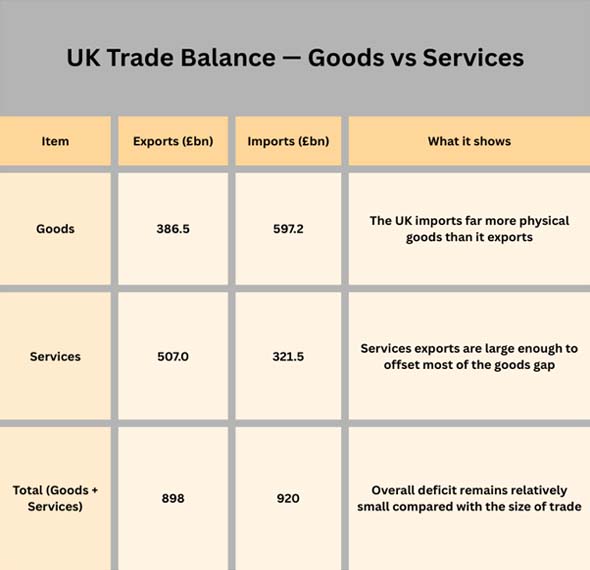
The UK's overall trading position makes the big change quite clear. In 2024, the UK ran a large deficit on goods, partly offset by a large surplus on services, leaving a relatively modest overall deficit. A key point is scale: services exports are not “small add-ons.” As per United Kingdom Import Export Trade Data by Import Globals, they are now bigger than goods exports in value terms and have become the main reason the UK’s total trade deficit is not vastly larger.
The Long-Run Shift: From Goods-Dominant to Services-Dominant Exports
The United Kingdom’s shift is also visible in export composition over time. Around 2000, goods still made up the majority of exports. In recent years, services have taken the larger share.
This is not a sudden “post-pandemic blip.” It reflects a long structural trend: manufacturing shrinking as a share of the economy, the United Kingdom becoming more specialized in high-value services, and global trade increasingly shifting toward intangibles (software, data-driven services, IP, and professional expertise).
What Counts as “Services Trade” in the UK Model?
Based on United Kingdom Import Custom Data by Import Globals, services exports include much more than tourism. In the UK’s external accounts, services span categories such as:
- Financial services (banking, asset management, fintech-linked services)
- Insurance and pensions
- Other business services (legal, accounting, consulting, advertising, engineering services, R&D services, and more)
- According to United Kingdom Import Trade Analysis by Import Globals, telecommunications, computer, and information services (IT services, data services, digital delivery)
- Intellectual property charges (payments for the use of IP such as patents, trademarks, software licensing, and related rights)
- Travel services (spending by foreign visitors in the United Kingdom)
These are often “high value density” exports: they can scale without shipping containers, and they tend to embed the United Kingdom in global corporate and financial networks.
What’s Driving the Services-Led Shift?
1) The United Kingdom’s Comparative Advantage moved toward Knowledge and Networks
As per United Kingdom Exporter Data by Import Globals, the UK developed world-class depth in financial markets, professional services, and creative/knowledge industries. Over time, that created an export advantage: international clients don’t just buy a UK service—they buy trust, standards, language, legal infrastructure, and global connectivity.
2) Globalization Changed the way Manufacturing Supply Chains Worked
The UK still has factories, but global supply chains grew and got better. Many mass production activities moved to areas with bigger industrial bases and lower costs, while the United Kingdom focused on services and higher-value areas.
3) Digitalization made Services into Goods that could be Sold around the World
Software and services offered digitally can be sold all over the world without having to be sent. This makes services increasingly “exportable,” and the United Kingdom’s tech and professional ecosystem benefits directly.
4) Trade Policy and Friction Affect Goods more Visibly
As per United Kingdom Importer Data by Import Globals, goods trade is often more sensitive to border friction, paperwork, rules-of-origin compliance, and logistics costs. Services trade faces its own barriers (recognition, licensing, data rules), but the “border effect” is often more immediate and costly for goods, especially for SMEs.
Where the UK’s Services Growth Is Coming From
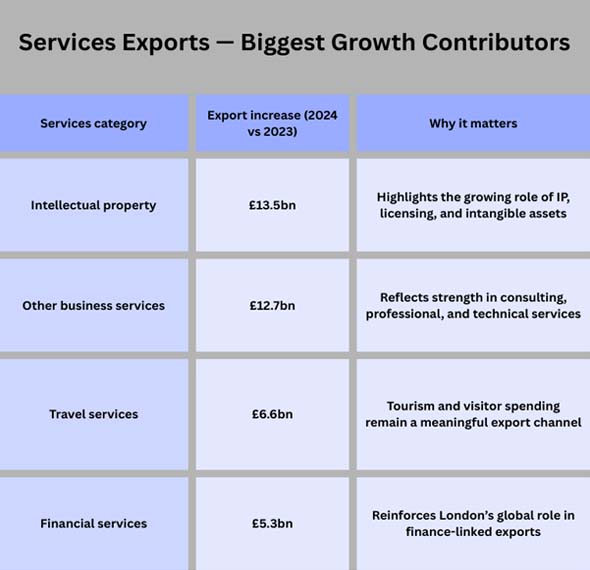
As per United Kingdom Import Trade Statistics by Import Globals, recent UK balance of payments reporting shows that the UK’s services surplus widened in 2024 because services exports grew strongly.
This pattern matters strategically: it shows that the United Kingdom’s services strength is not just one sector. It’s a portfolio—IP, business services, travel, and finance—each supporting the external balance.
How Services Help “Pay For” Goods Imports
The UK’s goods deficit is driven by structural needs and consumption patterns: energy imports (in some periods), food and consumer goods imports, complex manufactured products, and supply chain dependencies. As per United Kingdom Import Shipment Data by Import Globals, without a large services surplus, the UK’s external deficit would be far larger.
Services essentially function as the United Kingdom’s “external shock absorber”:
When goods prices rise or goods exports weaken, a services surplus can cushion the overall trade position.
Services may develop without a similar rise in physical inputs, which helps the UK keep its export value even when there are shocks to the supply of products.
The Dangers of a Trade Model Based on Services
An economy that is based on services is not always safer.It has its own problems:
1) Rules and Access to the Market are more Important than Tariffs
To make services trade operate, there needs to be regulatory recognition. As per United Kingdom Import Export Trade Analysis by Import Globals, this means there need to be rules for licensing, equivalence, data sufficiency, professional qualification recognition, and procurement. If they lose access or have to deal with different rules, exports can suffer a lot.
2) Issues with Measurement and Instability
It's harder to keep track of trade in services than trade in goods, and it usually changes more than trade in items. That makes the policy debate difficult and can make it hard for businesses that depend on service exports to know what to do.
3) The risk of Spatial Concentration
Some services that are sent to other countries are only available in select places, with London being the most prevalent. That can make inequality between regions worse and make some industries more likely to be affected by shocks.
What the Change Means for the United Kingdom's Trade Strategy
A modern trade plan for the United Kingdom needs to show how the country really makes money from outside:
As per United Kingdom Export Import Global Trade Data by Import Globals, put digital trade regulations, data mobility, and frameworks for delivering services across borders at the top of your list.
Pursue mutual recognition and regulatory cooperation that reduces friction for professional services.
Strengthen the United Kingdom’s position in IP-intensive sectors, including technology, creative industries, and R&D-linked services.
Keep improving the competitiveness of goods trade where the United Kingdom has strengths (advanced manufacturing niches, pharmaceuticals, aerospace), even if goods are no longer dominant.
Conclusion
The United Kingdom has not “stopped trading goods,” but it has become a services superpower by necessity and by advantage. In 2024, the UK’s sizeable services surplus offset most of its large goods deficit, keeping the overall trade gap relatively small. Over the longer run, the export mix has shifted dramatically—services now account for the majority of United Kingdom exports by value.
The policy implication is straightforward: if the UK wants to grow exports and protect resilience, it must treat services trade—not as a side chapter—but as the main story. Import Globals is a leading data provider of United Kingdom Import Export Trade Data.
FAQs
Que. Why does the United Kingdom run a goods trade deficit?
Ans. Because it imports large volumes of manufactured goods, energy-related products in some periods, and consumer items, while exporting fewer goods by value.
Que. What services does the United Kingdom export the best?
Ans. Financial services, other business services (professional/technical), exports of intellectual property, and travel services are some of the biggest strengths.
Que. Does trade that is based on services make the United Kingdom stronger?
Ans. Yes, services may grow and be valuable even when goods supply lines are broken. But it makes people more reliant on regulatory access and makes people throughout the world more confident in United Kingdom services.
Que. What rules help services exports?
Ans. Digital trade norms, procedures for moving data, mutual recognition of professional qualifications, cooperation between regulators, and robust IP regimes.
Que. Where to get detailed United Kingdom Import Export Global Data?
Ans. Visit www.importglobals.com.
