
The U.S.-Iran Trade Relationship in 2025 and 2026: Sanctions, Restrictions, and Commerce
- Mar 19, 2026
The U.S.-Iran Trade Relationship in 2025 and 2026: Sanctions, Restrictions, and Commerce
Iran and the US do very little business together. Significant hurdles to direct trade between the two countries include political hurdles, economic limitations, and geographical issues. Main elements impacting the relationship between 2025 and 2026 are the political situation in the Middle East, revisions to the humanitarian trade exemptions, and strict U.S. sanctions.
One of the world's largest commercial nations is the United States, and Iran is endowed with an abundance of natural resources, particularly oil and gas. Trade between the two nations remains minimal. USA Import Data from Import Globals indicates that the United States sanctions against Iran have a detrimental impact on the country's petroleum exports, financial system, maritime networks, and businesses that interact with the government. These penalties have rendered the two nations incapable of conducting commerce. As per USA Import Export Trade Data by Import Globals, subsequently, the restricted commerce that does occur is typically restricted to commodities that are advantageous to individuals, including food, agricultural products, and medical supplies.
The history of trade between the U.S. and Iran
Trade between the United States and Iran was significantly restricted as a result of the 1979 Iranian Revolution and the subsequent hostage crisis. As per USA Import Export Trade Data by Import Globals, subsequently, the United States implemented numerous restrictions on Iran's finance, oil, and government. People were more concerned about Iran's nuclear program in the early 2000s, which exacerbated the sanctions.
While the Joint Comprehensive Plan of Action (JCPOA) of 2015 temporarily alleviated certain restrictions, the reimposition of sanctions in 2018 significantly impeded Iran's ability to conduct business with other nations. Since that time, the United States has maintained its economic pressure campaign to decrease Iran's crude export revenue and impede the government's ability to access banks in other countries.
In 2025–2026, these penalties will continue to be the most significant factor influencing commerce between the two countries. The majority of commercial transactions with Iran are considered illegal in the United States; however, there are a few exceptions that are justified by humanitarian considerations.
Main Types of U.S. Goods Sent to Iran
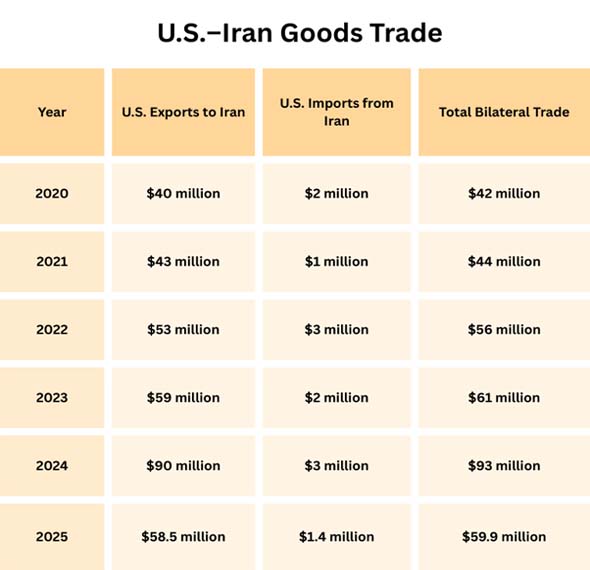
Even though there are rules, some trading is still going on because of some exceptions. Humanitarian trade routes let American companies deliver food, farm commodities, and some medical supplies to Iran.
As per USA Import Trade Analysis by Import Globals, Most of the things the U.S. sells to other countries are humanitarian supplies that are allowed by sanctions rules. There are very few things that Iran can send to the US because of severe rules on what can be brought into the country.
Iranian Goods Sold to the US
As per USA Export Data by Import Globals, in spite of the sanctions in place, humanitarian exemptions that are intended to assist civilians continue to permit certain categories of exports.
1. Farming-Related Products
Agricultural products comprise the majority of U.S. exports to Iran. These are:
- Corn
- Soybeans
- Wheat
- Animal feed
- Components of cuisine
These products enhance the domestic agricultural and sustenance supplies of Iran.
2. Drugs and Medical Supplies
Medical items are another big group. The US allows the export of:
- Tools for medicine
- Devices for diagnosis
- Medical supplies
These things are okay because the goal of sanctions rules is to protect civilians.
3. Items for Individuals in Need
As per USA Exporter Data by Import Globals, humanitarian exports may also encompass basic consumer commodities, nutritional supplements, and certain food products. These transactions are subject to stringent oversight and are required to adhere to U.S. licensing regulations.
Effects of U.S. Sanctions on Trade
Iranian exports to the US are very little because of import restrictions and the execution of sanctions. Some categories that show up in trade statistics from time to time are:
- A small number of food items
- Carpets created by hand
- Handmade items
But these deals are still a small part of Iran's total exports to the rest of the world. As per USA Importer Data by Import Globals, Energy exports, especially crude oil and petrochemicals, are far more important to the Iranian economy. But because of sanctions against Iran's oil industry, most of these exports can't get into the U.S. market.
Iran's Plan to Get Around Sanctions
Sanctions are still the most important thing that affects trade between the U.S. and Iran. The U.S. government has put in place several levels of restrictions that limit Iran's economic activity. These steps are aimed at industries like banking, transportation, energy, and manufacturing. As per USA Import Custom Data by Import Globals, the goal is to make it harder for Iran to do business with other countries and to limit the money it can use to pay for military or nuclear projects.
In the last few years, enforcement actions have become more common. U.S. Numerous individuals, enterprises, and vessels that assisted in the transportation of Iranian oil or were subjected to sanctions have been penalized by the authorities.
Businesses in other nations are also impacted by sanctions. Srecondary sanctions can punish foreign companies that do business with Iran, making it less likely that big companies will do business with the country.
The World Trade Scene in Iran
Iran nevertheless keeps trade going through other means, even when there are sanctions.
1. Networks for Shadow Shipping
As per USA Import Shipment Data by Import Globals, Iran has built a "shadow fleet" of old oil tankers that are regularly used to transport oil. These ships often turn off their monitoring systems so they won't be found as they take crude oil to buyers in Asia.
2. Other Business Partners
Iran still does a lot of business with India, China, and Turkey, among other places. These countries either buy energy products from Iran or transfer things to Iran and pay for them in a way that isn't direct.
3. Money Systems That Do Not Utilize Dollars
According to Import Globals' USA export data, individuals in Iran utilize alternative payment methods, including bartering, local currencies, or intermediaries such as banks. This is due to Iran's significant isolation from the global financial system, which is founded on the dollar.
What the US's Trade Policy Will be with Iran in 2026
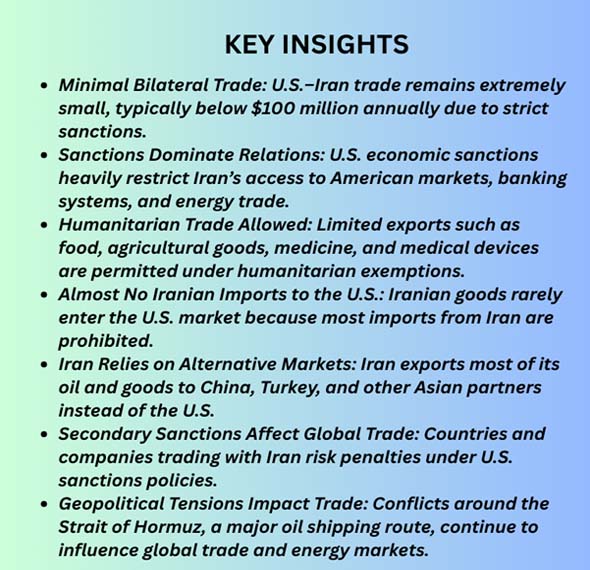
Despite the fact that Iran does not engage in frequent commerce with the United States, it remains an integral component of global economic networks.
- Crude oil and other commodities comprise Iran's principal exports.
- Petrochemicals
- Gasoline that is liquefied
- Minerals and metals
As per USA Import Export Trade Analysis by Import Globals, Iran has always exported a lot of crude oil, but sanctions have made it less competitive on the world market. Exports have bounced back a little in the last several years, hitting about 1.5 million barrels per day in 2025. However, this is still below the levels seen before the sanctions. Iran's biggest export market is still Asia, especially China, which has kept buying Iranian oil at lower prices.
The Strait of Hormuz, which normally carries around one-fifth of the world's oil supplies, has been disrupted by the battle. Changes in this area can have a large impact on the global energy market and the flow of trade between countries.
Shipping delays, greater insurance costs, and geopolitical risk have made oil prices and global supply chains less stable. These events show how tensions between the U.S. and Iran affect not only trade between the two countries but also the world economy as a whole.
Trade Routes for Humanitarian Aid
The United States continues to employ a combination of economic pressure and diplomacy in its negotiations with Iran.
As per USA Export Import Global Trade Data by Import Globals, additional sanctions against Iranian energy and shipping networks are among the most recent policy modifications.
Countries that conduct substantial business with Iran are threatened with tariffs. The region is currently engaged in diplomatic negotiations to resolve issues related to nuclear weapons and security.
In early 2026, the United States also announced that it would impose tariffs on countries that conducted business with Iran, thereby increasing Tehran's economic burden. The United States' approach to Iran is still significantly influenced by trade restrictions, as evidenced by these actions.
Effects on Iran's Economy
Despite the existence of stringent sanctions, humanitarian trade routes continue to operate, enabling individuals to obtain the necessary items. On these platforms, individuals are permitted to purchase and sell products in a legal manner.
- Products for farming
- Tools for health
- Things
These exceptions are in line with international rules that protect people from punishment. Still, the practicalities of humanitarian commerce are still hard because of problems with money and banks.
What Will Happen to U.S.–Iran Trade in the Future
- Iran's economy has been greatly affected by trade restrictions and sanctions.
- The following are some critical considerations: A decrease in revenue from hydrocarbon exports/
- The currency's value is declining.
- Not being able to easily get to global financial markets/
- The prices of imports and inflation are both rising up.
Iran has also tried to boost manufacturing at home and make more commercial deals with countries that are not part of the Western economic systemThe future of trade between the U.S. and Iran will depend a lot on what happens in politics and diplomacy.
Some probable situations are: Sanctions will keep happening. If the regulations don't change, the two countries will presumably only trade in goods that are good for people.
A Big Step Forward in Diplomacy
If there is a new nuclear deal, some restrictions might be lifted and there might be greater opportunity to trade.
More and more Conflict
More geopolitical tensions might make energy markets and global trade routes even smaller. No matter what happens, it's likely that trade between the U.S. and Iran won't happen again for a long time. That would have to happen in a very different political climate.
Conclusion
In 2025–2026, trade between the U.S. and Iran will still be affected by sanctions, world crises, and very little trade. Trade between the two countries is among the lowest of any major economy. This is because of years of political instability and problems with the economy.
Most business activities are still not allowed, however under certain conditions, humanitarian goods can still be sent from the US to Iran. Iran has also developed new trade networks and relationships with Asian and Middle Eastern countries to keep its economy going.
Changes in the oil markets in the Persian Gulf and around the world also affect the economic connections between the two countries. Trade between the U.S. and Iran will probably be relatively small and tightly controlled unless there is a big change in how sanctions are enforced or how diplomatic relations are handled. Import Globals is a leading data provider of USA Import Export Trade Data.
FAQs
Que. Why is trade between the US and Iran so small?
Ans. The U.S. has slapped economic sanctions on Iran's government, energy industry, and banks, which is the main reason commerce is limited.
Que. What kinds of products does the U.S. send to Iran?
Ans. Most of the goods that are sent out of the country are those that aid people, like food, medical supplies, pharmaceuticals, and farm products.
Que. Does Iran ship oil to the US?
Ans. No. Because of U.S. sanctions, it is against the law for Americans to bring Iranian crude oil and most other energy items into the country.
Que. At the moment, which countries do the most commerce with Iran?
Ans. Iran's main trading partners include China, Turkey, India, and a few other nearby countries that still buy Iranian oil or send goods to Iran.
Que. Where to get detailed USA Import Export Global Data?
Ans. Visit www.importglobals.com.
