
The U.S.傍aiwan Trade Deal (2026): Effects on Technology and Semiconductors
- Mar 05, 2026
The U.S.傍aiwan Trade Deal (2026): Effects on Technology and Semiconductors
In February 2026, the US and Taiwan signed a large "reciprocal trade" accord. This accord transforms how tariffs work, opens up new markets, and links improved results to investment, notably in high-tech supply chains like semiconductors.
The deal comes at a time when Washington wants to cut back on its dependence on critical technologies, and Taipei wants to keep its important industries and keep up with other big Asia-Pacific exporters. The fundamental aspect of the contract is that it sets a 15% "all-in" rate for Taiwanese goods sold in the U.S. In exchange, Taiwan commits to cut or get rid of tariffs and other trade obstacles for a lot of U.S. exports.
Along with that, both sides made investment a key negotiating chip: As per USA Import Data by Import Globals, big Taiwanese investment promises in U.S. semiconductor and high-tech capacities are seen as a method to get better treatment from the U.S., especially when it comes to national security tools like Section 232. This blog explains what's in the deal, what's not in the pact (and why it matters), and how it could affect trade flows, prices, supply chains, and semiconductor strategy through 2026 and beyond.
1) What does the Deal for 2026 Does
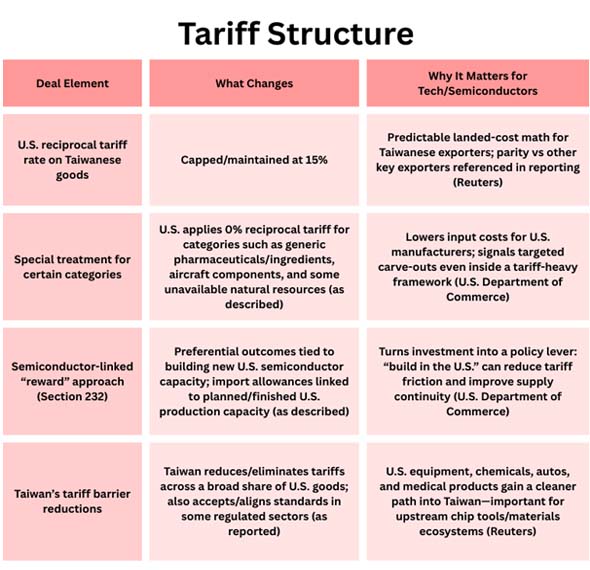
A 15% Tariff Cap in the U.S., With Some Exceptions
The deal sets a 15% U.S. reciprocal tariff rate on many Taiwanese imports, which brings Taiwan's tariffs in line with those of other important U.S. trading partners like Japan and South Korea. This makes things less unclear for exporters who had to pay higher rates.
The treaty also includes product carve-outs, which means that the United States treats some categories (such some pharmaceuticals and aerospace-related commodities) with 0% or better treatment. It also sets up "reward" systems for semiconductor companies who invest in U.S. capacity.
Taiwan's Promises on Access to Its Markets
As per USA Export Data by Import Globals, Taiwan says that the deal will get rid of or lower most of the tariff barriers and make it simpler for U.S. exporters to sell to Taiwan in categories including cars, drugs, and medical gadgets.
A "Package Deal" for Buying and Investing
A big part of the news is the number of Taiwan-related commitments around:
- Investing in U.S. semiconductors, AI, and energy (with $250 billion in investment pledges and $250 billion in credit/guarantees mentioned in the news).
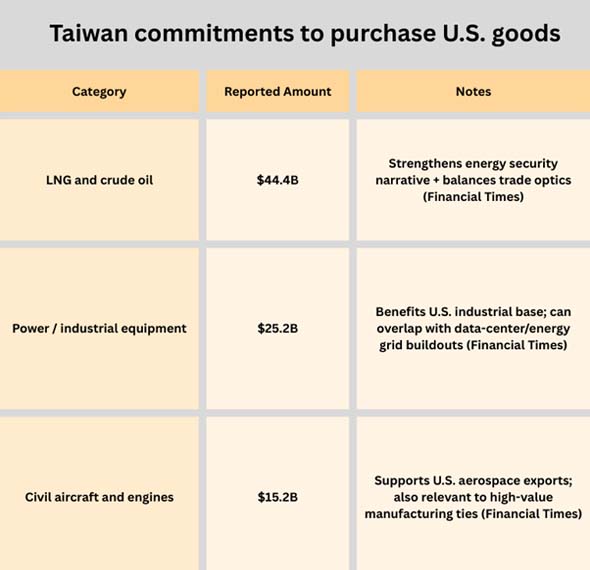
- Large purchases of U.S. goods that last for more than a year (energy, aviation, and power equipment figures are clearly shown).
- As per USA Import Export Trade Data by Import Globals, these things are important because they link tariff results to bigger supply chain goals, especially when it comes to chips.
2) Why Semiconductors Are the Center of Attention
The U.S. reliance Dilemma (and why Taiwan is "special" in this case)
The arrangement makes sense from an economic point of view, but it also makes sense from a semiconductor point of view: the U.S. imports a lot of advanced chips and related items from Taiwan, and officials are starting to see that as both an economic and national security risk. The news coverage of the accord makes it clear that chip flows have a big impact on the U.S. trade imbalance with Taiwan.
For Taiwan, the math is different: keep the advantages of high-end manufacturing and R&D at home while expanding offshore capacity sufficiently to lower political and trade risk. As per USA Import Custom Data by Import Globals, that balancing effort is clear in how the pact deals with semiconductors: instead of "simple" free trade, it uses incentives, conditions, and carve-outs.
The "Investment for Tariff Stability" Plan
The most strategically new part is how the agreement sets up future outcomes for semiconductor trade under Section 232: Taiwanese companies that build significant U.S. capacity can get better treatment or allowances for imports during and after construction (as explained in official fact sheet language).
The U.S. is basically saying, "If you make more stuff here, we'll treat your imports better (or at least not worse) under national-security trade tools." That's a big change from earlier trade agreements, which mostly dealt with tariffs and access to markets.
3) What's Not Included (and Why It Matters)
Even while the news says tariffs would go down, this deal isn't a blanket "free trade" agreement, especially not for the most important portions of the semiconductor ecosystem.
Sensitive electronics doesn't get a lane without bumps. Even while the accord aims to stabilize commerce, U.S. national security tools are still in use. The semiconductor field is uniquely affected by:
As per USA Import Trade Analysis by Import Globals, Section 232-style measures (national security tariffs/controls) being clearly a part of the framework and tied to how people invest.
The U.S. takes a more general approach to "strategic" chips and high-end computing supply chains. For example, even if headline tariffs are lower, certain products or destinations may still be limited by policy (this is shown in policy commentary coverage around semiconductor measures during the same time period).
So, although many items are moved toward a predictable 15% band (or carved out), the most important semiconductor categories are classified as "special cases" and are governed through incentives and security frameworks instead of being entirely liberalized.
Why is this Structure Planned?
For Washington, full liberalization would take away its power at the very time it wants to shift capacity back to the US or "friend-shore" it. As per USA Exporter Data by Import Globals, it is very important for Taipei's tech economy to keep a protected strategic core. The deal's structure, which includes tariff caps, investment, and selective carve-outs, helps both sides claim victory without losing their negotiation power in the most contentious areas.
4) Immediate Effects on Prices and Trade in Technology
1) Clear Landed Costs for Taiwanese Exporters
As per USA Importer Data by Import Globals, a consistent 15% ceiling lowers the "policy volatility premium" for numerous Taiwanese products that move into U.S. supply chains, such as electronics parts, intermediate commodities, and high-value finished goods.
This is important because tiny changes in tariff expectations might change:
- Pricing for contracts
- Strategy for inventory
- Decisions about where to put the final assembly
- When shipments are sent out around policy deadlines
2) Exporters from the U.S. have a Clearer Path to Taiwan
According to reports, Taiwan's cuts in tariffs and measures to recognize regulations could help U.S. producers of industrial machinery and manufacturing tools.
- Chemicals and materials that are important for making electronics.
- Cars and parts.
- Medical devices and drugs (when it counts to be recognized by standards).
- "Tools and materials" are often just as crucial as the chips themselves when it comes to semiconductors. As per USA Import Shipment Data by Import Globals, if it's easier for U.S. companies to sell to Taiwan, it might make the chipmaking ecosystem more interdependent. This is ironic because the U.S. is trying to lessen its reliance on offshore manufacturing.
3) Faster Investment, Especially in Fabs and the Supply Chains That Go With Them
The investment promises (which are being publicized on a huge scale) will probably lead to more expenditure not just on fabs but also on:
- Advanced packaging
- Specialty chemicals and subcomponents
- Testing and assembly skills
- Data centers and electrical infrastructure that are close to fabs.
The point is that if the "reward" system is believable and long-lasting, it will be a powerful reason to establish a whole semiconductor industrial cluster in the U.S., not just a few fabs.
5) Second-Order Effects Till 2026
A) The Tension Between Supply Chain Resilience and Rising Costs
As per USA Import Export Trade Analysis by Import Globals, it costs a lot of money, takes a long time, and uses a lot of energy to build semiconductor capacity. If investment goes up, costs in the short term (for things like building, hiring, and local infrastructure) can also go up, even as the economy becomes more stable in the long term. Expect a time when: Capex and operating costs go up in the short term In the medium run, lead times and capacity security get better. Businesses strive to pass on expenses until demand or competition drops.
B) How Do We Stack Up Against Japan, Korea, and the EU in Terms of Competition
"Relative treatment" is one viewpoint that doesn't get enough attention. People keep talking about Taiwan's 15% alignment in regard to other important exporters. That makes it look like the U.S. is intentionally creating a tiered tariff system between its allies and partners in the area.
If you're an electronics company that does business around the world, these differences can impact where you:
- Put together the last parts
- Source subparts
- Logistics for the route
- Plan for future capacity
C) Trade Balance Optics and Political Stability
The commitments to buy (energy, planes, and equipment) aren't arbitrary; they're big-ticket items that can be used to support U.S. jobs and can be used in domestic politics. That makes it more likely that the pact will still be politically sound even if some sectors protest about tariffs. In real life, durability may be just as essential as the specific tariff rate.
6) What Businesses Should Look Out For Next
1) The Specifics of How It Will Be Put Into Action, Such as Timelines, Product Lists, and Enforcement
The biggest effects in the actual world will depend on whatever product lines can be carved out. How to check and assess "investment-linked" preferential treatment How fast Taiwan's cuts to tariffs and acceptance of standards go from being announced to being used at customs.
2) Important Dates for Semiconductor Investments
Because the contract links good treatment to increasing U.S. capacity, keep an eye out for:
- Groundbreakings and construction timelines
- Supplier localization promises
- Workforce and training programs
- Proof that imports are being treated better for investors who follow the rules, as the framework says
3) How It Works With Other Security Policies
As per USA Export Import Global Trade Data by Import Globals, Export regulations and national security rules can limit even a robust trade pact. The most important question is whether policy changes in 2026 will make the deal's incentives stronger or send mixed messages that make things less clear. During the same time, policy analysis coverage shows how active and fast-moving semiconductor policy can be.
Conclusion
The trade treaty between the U.S. and Taiwan in 2026 is more of a strategic industrial accord than a standard tariff-cutting one. Yes, the 15% tariff cap and carve-outs make things more predictable and provide people a break in the short run for many traded goods. But the greater story is how the deal exploits investment pledges, notably in semiconductors, to change where capacity is produced and how sensitive supply chains are managed.
This deal does not "fully liberalize" semiconductors. Instead, they stay in a controlled area where tariffs, national security instruments, and investment goals all work together. If the incentives work as planned, the pact might speed up the expansion of U.S. semiconductor manufacturing while keeping Taiwan as an important technical partner. Businesses may still confront uncertainty if implementation becomes political or inconsistent, but it will be in a different way than before. Import Globals is a leading data provider of USA Import Export Trade Data.
FAQs
Que. Does the accord get rid of taxes on IT exports from Taiwan to the U.S.?
Ans. Not all the time. A 15% reciprocal tariff structure governs the movement of many commodities, with few exceptions and special treatment categories. Sensitive semiconductor policy is still regulated through security instruments and investment-linked incentives.
Que. Why do semiconductors get different treatment than other things?
Ans. Because chips are important for national security and the economy's ability to bounce back. The pact makes it clear that how the US treats semiconductor trade is linked to growing capacity in the country.
Que. What are the most important things that Taiwan has agreed to do?
Ans. Reported commitments include big promises of U.S. investment (said to be $250 billion, with further support mentioned) and big purchases over several years, such as $44.4 billion in LNG/crude, $15.2 billion in aircraft/engines, and $25.2 billion in power equipment.
Que. What should tech businesses keep an eye on in 2026?
Ans. Keep an eye on the details of the agreement's execution (product coverage, enforcement), the milestones for semiconductor investments, and how other U.S. security policies affect the agreement's incentives.
Que. Where to get detailed USA Import Export Global Data?
Ans. Visit www.importglobals.com.
