
A Full Look at Luxembourg's Trade with Other Countries
- Nov 30, 2025
- 94 Views
A Full Look at Luxembourg's Trade with Other Countries
The country is small and has around 650,000 people, yet it has built a worldwide economy focused on trade, financial services, and high-value sectors. Luxembourg has one of the highest GDPs per person in the world.
As per Luxembourg Import Data by Import Globals, it has a diverse trading portfolio, bringing in raw materials and consumer goods and sending out modern machinery, steel, chemicals, and services.
Because it lies at the crossroads of Europe, with Belgium, France, and Germany on three sides, Luxembourg is an important place for logistics and finance. As per Europe Export Import Global Trade Data, it is much more connected to the rest of the globe since it is a member of the European Union (EU), the Eurozone, and international trade groupings. This blog goes into great depth about Luxembourg's trade, including its most important imports, exports, and trading partners, as well as evidence to back it up.
Why Trade Matters to Luxembourg?
Trade is important for Luxembourg's economy. The country doesn't have a lot of natural resources, so it has to buy energy, raw materials, and consumer products from other countries to keep its industry functioning and its people happy. Luxembourg has a strong industrial base, especially in steel and equipment, and it is good with money. This is why it exports goods and services.
As per Luxembourg Export Data by Import Globals, the country's trade-to-GDP ratio is constantly above 150%, which illustrates how well it is connected to the rest of the world. Luxembourg's economy is strong due to its trade reliance and adaptability to global supply and demand changes.
Luxembourg's Export Profile
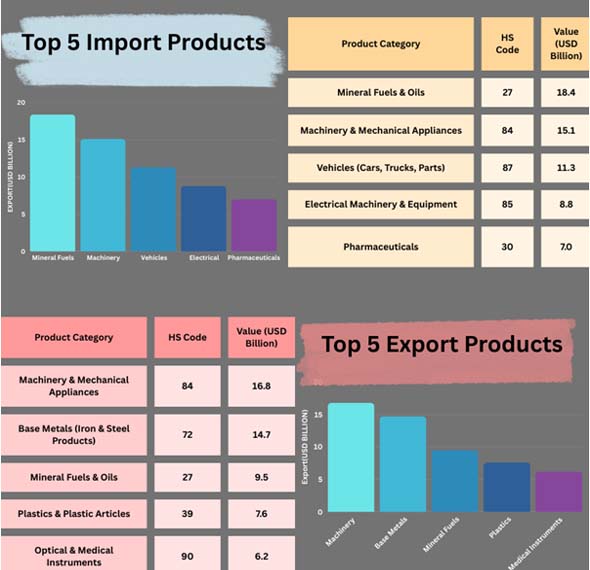
Luxembourg's economy depends a lot on exports, and trade is based on high-value items. In the past, steel was the most important export. Even if its value has gone down, it is still important, along with modern equipment, chemicals, and plastics. As per Luxembourg Import Export Trade Data by Import Globals, Luxembourg's exports are mostly made up of industrial and high-value commodities. Steel and machinery are the most important industries, which help its status as a manufacturing powerhouse. At the same time, the country's exports of plastics and precise instruments show that its industrial base is becoming more diverse.
What Luxembourg Imports
Imports are just as important to Luxembourg's economy. The country imports chemicals, machinery, energy, and consumer products to meet the needs of its industry and its people. Luxembourg is an energy-dependent country that gets a lot of its oil and gas from other countries. As per Luxembourg Import Custom Data by Import Globals, Luxembourg's import profile shows that the country depends a lot on energy and manufactured products from other countries. Fuels are the most important part of the industrial and consumer markets, although machinery and automobiles are also quite important. Pharmaceuticals show how important trade in healthcare is.
The Most Important Trading Partners for Luxembourg
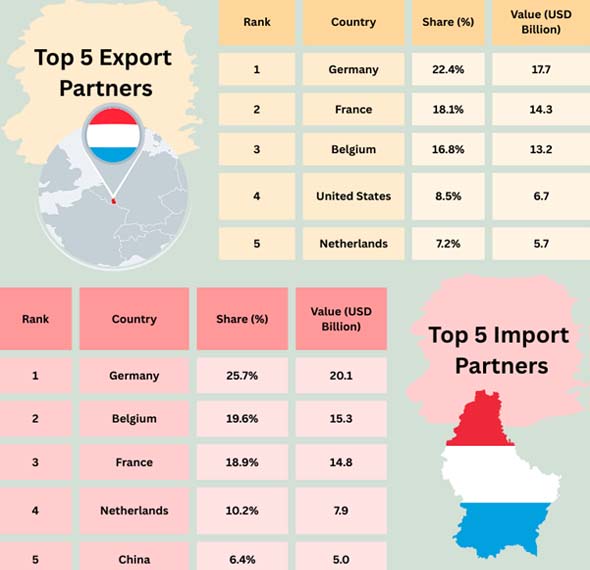
Luxembourg's commerce is very connected to that of its European neighbors and the rest of the world. Germany, France, and Belgium are its main trading partners since they are close by, are all members of the EU, and have robust supply networks. The US and China are also key partners, but they are not in Europe. As per Germany Import Trade Analysis by Import Globals, Germany is still Luxembourg's biggest export market, especially for steel and equipment. France and Belgium also get a lot of business from cross-border supply chain integration. Germany sends us machines, automobiles, and energy. Belgium and France send us fuels, chemicals, and consumer goods. China is becoming more important, especially in electronics and other manufactured items.
Luxembourg's Role as a Trade and Financial Center
Luxembourg is one of the world's top financial hubs, in addition to being a place to buy and sell things. The country's banking and investment industries handle assets that are far larger than its GDP. As per Europe Exporter Data by Import Globals, this makes financial services a major part of exports in terms of services. With its excellent infrastructure and connections to European transport networks, Luxembourg also serves as a logistics hub.
It is an even bigger global commercial center since it is part of the EU Customs Union, has free market principles, and is a good place for investors. There are a lot of difficulties with Luxembourg's trading with other countries.
Energy Dependence: It is susceptible to fluctuations in global energy costs since it relies on fuels from other countries.
Global Competition: Its businesses have to compete with larger economies that have lower expenses.
Risks in the Supply Chain: Luxembourg is very tied to global value chains; thus, it is open to crises like pandemics or political conflicts.
But Luxembourg's ability to adapt, come up with new ideas, and work with the EU keeps things steady.
What Will Trade Be Like in Luxembourg?
There are positive signs for Luxembourg's trading future, with prospects in:
Transition to Green Energy: As per Luxembourg Importer Data by Import Globals, there is more money flowing into buying and selling green technologies and renewable energy.
Digital Economy: The rise of ICT and digital services as part of its global trade offerings.
High-Tech Manufacturing: More and more accurate tools and complicated equipment are being developed.
Luxembourg's main economic partners, notably those in Europe, will keep trade going while new ones open up in Asia and North America.
Luxembourg's Trade in Services
Luxembourg's economy relies on both goods and services, but goods make up a large part of its trade. According to Import Globals' Europe Import Trade Statistics, the country is one of the world's top financial hubs, and a lot of its trade value comes from exports of financial services. The most important businesses in Luxembourg are banks, money managers, and insurance companies. There are a lot of Europe's major investment businesses in the nation.
Luxembourg doesn't simply transfer money abroad; it also sends out IT, logistics, and telecommunications services. The government's spending on digital infrastructure and innovation hubs has made the country a growing exporter of ICT services. Luxembourg's strong service sector helps its trade be more balanced, so it doesn't depend just on industrial exports.
Green Trade and Efforts to Make Things Last
Over time, Luxembourg has made sustainability a major component of its trading plans. The government is moving away from fossil fuels and toward renewable energy imports because it recognizes how bad climate change and relying on foreign energy are. The financial sector is just as critical to this transition. According to Import Globals' Luxembourg Import Shipment Data, Luxembourg is a leader in sustainable finance, making green bonds and investment alternatives that focus on climate change. These goods have an effect on marketplaces all across the world.
In the industrial sector, individuals are trying to modernize steel and manufacturing processes with cleaner technology that releases less carbon. As per Luxembourg Import Export Trade Analysis by Import Globals, Luxembourg not only improves its reputation throughout the globe by making commerce more sustainable, but it also makes sure it stays competitive in the long run in a world where green standards are becoming more important.
Conclusion
Luxembourg illustrates that a small country can perform well in international trade provided it has the right strategy, infrastructure, and partnerships. Its reliance on imports drives industrial growth, and its exports reflect how strong high-value products and services are. Luxembourg is still very much a part of the European trading system, with Germany, France, and Belgium as its key partners. It also has strong linkages to markets across the world, such as the U.S. and China. Trade is vital to Luxembourg's economy and its long-term success, growth, and stability. Import Globals is a leading data provider of Luxembourg import export trade data.
FAQs
Que. What are the most important things that Luxembourg sells to other countries?
Ans. Some of the things that Luxembourg sells to other countries are equipment, steel goods, mineral fuels, plastics, and medical items.
Que. What nations does Luxembourg buy the most from?
Ans. Luxembourg's top trading partners for imports are Germany, Belgium, France, the Netherlands, and China.
Que. Why does Luxembourg depend so much on imports?
Ans. Luxembourg draws its energy, raw materials, and consumer goods from other nations because it doesn't have many natural resources.
Que. How does Luxembourg's banking industry affect its trade?
Ans. Luxembourg's financial industry helps its worldwide trade by exporting services, including banking, asset management, and investment solutions.
Que. Where can you obtain detailed Luxembourg Import Export Global Data?
Ans. Visit www.importglobals.com or email info@importglobals.com for more information on up-to-date data.
