
Nickel and EV Batteries: How Indonesia Is Electrifying Its Export Economy
- Feb 03, 2026
Nickel and EV Batteries: How Indonesia Is Electrifying Its Export Economy
For a long time, Indonesia's minerals tale was the same: dig, transport, and do it again. Nickel ore left the country, value was added in other places, and Indonesia only got a small part of the final profits.
That playbook has altered a lot. As per Indonesia Import Data by Import Globals, Indonesia is working to build a whole export ecosystem for nickel, which is one of the most critical metals for many EV batteries. This ecosystem will include mining, smelting, battery chemicals, cells, and eventually automobiles.
This isn't only a test of industrial policy. The goal of the country is to move up the value chain, bring in foreign direct investment, and become an important part of global electrification. And as a result, Indonesia is changing what it exports: less raw materials, more processed nickel products, and more parts for electric vehicle batteries.
Nickel is Important for the Electric Vehicle Era
As per Indonesia Export Data by Import Globals, not all EV batteries have a lot of nickel in them, but a lot of the ones that do are quite energy-dense. Nickel-rich cathodes, which are often used in longer-range electric vehicles (EVs), usually offer better energy density. This means that the same battery weight can provide you more driving range. Nickel is a critical "bridge metal" for the current generation of electric vehicles, even as battery companies try to lower costs and hazards by using different chemistries.
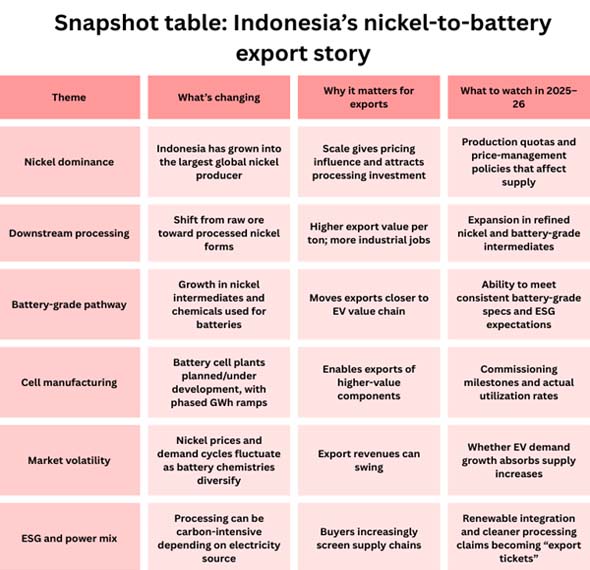
As per Indonesia Import Export Trade Data by Import Globals, Indonesia isn't just exceptional because it possesses nickel; it's also big. In the past several years, Indonesia has become the world's largest producer of nickel. This gives it power over the supply and pricing of nickel around the world. This size advantage has changed Indonesia from a country that exports goods to one that can shape the global battery supply chain.
The Downstreaming Pivot: As per Indonesia Import Custom Data by Import Globals, sending less ore abroad and making more at home "Downstreaming" was Indonesia's most famous action. It meant that processing and manufacturing would happen in Indonesia instead of overseas. Limiting exports of unprocessed nickel ore and encouraging (or demanding) processing in the home country has been a key part of this approach.
The Reasoning is Simple: Ore exports bring in money, but the margins are small and there aren't many employment.
As per Indonesia Import Trade Analysis by Import Globals, Nickel pig iron, ferronickel, matte, mixed hydroxide precipitate, nickel sulfate, and refined nickel are all processed nickel products that add value, increase industrial capacity, and create more skilled jobs.
Products in the battery supply chain add even more value, especially if Indonesia can consistently provide battery-grade materials and cells.
As per Indonesia Exporter Data by Import Globals, this approach has brought in a lot of money for smelters, industrial parks, and chemical processing. The end effect is that Indonesia exports more "nickel value," even if it sends less raw ore.
The mix of things that are exported is changing, from stainless steel to batteries. In the past, a lot of Indonesia's processed nickel went into making stainless steel. That is still crucial. But the battery narrative is now very important to Indonesia's plans to export.
Indonesia's goal isn't to win every tier of the battery chain right now, but to protect the most important middle layers:
- Mine a lot of nickel
- Make intermediate products out of it (matte, MHP)
- Change intermediates into battery compounds, such as nickel sulfate.
- Increase the ability to make cells
- Make an electric vehicle ecosystem that can send parts and cars to other countries.
As per Indonesia Importer Data by Import Globals, Every step makes Indonesia's position in global electrification less dependent on commodity prices and more "sticky."
The "Cluster Effect," Scale Economies, and Industrial Parks
A big reason Indonesia has moved so swiftly is that it has clustered. Costs go down and new projects come in faster when smelters, chemical plants, logistics, and electrical infrastructure are all in the same place, like in industrial parks. The cluster effect also makes it easier for suppliers and buyers to work together and share technologies because they might be close to the same processing centers.
Indonesia has been able to grow from mining to making many other types of nickel that can be exported, including forms that can be used in batteries. The practical effect is that Indonesia may transport not only raw materials but also more and more finished goods that are closer to the battery supply chain.
Battery Production: Plans, Deadlines, and What "Capacity" Means
GWh (gigawatt-hours) is a common way to measure how much battery manufacturing capacity there is. One GWh can power tens of thousands of EVs, give or take, depending on the size of the average battery pack. Indonesia wants to go from being a "nickel supplier" to a "battery ecosystem builder." This would involve collaborations with large global companies and Indonesian state-linked organizations.
Some projects are moving forward, while others have had to change their plans. As per Indonesia Import Trade Statistics by Import Globals, timelines can also change because of funding, technology choices, and market conditions. Still, it's obvious what Indonesia wants: a battery sector that can make batteries for electric vehicles and export them to other countries in the area.
The Geopolitical Angle: A Mineral That is Important and Gives You Power
Indonesia's plan will have effects all around the world. As countries compete to get the important minerals they need for the energy transition, concentration risk is a worry. Importers worry about price shocks, regulatory changes, or disruptions when one country controls the supply. As per Indonesia Import Shipment Data by Import Globals, manufacturers also want supplies that are reliable and can grow with them, and Indonesia can provide those.
It's challenging to achieve a balance because Indonesia wants to make the most of its resources and build its economy.
Buyers want a supply that is safe, diverse, and meets ESG standards. Investors want banks to have clear rules and project economics that make sense. The way Indonesia deals with this triangle in 2025–26 will have a huge effect on how much of the global EV supply chain it really controls.
The key problems (and why they don't kill the plan)
The story of Indonesia's electrification export is strong, but it has certain drawbacks.
1) Cycles of Demand and Pricing
As per Indonesia Import Export Trade Analysis by Import Globals, Nickel markets can get too full when new processing equipment comes online faster than demand grows. That can hurt project results and make producers less money. Even while short-term cycles are unpredictable, the long-term shift to electric vehicles maintains strategic demand steady.
2) Review of ESG
People are paying closer attention to how battery supply chains affect the environment, how they treat workers, and how much carbon they put out. People who care a lot about sustainability might not want to buy from companies that work with coal-heavy grids. This makes Indonesia want to utilize cleaner energy and be more honest about how its supply chains work.
3) Risk of Being Executed
It's challenging to do projects like gigafactories. Things get delayed. Partnerships are not always the same. As per Indonesia Export Import Global Trade Data by Import Globals, some investments that were announced don't go as planned. The most important thing is if Indonesia can provide operational capacity, not just headlines.
Even with these problems, Indonesia's key advantage is still that it can provide a lot of nickel and process it near to the source. That's a structural advantage.
What "success" might look like in 2026
Indonesia doesn't have to be the world's biggest exporter of finished EVs by 2026 to win. A more realistic measure of success is:
- A bigger part of nickel exports is now going to processed and battery-related goods.
- At least one or more battery cell factories that make reliable products
- Better manufacture of battery chemicals, which is helping the expansion of EVs and energy storage in the area
- A clearer ESG roadmap that maintains Indonesia in the running for high-quality global supply chains
- To sum up, Indonesia's export economy is less about sending raw resources and more on sending industrial competence. Import Globals is a leading data provider of Indonesia Import Export Trade Data.
FAQs
Que. Is nickel always needed for batteries in electric vehicles?
Ans. No. Nickel is not used in a lot of popular chemistries. However, nickel-rich cathodes are still vital for many long-range EVs since they allow for increased energy density.
Que. What was it about "downstreaming" that made Indonesia so interested in it?
Ans. Because processing minerals in the country adds greater value, provides more jobs, and establishes industries that can sell goods that are worth more than raw ore.
Que. What does the battery's capacity (GWh) mean?
Ans. GWh tells you how much energy a battery factory can make in a year. A higher GWh usually suggests more possible EV batteries, but only if the facility is running at full capacity.
Que. What is the biggest threat to Indonesia's plans to export electric vehicles?
Ans. A mix of cycles in the prices of goods, ESG rules (particularly for processing that uses a lot of carbon), and the risk of not being able to finish big industrial undertakings. It will be very important to have stable policies and cleaner electricity integration.
Que. Where to get detailed Indonesia Import Export Global Data?
Ans. Visit www.importglobals.com.
