
Poland’s Manufacturing-Led Export Growth in the EU Market
- Jan 07, 2026
Poland’s Manufacturing-Led Export Growth in the EU Market
Poland has become one of the EU’s standout manufacturing exporters—not by relying on a single flagship industry, but by building a broad, resilient industrial base that plugs directly into European supply chains. Over the past two decades, Poland’s export growth has been driven by a powerful combination: a large and skilled workforce, competitive production costs, heavy investment in modern factories, and deep integration with the EU single market.
As per Poland Import Data by Import Globals, the result is a country that increasingly exports not only “made in Poland” finished goods, but also the parts, modules, and intermediate products that keep Europe’s industrial engine running.
What makes Poland's export story so interesting is how different types of manufacturing and regional integration help each other. Based on Poland Export Data by Import Globals, Polish factories sustain consumer demand across Western Europe, feed Germany's automotive and equipment hubs, and are rapidly serving new development areas like batteries and electrification. When one part of the economy slows down, another often picks up, which helps Poland keep going even when the global economy is unstable.
The Big Picture: What Exports Are Made for the EU Single Market
The EU makes up a large part of Poland's export market. According to Poland Import Export Trade Data by Import Globals, this is important because the EU internal market makes trading easier by having consistent standards, reliable logistics routes, and rules that are fairly easy to follow. In that environment, manufacturing locations that can deliver high quality at scale tend to expand quickly.
Long-run Eurostat analysis of intra-EU trade shows that Poland is among the EU countries with the fastest growth in exports to EU partners over a multi-decade period—highlighting how consistently Poland has expanded its role inside Europe’s production networks.
This “EU-first” orientation is not a limitation—it is a strategic advantage. As per Poland Import Custom Data by Import Globals, it allows Polish manufacturers to specialize, scale, and move up the value chain with fewer market-entry barriers compared to exporting into distant regions with different standards and complex trade rules.
What is the Size of Poland's Exports Today?
Poland's overall merchandise exports are presently exceptionally high for a European country. Recent trade figures show that Poland's merchandise exports in 2023 will be in the hundreds of billions of dollars. This scale is the foundation for Poland’s manufacturing-led growth. It also explains why export performance is closely tied to factory output, logistics capacity, and competitiveness in energy and labor costs.
What Poland Exports: A Manufacturing Portfolio, Not a Single Bet
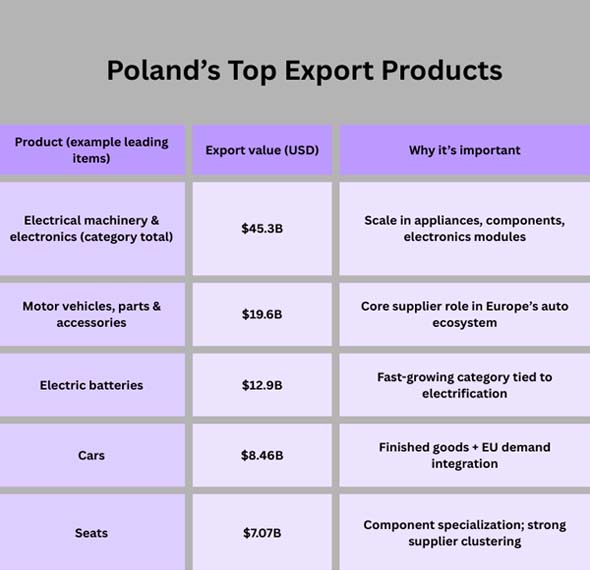
Poland’s manufacturing export strength comes from a wide set of industrial categories. Instead of depending on one “super export,” Poland ships many high-performing product lines into the EU—especially automotive-related goods, electronics, machinery and equipment, and manufactured consumer goods.
Based on Poland Import Trade Analysis by Import Globals, a helpful way to understand Poland’s mix is to look at leading export products by value. Automotive items (vehicles and parts), electronics, and batteries stand out, alongside other manufactured goods that scale well in EU markets.
This Mix Reveals a Key Reality: Poland is strong in both final assembly (finished products like cars) and intermediate manufacturing (parts and components like seats, electronics modules, and other automotive inputs). That dual capability is exactly what makes a country “supply-chain central” inside the EU.
The EU Demand Map: Poland’s Top Export Partners
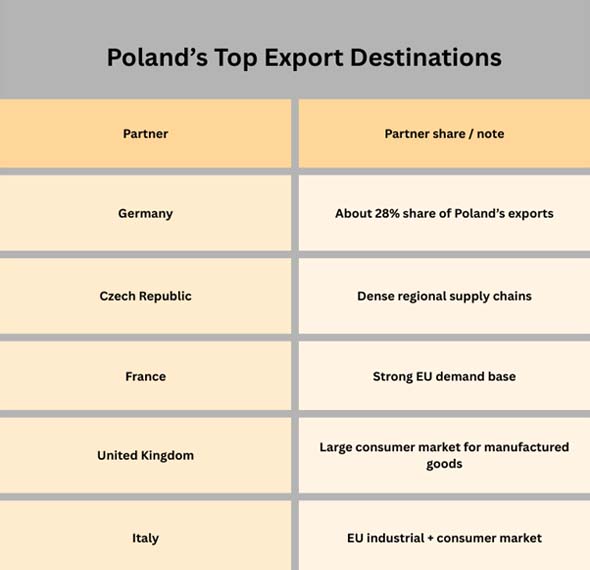
Poland’s export partner list is dominated by nearby EU economies, with Germany as the anchor. Germany's position is based on geography and structure. Poland provides Germany with the parts and intermediate goods it needs to make things, while Germany provides Poland with the finished goods and retail-ready goods it needs to sell. The Czech Republic and France are also high on the list, which illustrates that majority of Poland's manufacturing commerce happens within the region.
As per Poland Exporter Data by Import Globals, this partner structure is typical of a mature EU manufacturing hub: most trade flows are short-to-medium distance, truck-enabled, and synchronized with production schedules.
Why Poland’s Manufacturing Exports Grew So Fast
Poland’s rise as an EU manufacturing exporter is the outcome of several reinforcing dynamics:
1) Supply-Chain integration with Central Europe and Germany
Poland is part of the broader Central European industrial corridor. Parts and sub-assemblies often migrate across borders, which allows for specialization. Factories may concentrate on what they do best, including making chairs, wiring systems, electronics modules, metal parts, and appliances, since they know that nearby facilities will put these things together into bigger end goods.
2) Size and Variety
As per Poland Importer Data by Import Globals, Poland's local market is big enough to support production learning curves and supplier depth, but exports are still important for growth. Many manufacturers sell to both EU and US markets, which helps to balance out changes in demand.
3) Manufacturing Improves Over Time
Poland's factories have been making things that are more and more complicated and valuable. Poland's export basket has gotten more modern with the addition of new devices and batteries.
4) The benefits of logistics and being close by EU clients care about reliability. Poland is adjacent to important markets and has great road freight connections, which makes it easy to deliver goods quickly. This is very important for supply chains in industry that don't have a lot of stock.
Electronics and Appliances: The Quiet Giant of Polish Exports
As per Poland Import Trade Statistics by Import Globals, one of Poland’s most powerful manufacturing pillars is electrical machinery and electronics. This category captures a wide range: household appliances, components, electrical devices, and electronics-related manufacturing. The category is large and EU-facing, and Germany is the top destination by a wide margin.
This electronics strength fits Poland’s export model well: electronics manufacturing can scale rapidly, supports strong supplier networks, and benefits from EU-wide demand for appliances and industrial electrical equipment.
Poland's Strategic Shift in Exports: Batteries and Electrification
Poland's participation in Europe's electrification may be the most important export trend for strategy. Poland's battery exports are currently some of the most valuable products the country sells. As per Poland Import Shipment Data by Import Globals, this is because of investment and expansion in the supply chains for electric vehicles (EVs) and energy storage. Batteries are "value dense," easy to trade, and particularly crucial to Europe's industrial policy aims. Because of this, they will be one of the most important things to export for the next ten years.
This Trend is also Part of a Wider Change: Poland is no longer merely creating traditional produced goods. It is also getting more involved in new sectors of economic growth that have to do with moving to cleaner energy sources, getting around, and making things in new ways.
What Could make the Momentum slow down? Limits and Risks
Export success generated by manufacturing gets people talking:
Dependence on Demand from the EU: Poland feels the effects of a slowdown in EU industrial production right away, especially through supply chains that are linked to Germany.
Cost Pressures: If productivity doesn't keep up, rising energy costs, salaries, and regulatory limits can make a corporation less competitive.
Changes in trade policy, such as higher tariffs from other nations or changes in EU policy, can have a large influence on supply chains, especially in industries that export a lot.
Still, Poland's diversity makes it strong. As per Poland Import Export Trade Analysis by Import Globals, when automotive demand softens, electronics, appliances, furniture, or other manufactured goods can stabilize exports—one reason Poland has remained a strong exporter through multiple economic cycles.
Conclusion
Poland’s manufacturing-led export growth is one of the EU’s defining economic stories of the last two decades. As per Poland Export Import Global Trade Data by Import Globals, by integrating into the EU single market, building a diversified manufacturing base, and specializing inside regional supply chains—especially around Germany—Poland has scaled exports to hundreds of billions of dollars annually. The emergence of high-growth categories like batteries and electronics suggests that Poland’s export model is not only durable, but evolving toward the next phase of European industrial demand.
In short: Poland is no longer simply a low-cost manufacturing location. It is increasingly a core production partner inside the EU—shipping complex goods and components that matter to Europe’s competitiveness. Import Globals is a leading data provider of Poland Import Export Trade Data.
FAQs
Que. Why is Germany Poland’s top export market?
Ans. Because of proximity and supply-chain structure: Poland supplies Germany’s manufacturers with components and also sells finished goods into Germany’s large consumer market.
Que. What makes Poland’s export growth “manufacturing-led”?
Ans. A large share of exports comes from industrial products—vehicles and parts, electronics and appliances, machinery-related goods, and fast-growing categories like batteries.
Que. Does Poland depend on the EU for business?
Ans. Yes. Poland's export model is quite similar to the EU's single market and the way goods move around in the EU.This helps growth, but it also makes Poland more vulnerable to slowdowns in the EU.
Que. What new industries are going to change Poland's exports in the future?
Ans. Batteries and manufacturing related to electrification are two of the fastest-growing fields, coupled with large-scale exports of electronics and electrical machinery.
Que. Where to get detailed Poland Import Export Global Data?
Ans. Visit www.importglobals.com.
