
New Zealand’s Global Dairy Trade: The Strategic Insights Into the Dynamic Trade Overview of 2025
- Nov 24, 2026
- 34 Views
New Zealand’s Global Dairy Trade: The Strategic Insights Into the Dynamic Trade Overview of 2025
New Zealand, an island country in the south-western Pacific Ocean, has emerged as the ultimate trader of dairy products in the worldwide marketplace. The temperate climate of the nation, with consistent rainfall and the millions of dairy cattle relative to population size, has promoted the dairy trade of the country.
The low domestic population consumption and the stable production increase are behind the static trade of dairy products from New Zealand. The investment in high-value product processing and research and development proficiency has resulted in a total valuation of dairy products export from New Zealand worth 12 billion US dollars in 2025.
The urbanization and Western diet adoption have lowered the strong global commodity prices, which have been promoting stability in trade. Subscribe to Import Globals, the leading New Zealand import export trade provider, to stay updated with the latest information regarding the dairy products export of the nation via the New Zealand Trade Data.
New Zealand’s Major Dairy Export Products and Their Global Demand
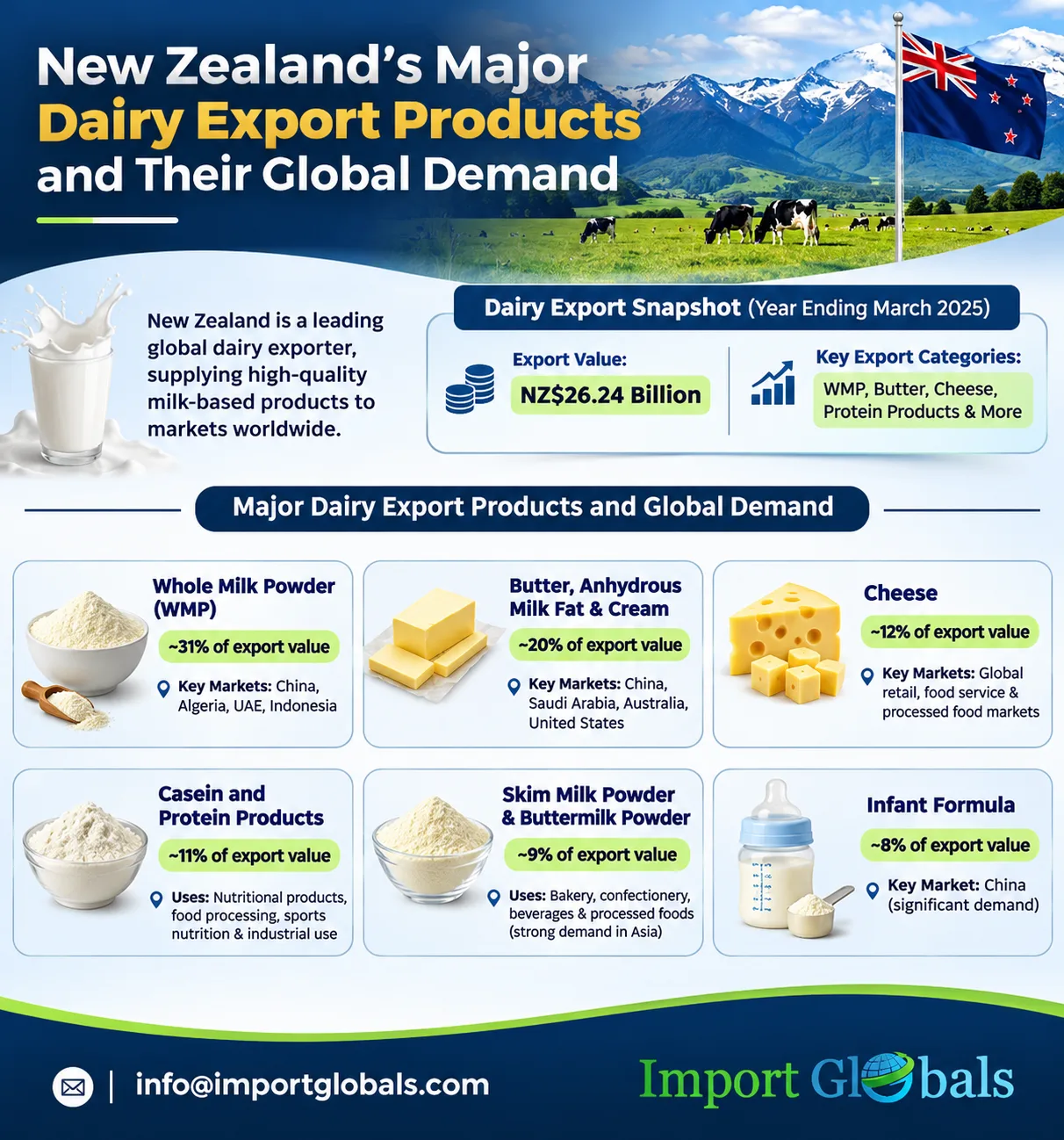
New Zealand is one of the leading dairy exporting countries of the world and exports dairy products to various food manufacturing companies, retailers and consumers in foreign countries. New Zealand earned about US$14.37 billion from dairy exports in the year to March 2025. The main export categories are whole milk powder, butter, cheese and specialty dairy ingredients.
1. Whole Milk Powder (WMP): Whole milk powder is New Zealand’s largest category of dairy product exports, accounting for nearly 31% of dairy export earnings in the year to March 2025. It is an ingredient in the processing of food and in the manufacture of bakery products and confectionery and dairy products. It is exported to China and other destinations such as UAE, Indonesia and Algeria.
2. Butter, Anhydrous Milk Fat, and Cream: Such products made up about 20% of dairy export earnings. The world demand comes from bakeries, food producers, restaurants and retailers as dairy fats are required to prepare food.
3. Cheese: Cheese accounted for roughly 12% of dairy product export revenue. New Zealand makes a wide variety of cheeses for retail, food service and manufacturing markets. Demand is driven by international consumption and cheese use in prepared foods.
4. Casein and Protein Products: Specialized dairy ingredients made up around 11% of export income. Such dairy ingredients are utilized in nutraceutical, food processing, sports nutrition and industrial applications.
5. Skim Milk Powder and Buttermilk Powder: Together these products accounted for about 9% of revenue from dairy exports. They find a broad range of applications in bakery products, confectionery, beverages and processed foods, with a demand in food manufacturing companies of Asian and other international markets.
6. Infant Formula: Infant formula made up some 8 per cent of the revenue in dairy exports. This is a special part of the nutrition sector where China is an important export destination.
How New Zealand Trade Data Supports Market Research
The New Zealand Trade Statistics can be used by the businesses for analyzing the dairy product segments, HS codes, export destinations, shipments and international buyers. Import Globals can assist companies in researching trade trends, finding potential buyers, and assessing the competition.
Authorities Boosting the Dairy Products Trade
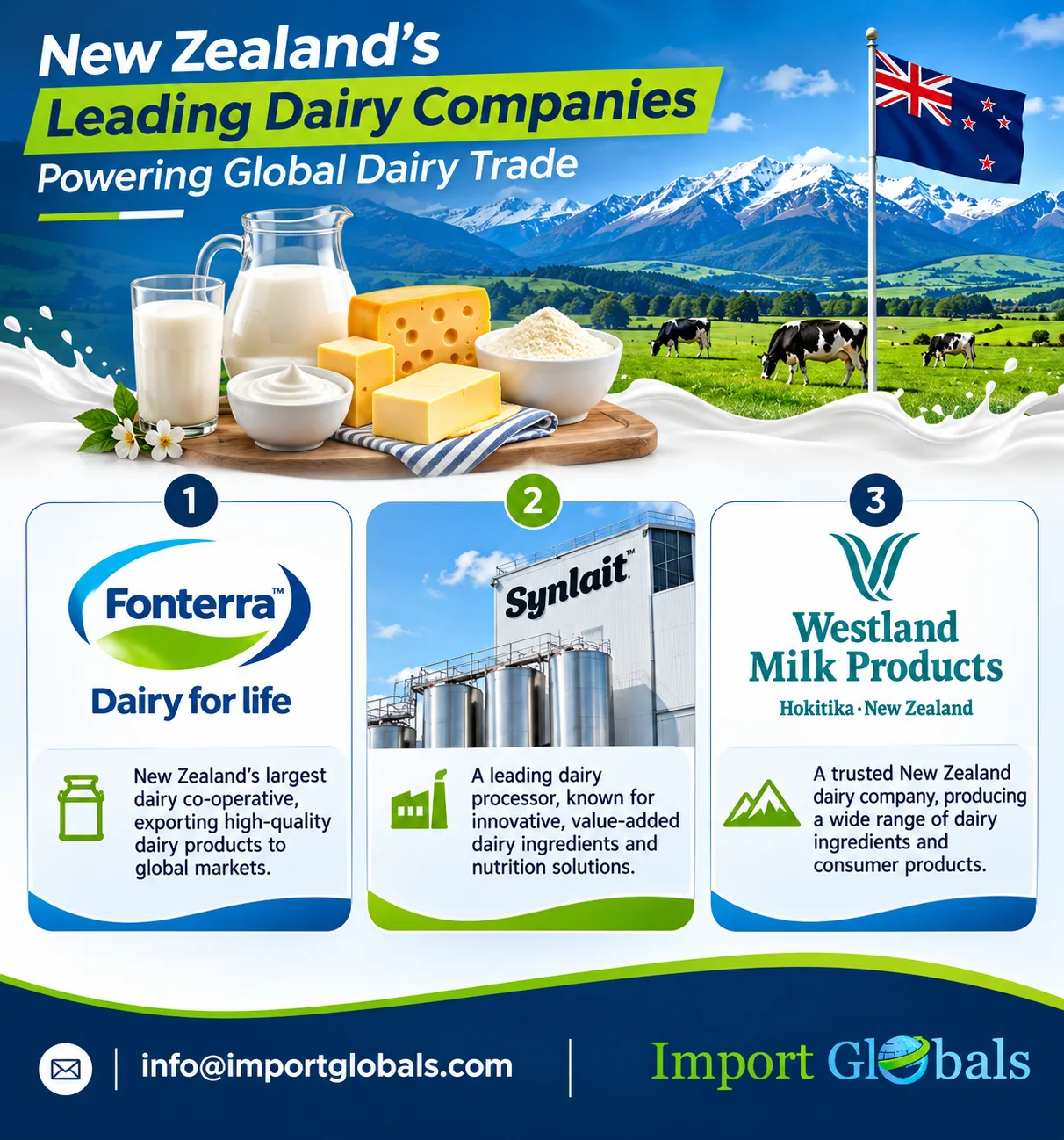
1. Fonterra - Fonterra, based in New Zealand, is one of the largest dairy cooperatives and the dominant force that has been promoting the global dairy trade. The authority is owned by thousands of local farmers in the country. The specialization of the authority in whole milk powder and skim milk powder production, along with butter and cheese-like ingredients, has raised the dairy products export contribution to the country's GDP.
2. Synlait Milk - This company holds a vital role in expanding New Zealand's trade rank. The authority, being particularly recognized for its expertise in infant formula, is mainly popular due to the focus of the manufacturing units on premium and specialized nutrition markets. The vertical integration towards the supply chain, advanced processing technology, and strict quality standards have been supporting the stronger trade of global essentials.
3. Westland Milk Products - Wrapping up the list of the dominating companies shaping the dairy products export trade of New Zealand, Westland Milk Products is a crucial one. The company is responsible for producing milk powders, butter, protein concentrates, and specialty dairy ingredients. The modern processing facilities adopted in terms of quality and the investment in efficiency upgrades have enhanced the export capacity and product quality.
Dairy Exports Economic Contribution to the National GDP
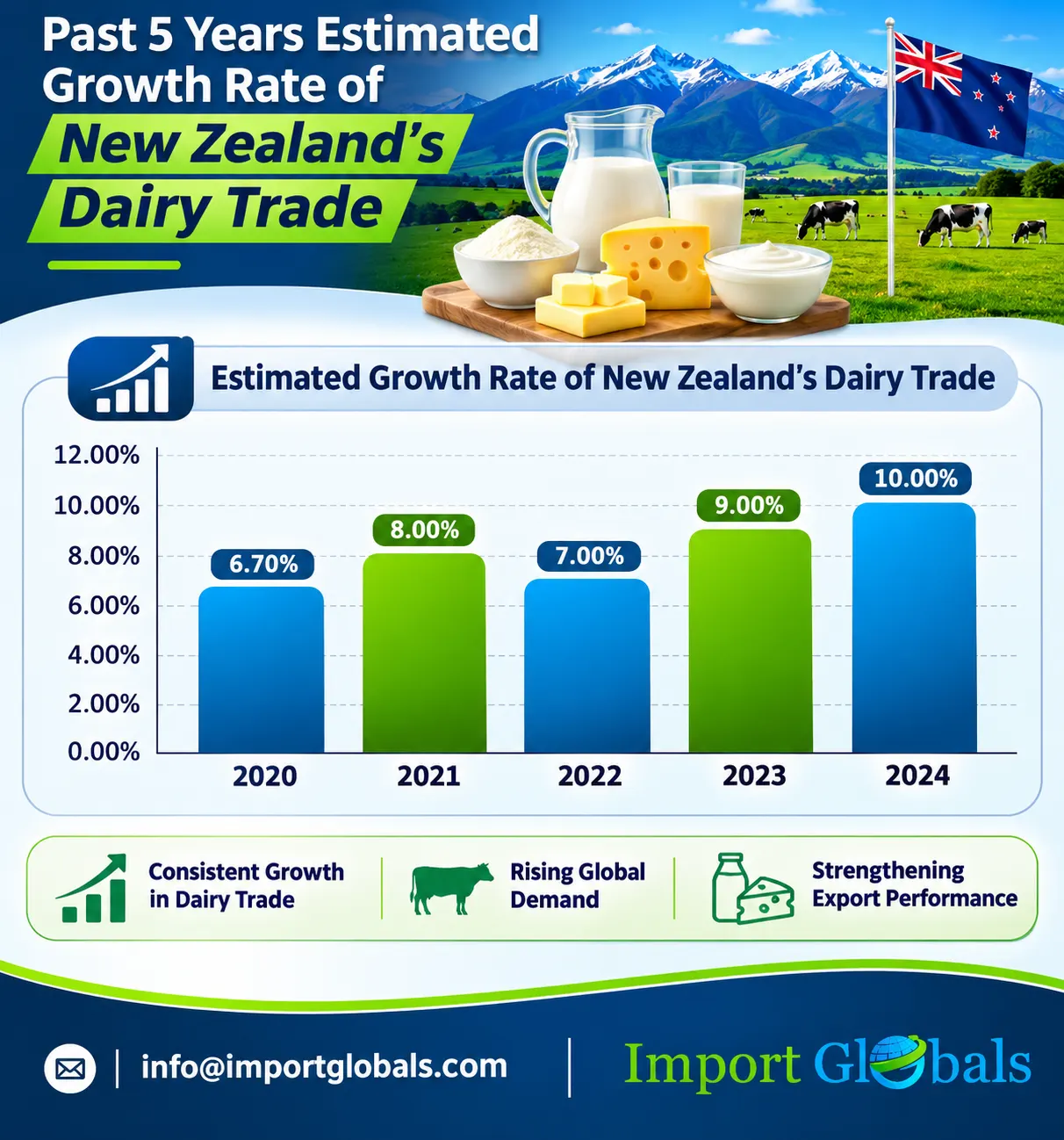
Dairy exports of New Zealand have been a supporting factor for the national GDP growth rate. It is one of the largest merchandise export sectors and is responsible for generating substantial foreign exchange earnings. The specific niche is a strong multiplier of trade generation across the economy. With proper support of the logistics industries, it even drives the investment in processing infrastructure.
Dairy exports of New Zealand have strengthened the trade balance, with a simultaneous contribution to the national income. The heavy investment by the major dairy cooperatives in research, technology, and value-added production has increased productivity, which has led to export competitiveness.
New Zealand’s Dairy Import Trends and Key International Suppliers
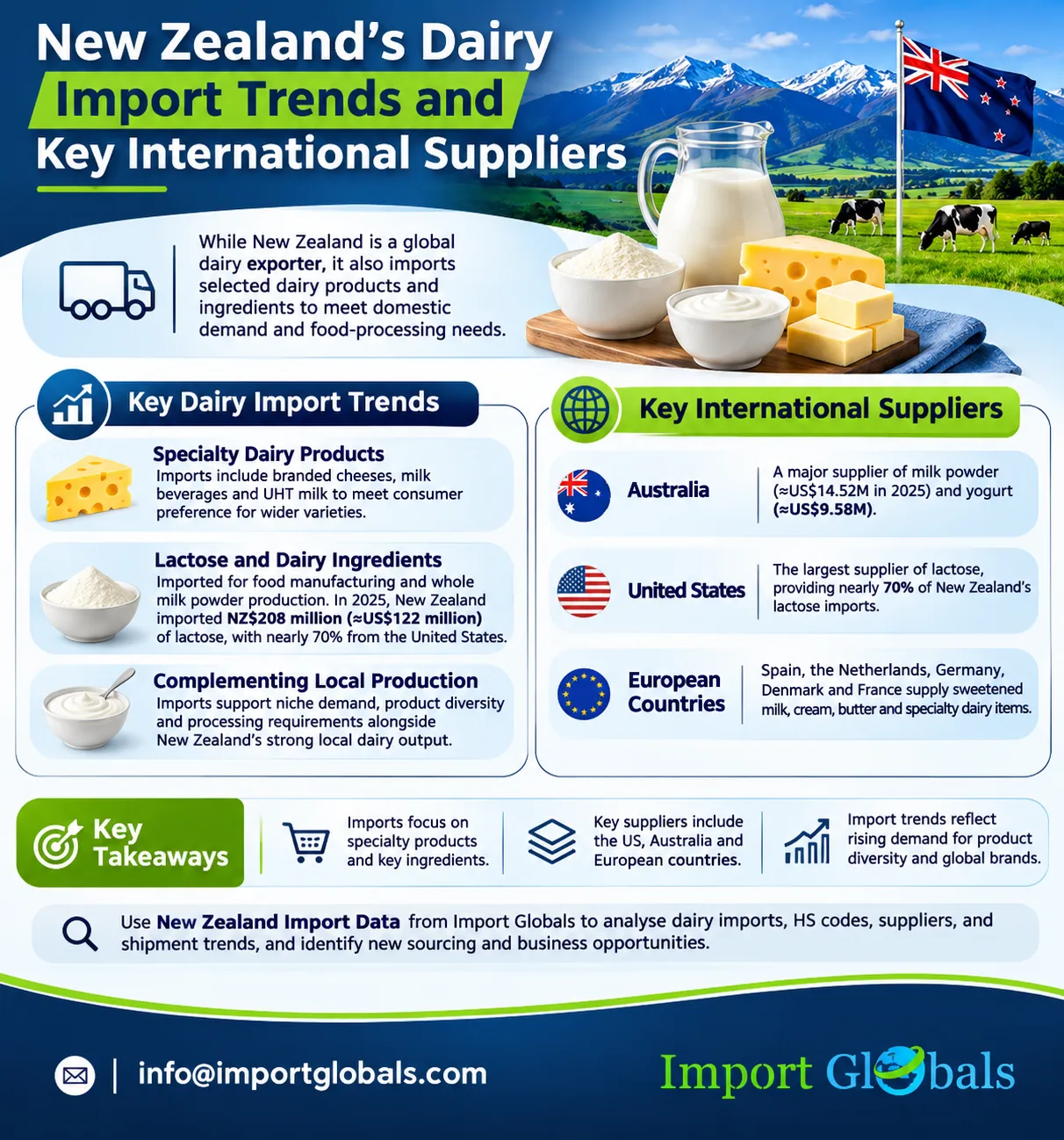
New Zealand is known globally as one of the largest exporters of dairy products. Yet, it also imports some dairy products and other ingredients. Such imports complement the country’s high levels of dairy production, and provide access to international brands and ingredients.
Key Dairy Import Trends and International Suppliers
1. Specialty Dairy Products: New Zealand imports niche dairy products including branded cheese, milk drinks and ultra-high-temperature (UHT) milk. These products satisfy the needs of consumers for some varieties which cannot be produced locally in large quantities.
2. Lactose and Dairy Ingredients: Lactose is one of the dairy products imported into New Zealand for use in food processing and whole milk powder manufacture. New Zealand imported US$122 million worth of lactose in 2025. Almost 70% of the lactose was imported from the USA.
3. Australia as a Key Supplier: Australia’s produce includes milk powder and yogurt. About 2025, Australia will supply New Zealand with about US$14.52 million of low fat milk powder imports and about US$9.58 million of yogurt imports.
4. European Dairy Suppliers: Sweetened milk, cream, butter and other dairy products are supplied by Spain, The Netherlands, Germany, Denmark and France, among others.
5. United States: The US is another country supplying lactose and some other dairy ingredients to meet New Zealand's processing needs.
How Import Globals Supports Trade Research
New Zealand Import Data can help companies to do analysis related to imports of dairy products, HS codes, importing countries, shipment patterns and prospective business partners. Import Globals helps with sourcing and international market research.
Dominating Variants of Dairy Products Exported From New Zealand in 2025
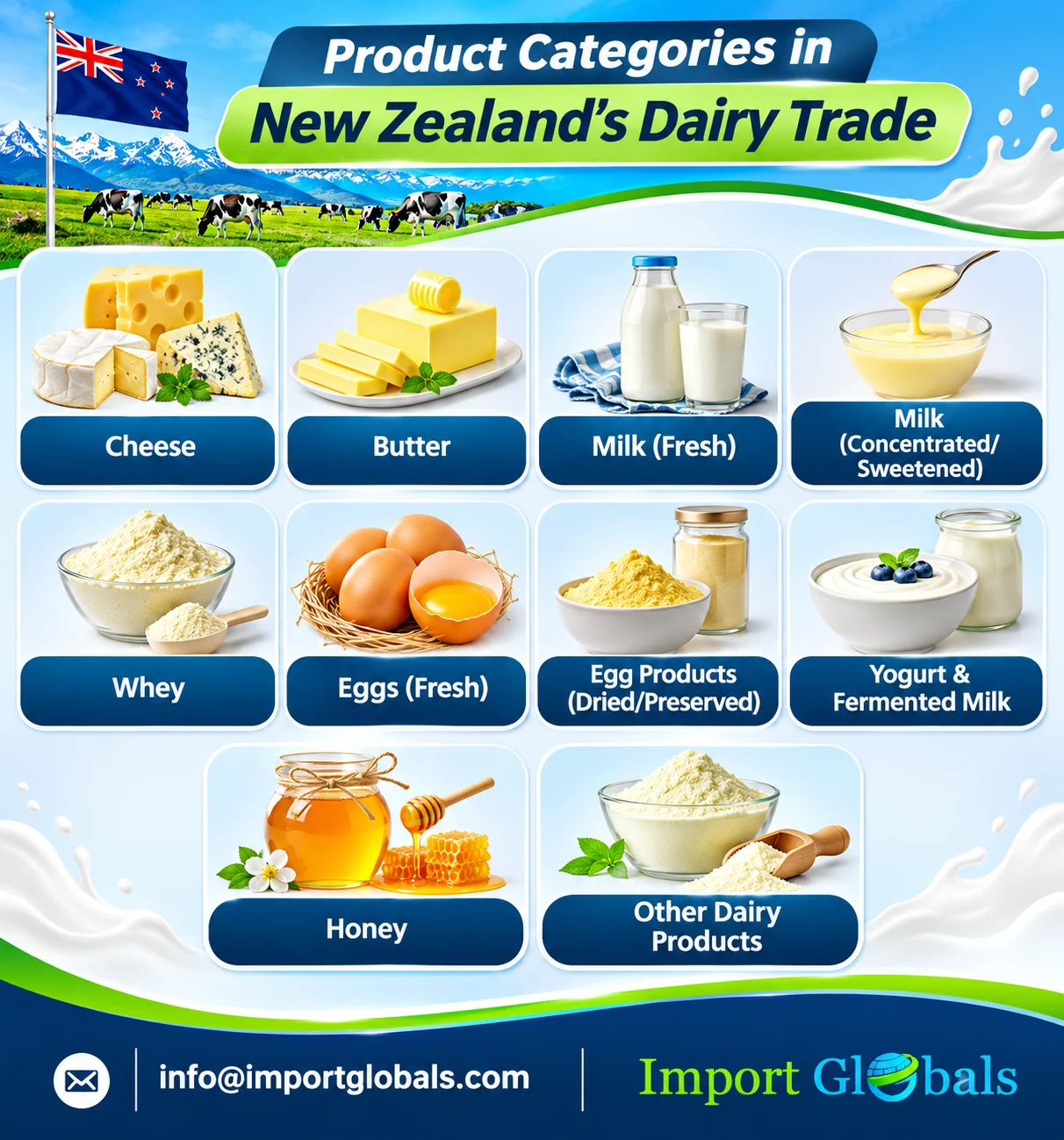
The milk production trends and the advancements in dairy product processing technology have resulted in a diversity in the global trade output of dairy essentials. According to the New Zealand Export Data, the topmost variants of dairy products exported from the nation in 2025 are,
- Cheese – The annual valuation of Cheese exported from New Zealand in 2025 – 2.65 billion US dollars.
- Butter – The annual valuation of Butter exported from New Zealand in 2025 – 1.89 billion US dollars.
- Milk (fresh) – The annual valuation of Milk (fresh) exported from New Zealand in 2025 – 1.56 billion US dollars.
- Milk (concentrated/sweetened) – The annual valuation of Milk (concentrated/sweetened) exported from New Zealand in 2025 – 1.22 billion US dollars.
- Whey – The annual valuation of Whey exported from New Zealand in 2025 – 1.09 billion US dollars.
- Eggs (Fresh) – The annual valuation of Eggs (fresh) exported from New Zealand in 2025 – 843 million US dollars.
- Egg Products (Dried/Preserved) – The annual valuation of Egg products (dried/preserved) exported from New Zealand in 2025 – 709 million US dollars.
- Yogurt & Fermented Milk – The annual valuation of Yogurt & fermented milk exported from New Zealand in 2025 – 582 million US dollars.
- Honey – The annual valuation of Honey exported from New Zealand in 2025 – 321 million US dollars.
- Other Dairy Products – The annual valuation of Other dairy products exported from New Zealand in 2025 – 265 million US dollars.
Top Trade Partners of New Zealand in 2025
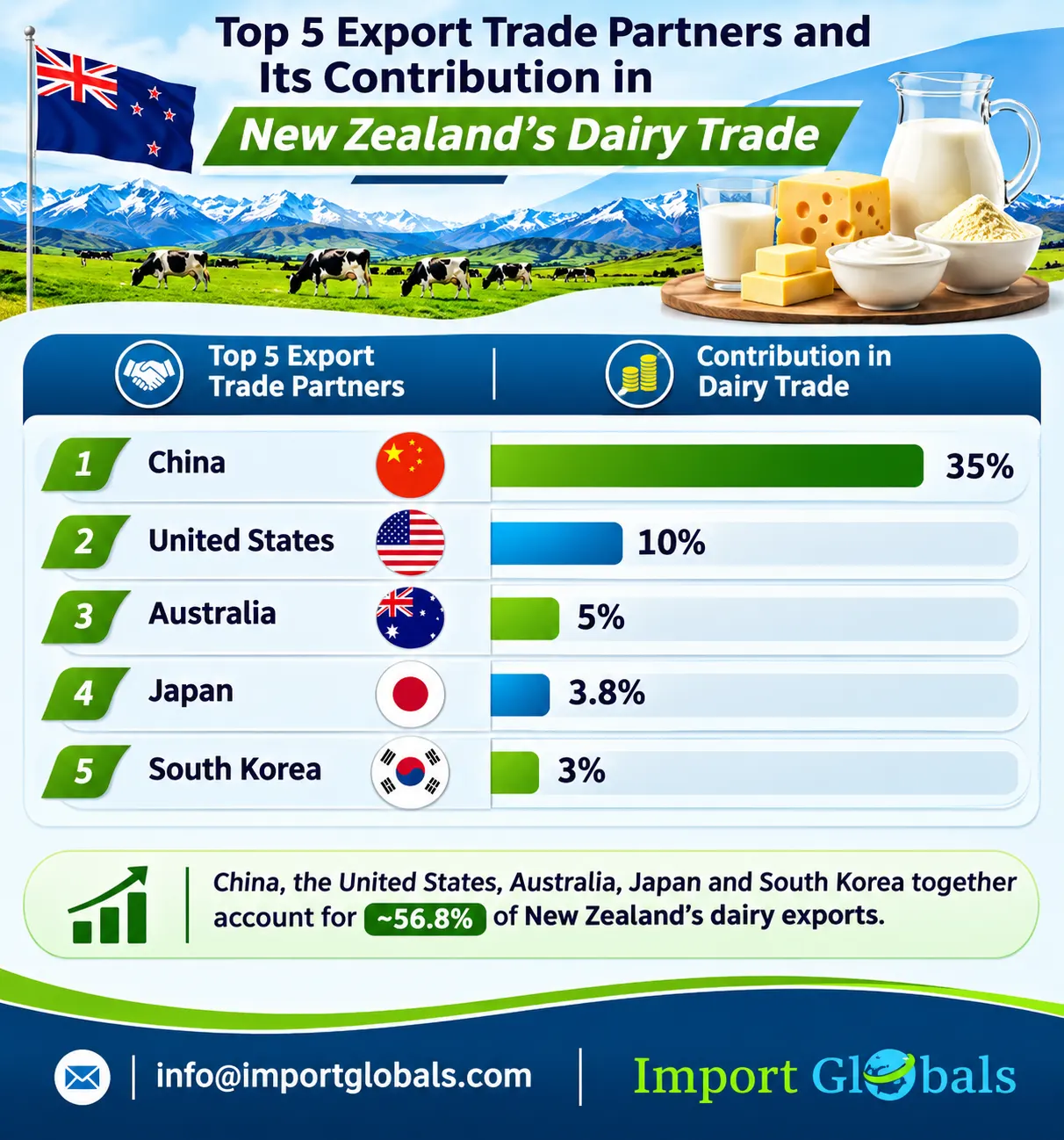
The emerging markets driving the demand growth and the major dairy companies shaping the trade have led to proper bilateral relationships. As per the New Zealand Customs Data, the topmost trade partners benefiting the dairy product export of the nation in 2025 are,
- China – The total valuation of dairy products exported from New Zealand to China in 2025 – 2.69 billion US dollars.
Top 5 variants of dairy products exported
1. Custard powder (milk-based)
2. Dairy-based mousse
3. Dairy-based cheesecake
4. Evaporated milk desserts
5. Dairy-based sauces
- United States – The total valuation of dairy products exported from New Zealand to the United States in 2025 – 1.72 billion US dollars.
Top 5 variants of dairy products exported
1. Whipped butter
2. Butter sticks
3. Butter powder
4. Margarine (dairy-based)
5. Butter blends for baking
- Australia – The total valuation of dairy products exported from New Zealand to Australia in 2025 – 1.59 billion US dollars.
Top 5 variants of dairy products exported
1. Cultured butter
2. Clarified butter (ghee)
3. Spreadable butter blends
4. Butter oil
5. Dairy fat blocks
- Japan – The total valuation of dairy products exported from New Zealand to Japan in 2025 – 1.28 billion US dollars.
Top 5 variants of dairy products exported
1. Monterey Jack
2. Parmesan
3. Pecorino
4. Swiss cheese
5. String cheese
- South Korea – The total valuation of dairy products exported from New Zealand to South Korea in 2025 – 1.16 billion US dollars.
Top 5 variants of dairy products exported
1. Smoked cheese
2. Goat cheese
3. Sheep cheese
4. Cheese curds
5. Mascarpone
- Singapore – The total valuation of dairy products exported from New Zealand to Singapore in 2025 – 821 million US dollars.
Top 5 variants of dairy products exported
1. Paneer
2. Cottage cheese
3. Cream cheese
4. Processed cheese slices
5. Cheese spreads
- United Kingdom – The total valuation of dairy products exported from New Zealand to United Kingdom in 2025 – 540 million US dollars.
Top 5 variants of dairy products exported
1. Maasdam
2. Emmental
3. Brie
4. Camembert
5. Blue cheese (Roquefort, Gorgonzola)
- Indonesia – The total valuation of dairy products exported from New Zealand to Indonesia in 2025 – 392 million US dollars.
Top 5 variants of dairy products exported
1. Clotted cream
2. Double cream
3. Sour cream
4. Coffee creamers (dairy-based)
5. Cultured cream
- Thailand – The total valuation of dairy products exported from New Zealand to Thailand in 2025 – 242 million US dollars.
Top 5 variants of dairy products exported
1. Milk powder (skimmed)
2. Cream (heavy)
3. Cream (light)
4. Half-and-half
5. Whipping cream
- United Arab Emirates – The total valuation of dairy products exported from New Zealand to the United Arab Emirates in 2025 – 165 million US dollars.
Top 5 variants of dairy products exported
1. Semi-skimmed milk
2. Flavored milk (chocolate, strawberry, etc.)
3. Lactose-free milk
4. UHT (long-life) milk
5. Evaporated milk
HS Codes and Product Categories in New Zealand’s Dairy Trade
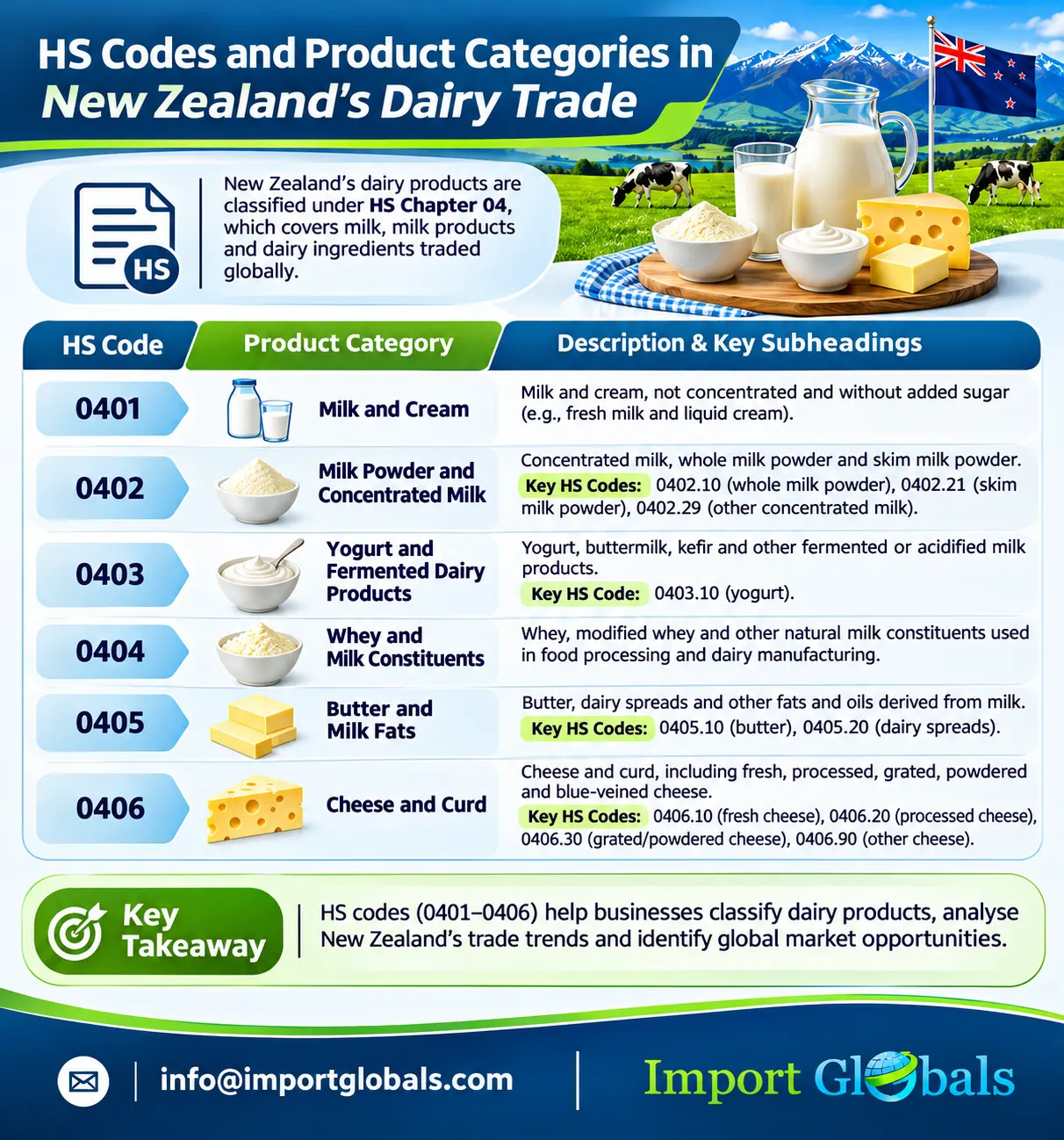
New Zealand’s dairy export comprises milk, milk powder, butter, cheese, whey and special dairy ingredients. Products are covered under Chapter 04 of the Harmonized System (HS) used by business to monitor importation and exportation of products and to analyze international trade patterns.
Major Dairy Product Categories and Their HS Codes
1. HS Code 0401 – Milk and Cream: It contains milk and cream that are unconcentrated and contain no added sugars. This category contains fresh liquid milk and cream products with varying fat contents.
2. HS Code 0402 – Milk Powder and Concentrated Milk: It is for whole milk powder, skim milk powder, concentrated or sweetened milk. The subheadings identify the products by their fat contents and composition, including 0402.10, 0402.21 and 0402.29.
3. HS Code 0403 – Yogurt and Fermented Dairy Products: It includes yogurt, buttermilk, kefir and other fermented or acidified milk products . HS 0403.10 identifies yogurt.
4. HS Code 0404 – Whey and Milk Constituents: Whey, modified whey and other normal milk components used for food preparation, nutrition and dairy manufacturing.
5. HS Code 0405 – Butter and Milk Fats: Milk and milk products: butter, spreads and other fat/oil products. The relevant subheadings here are 0405.10 (butter) and 0405.20 (dairy spreads).
6. HS Code 0406 – Cheese and Curd: Fresh cheese, processed cheese, grated/powdered cheese, blue-cheese etc. The important subheadings are 0406.10, 0406.20, 0406.30 and 0406.90.
Conclusion
In 2025, New Zealand’s international dairy trade suggested that the country had a highly developed dairy industry because of the global demand, quality products, and extensive export markets. The country’s dairy export earnings of US$14.85 billion showcased the industry’s importance to its economy. Whole milk powder, butter, cheese and special dairy products found favor in the global market. New Zealand Trade Data will enable you to find new export opportunities, perform competitor analysis and find potential customers. Import Globals can provide useful information about shipments and markets.
CTA
Find Out Global Dairy Trade 2025 at Import Globals in New Zeeland! Use important New Zealand Trade Data to identify major dairy importers and exporters, perform an analysis of export trends and discover international business opportunities. Contact www.importglobals.com or email to [email protected].
FAQ's
Que. What are the primary dairy products exported by New Zealand in 2025?
Ans. Whole milk powder, butter, cream, cheese, casein, skim milk powder, and infant formula are some of the primary dairy products that New Zealand exports.
Que. What was the value of New Zealand dairy exportations in 2025?
Ans. In the fiscal year 2025, New Zealand recorded dairy exportation worth a total of NZ$27.15 billion (equivalent to about US$16.5 billion).
Que. Which nation is the largest buyer of New Zealand dairy products?
Ans. China is the leading exporter for New Zealand dairy products.
Que. What is the most valuable dairy export category for New Zealand?
Ans. Whole milk powder is the most valuable category, representing around 31% of total dairy export revenue in March 2025.
Que. What HS code applies to milk powder exportations from New Zealand?
Ans. Milk powder exportations fall under HS Code 0402.
Que. Why is New Zealand important for the global dairy industry?
Ans. New Zealand is one of the world’s leading suppliers of dairy produce and exports its products to about 140 international markets.
Que. Which are the dairy products that have high international demand?
Ans. There is high international demand for whole milk powder, butter, cheese, infant formula, and speciality dairy ingredients.
Que. What are the uses of New Zealand Trade Data for dairy companies?
Ans. It assists them in analysing their export data, identifying trade partners, tracking shipments, and identifying buyers.
Que. How frequently is New Zealand Dairy Trade Data updated?
Ans. Update frequency depends on the reporting source and data category; official trade statistics are generally released periodically.
Que. How does Import Globals support New Zealand dairy trade research?
Ans. Import Globals provides New Zealand Trade Data and shipment insights to help businesses identify buyers, analyse competitors, and explore global dairy trade opportunities. Visit www.importglobals.com or email [email protected].
You Can Also Visit :-
