
Renewable Energy Equipment Trade in 2025: Solar Panels, Batteries and Wind Turbines
- Nov 06, 2026
- 71 Views
Renewable Energy Equipment Trade in 2025: Solar Panels, Batteries and Wind Turbines
The trade of renewable energy technology at a global level has increased in the year of 2025 when countries have been spending money on the production of clean electricity, storage of energy, and decarbonisation initiatives.
Trade has started to recover after a decline in 2024. Gross exports of certain clean energy technologies from China have constituted more than 165 billion US dollars, which is equivalent to around fifty percent of overall exports if we exclude trade within the EU. As per the Global Import Shipments Data, the European Union and the United States are presented as the top importer of renewable energy equipment with 15% accountability and 45% accountability of the global import of renewable energy essentials.
China has been leading the production of solar panels and their parts. In 2025, the export of the solar panels is currently taking place in different regions around the world like Vietnam, Malaysia, and Thailand. Solar panels photovoltaic cells, wind energy units, and lithium batteries are some of the top traded renewable energy equipment in 2025 which are demanded on a global scale.
Global Renewable Energy Equipment Summary
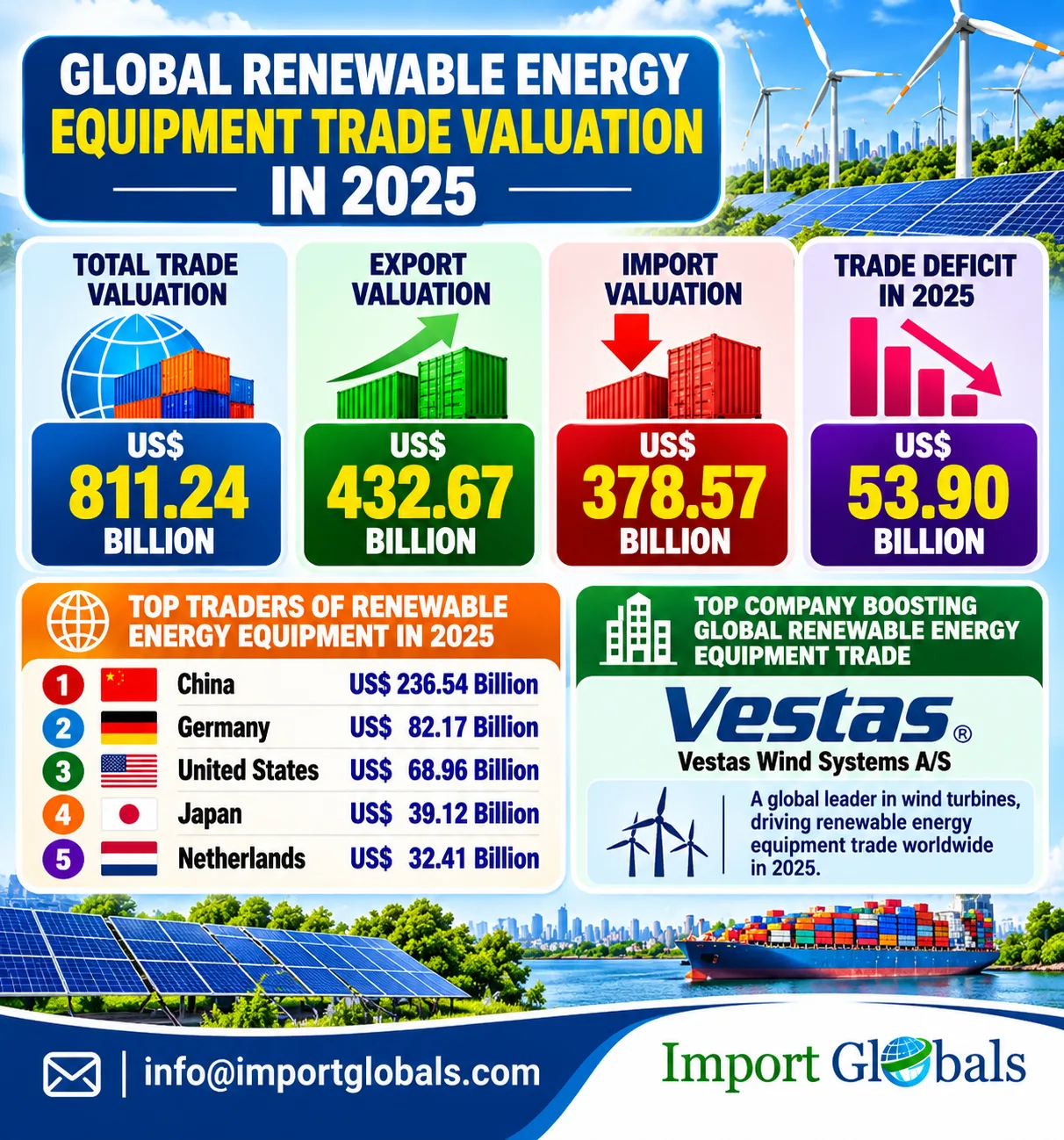
The overall trade valuation of the global renewable energy equipment in 2025 has attained a staggering valuation of 811.24 billion US dollars. This represents the critical role play of the specific commodity in different economies. The global exports of the product totalled valuation of 432.67 billion US dollars, whereas the imports of the specific product is at a staggering rate of 378.57 billion US dollars. The infographic, however, mentions a US$53.90 billion trade deficit, which contradicts the figures reported above. The largest participant in renewable energy equipment trade was China with US$236.54 billion of trade value, followed by Germany with US$82.17 billion, and the United States with US$68.96 billion of trade value.
Japan came fourth as a player in this sector with US$39.12 billion, with the Netherlands taking fifth place with US$32.41 billion of trade value. This group of countries features the most significant companies in the sector, contributing to technological and manufacturing processes as well as distribution processes. In particular, Vestas Wind Systems A/S is worth mentioning for its input to the development of the wind energy industry since the company is said to be a key manufacturer of wind turbines and a facilitator of renewable energy equipment trade.
Top 10 Renewable Energy Equipment Exported Globally
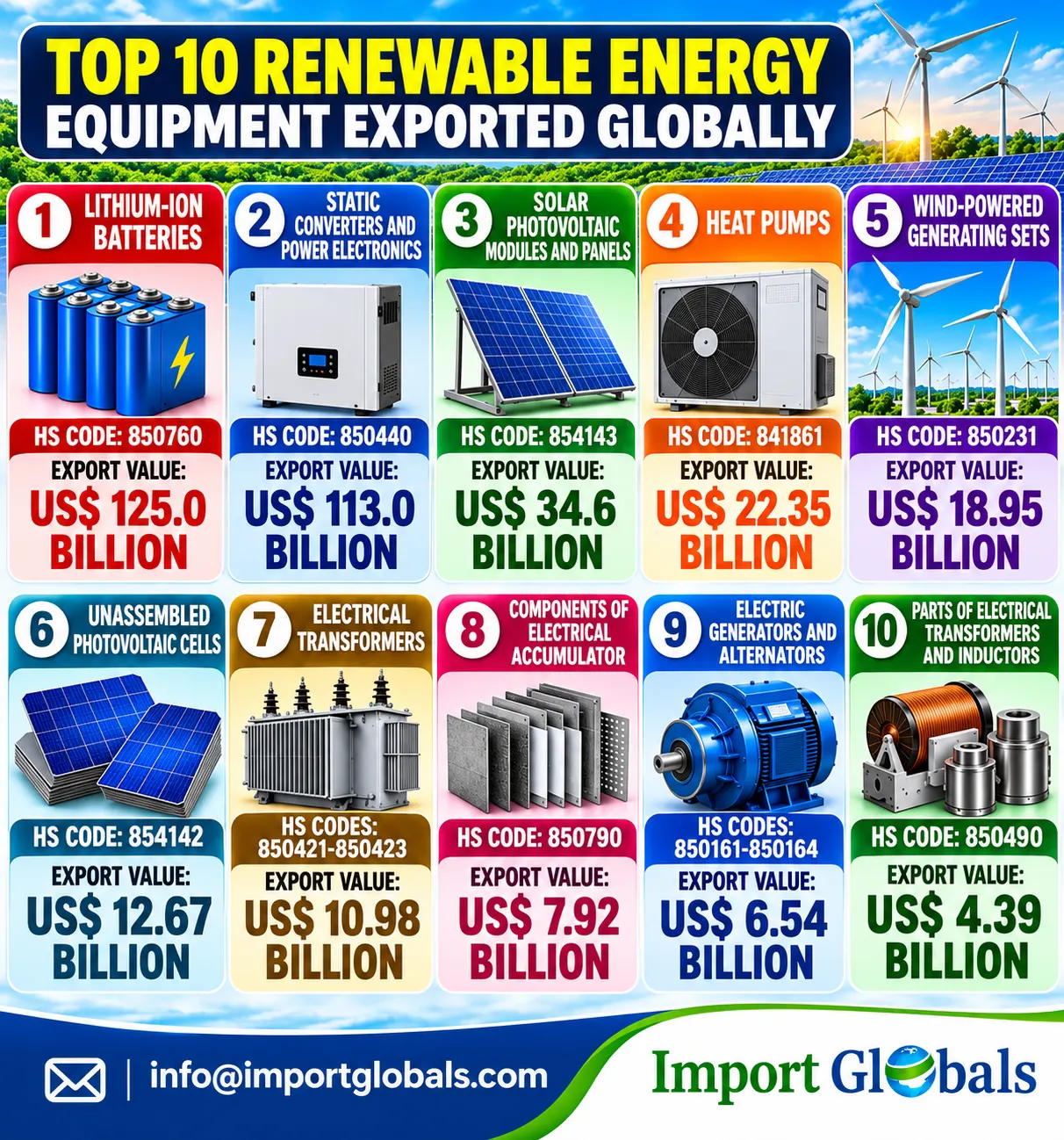
1. Lithium-Ion Batteries – Harmonized System Code 850760 – Export Value: US$125.0 Billion
Lithium-ion batteries play an important role in the use of renewable energy by storing electricity generated from solar and wind facilities. The batteries are extensively employed in electric vehicles, portable devices, as well as in power grids.
2. Static Converters and Power Electronics – Harmonized System Code 850440 – Export Value: US$113.0 Billion
Static converters include machines that convert electric energy from one type to another. For instance, solar inverters and static converters connect solar panels to the electric grid. In addition, this code relates to multiple uses.
3. Solar Photovoltaic Modules and Panels – Harmonized System Code 854143 – Export Value: US$34.6 Billion
Solar photovoltaic modules are used for the conversion of solar energy into electric energy. These modules are widely traded and used for various purposes of production, residential and commercial use. China produces and exports a significant amount of solar modules, reported Global Import Export Data.
4. Heat Pumps – Harmonized System Code 841861 – Export Value: US$22.35 Billion
Heat pumps used for heating spaces and heating water contribute to energy efficiency. The trade in this sector promotes the implementation of efficient heating technologies and reduces reliance on traditional fossil fuels.
5. Wind-Powered Generating Sets – HS Code 850231 – Export Valuation: US$18.95 Billion
Wind-powered generating sets are a set of systems that are used to utilize wind energy for electrical power generation. By using wind-generated energy, wind farms – onshore and offshore – are contributing to electricity generation and the development of renewable energy systems.
6. Unassembled Photovoltaic Cells – HS Code 854142 – Export Valuation: US$12.67 Billion
Unassembled photovoltaic cells are used for the semiconductor devices used to manufacture solar modules. The cells are engaged in long-distance trade before being supplied to the solar panels for both home and commercial purposes.
7. Electrical Transformers – HS Codes 850421-850423 – Export Valuation: US$10.98 Billion
Electrical transformers allow one to regulate the voltage level at which electrical energy is transmitted. Basically, they are used in renewable energy systems connecting solar plants, wind, batteries, and other electrical plants.
8. Components of Electrical Accumulator – HS Code 850790 – Export Valuation: US$7.92 Billion
Components of the battery, such as plates, separators, and other parts of the battery, are used in the production of systems to store energy. The components are also traded internationally.
9. Electric Generators and Alternators — HS Codes 850161–850164 — Export Valuation: US$6.54 Billion
Electric generators and alternators create electric energy for many activities. Some devices are used in alternative energy systems, e.g., wind farms, but this category also covers equipment utilized for traditional electricity generation.
10. Parts of Electrical Transformers and Inductors — HS Code 850490 — Export Valuation: US$4.39 Billion
Parts of transformers and inductors help assemble, repair, and operate electrical appliances. These parts aid in developing the energy infrastructure connected to alternative energy facilities, electric stations, and electricity distribution lines.
Top 10 Renewable Energy Equipment Imported Globally
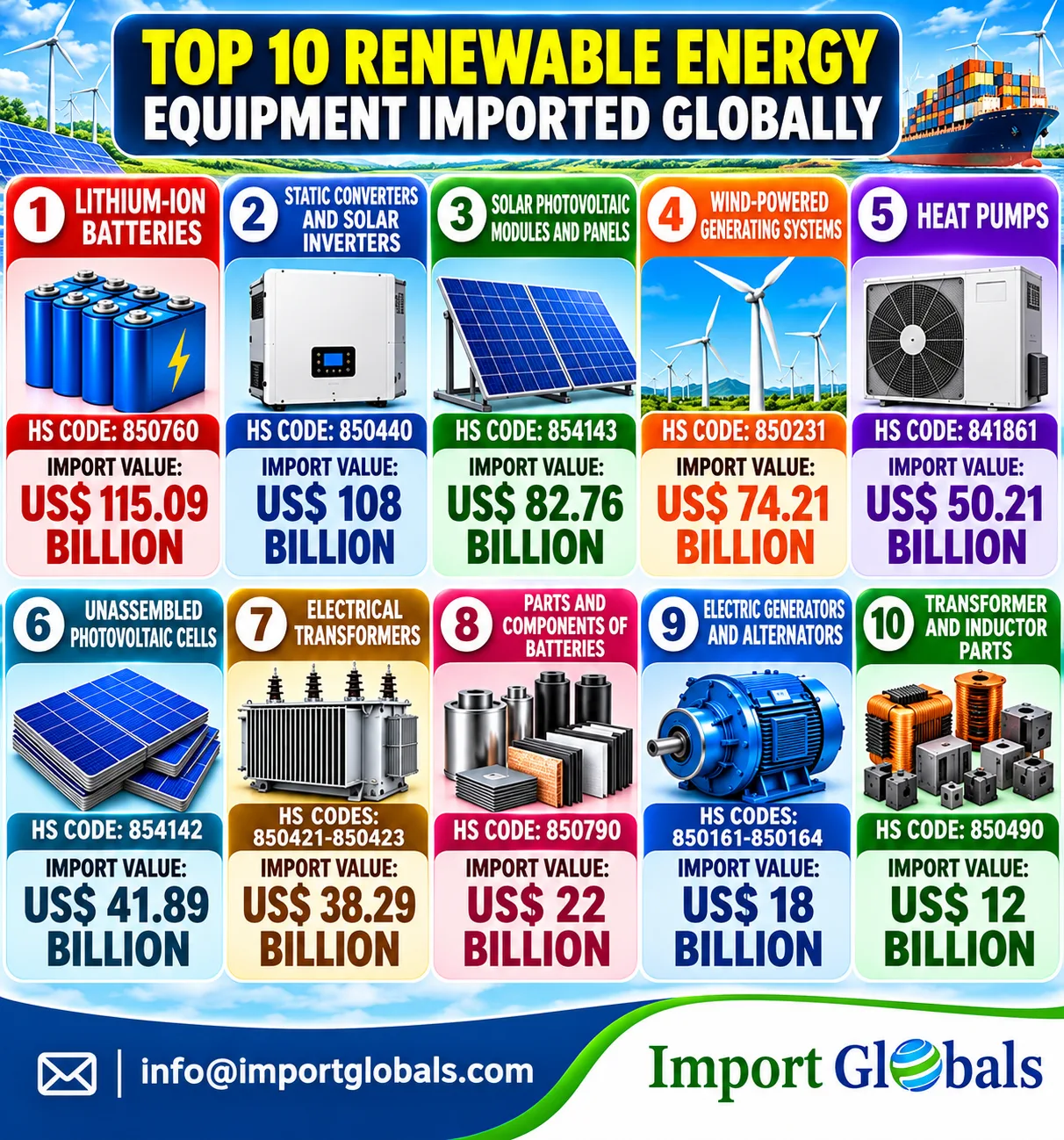
1. Lithium-Ion Batteries — HS Code 850760 — Import Valuation: US$115.09 Billion
Lithium-ion batteries are the top imported variant of renewable energy equipment by different economies worldwide. It mainly includes renewable power storage, electric transportation, and load balancing application. The import valuation of the specific commodity is at a rate of 115.09 billion US dollars.
2. Static Converters and Solar Inverters — HS Code 850440 — Import Valuation: US$108 Billion
Static converters and solar inverters are the top second imported variants of renewable energy equipment in 2025. The solar inverter concern on a global scale is mainly because of the direct current produced by solar panels for alternating current mostly utilized for power networks.
3. Solar Photovoltaic Modules and Panels — HS Code 854143 — Import Valuation: US$82.76 Billion
Different economies worldwide are importing solar photovoltaic modules in order to build solar systems mainly for personal use and commercial purposes, says Global Trade Data. Such devices are capable of producing electric energy from sunlight, and therefore, they are a key component of the international clean energy supply chain.
4. Wind-Powered Generating Systems - HS Code 850231 - Import Valuation: US$74.21 Billion
Wind power generating systems are getting imported on a wide plethora on the global scale. The utility of the specific commodity for production of electricity develop alternative power generation methods.
5. Heat Pumps - HS Code 841861 - Import Valuation: US$50.21 Billion
Heat pumps are at a staggering import valuation of 50.21 billion US dollars. The specific commodity is under the HS code of 841861 and holds a massive accountability with minimal complexities of trade.
6. Unassembled Photovoltaic Cells - HS Code 854142 - Import Valuation: US$41.89 Billion
Unassembled photovoltaic cells imported by solar manufacturers enable their use in the assembly of solar panels. They help local plants in producing solar panels and also facilitate the worldwide network in producing renewable energy.
7. Electrical Transformers - HS Codes 850421 - 850423 - Import Valuation: US$38.29 Billion
Electrical transformers help the adjustment of electricity and connect renewable power generation systems with transmission and distribution networks. Global trade statistics reported solar parks, wind projects, and substations as the main components within the specific subcategory.
8. Parts and Components of Batteries - HS Code 850790 - Import Valuation: US$22 Billion
Parts and component of batteries are at a staggering import valuation of 22 billion US dollars. The resourcing of the commodity is mainly because of its effective role play in manufacturing processes, assembly, repair, and maintenance of energy storage units. Battery supply chains are supporting the renewable energy storage for energy generation.
9. Electric Generators and Alternators - HS Codes 850161-850164 - Import Valuation: US$18 Billion
Electric generators and alternators are applied in a number of power generation facilities, including those based on renewable energy utilization. Importers procure this equipment for electricity generation and industrial projects; however, it would be correct to emphasize the fact that the HS codes also cover non-renewable applications.
10. Transformer and Inductor Parts - HS Code 850490 - Import Valuation: US$12 Billion
Transformer and inductor parts are used in electric power equipment manufacturing, repair, and maintenance processes. Import of this equipment leads to the preservation of power networks and the connection of renewable power stations to power networks and power hubs.
Top 10 Global Exporters of Renewable Energy Equipment in 2025
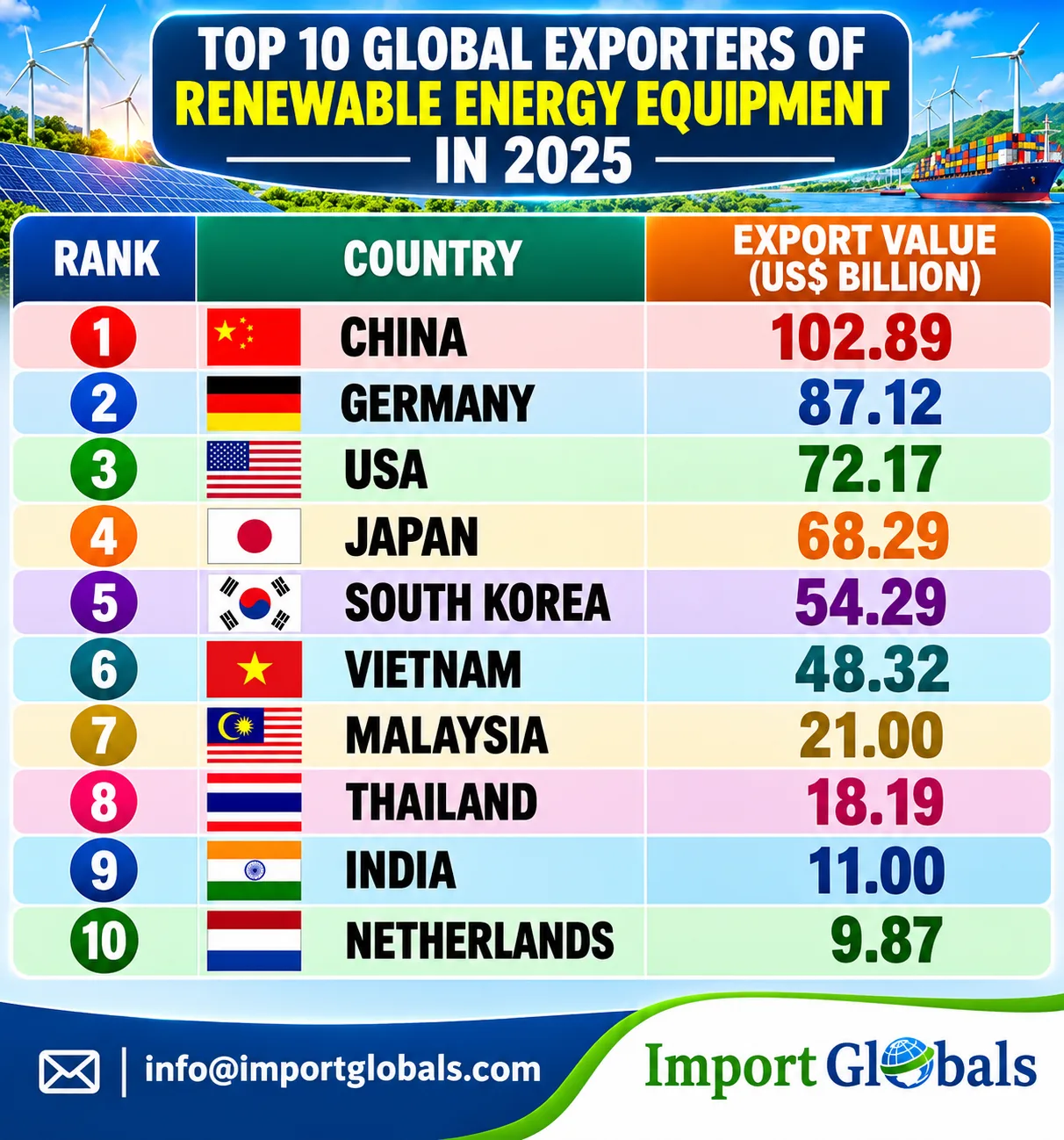
1. China – Export Value: 102.89 billion US Dollars
China has been the leader in terms of the export of clean energy technologies in 2025, such as photovoltaic modules, batteries, electric vehicles, etc. The country was able to secure its own position in the international supply chains thanks to its manufacturing scale and competitive prices; it became the leader in this field.
2. Germany – Export Value: 87.12 billion US Dollars
Germany is one of the most significant exporters of clean energy equipment, including wind technologies, power electronic devices, systems for industrial energy usage, and other particular machinery. Engineering expertise allows Germany to be an important player and contribute to the development of clean energy infrastructure in Europe and the whole world.
3. USA – Export Value: 72.17 billion US Dollars
The country takes part in exporting clean energy equipment with the help of advanced electronic devices, batteries, energy management systems, and other kinds of special machinery. Thus, they contribute to the implementation of clean energy projects around the globe.
4. Japan — Export Valuation: 68.29 billion US Dollars
Japan is engaged in supplying renewable energy manufacturing equipment and manufacturing battery technology, electrical components, and power conversion systems. The technology sector in Japan is aiding in energy storage and solar energy projects.
5. South Korea — Export Valuation: 54.29 billion US Dollars
South Korea is engaged in supplying battery cells and energy storage technology, electrical apparatus, and related industrial components. This country's advanced manufacturing sector has led to an increase in the need for energy storage and renewable energy devices and systems.
6. Vietnam — Export Valuation: 48.32 billion US Dollars
Vietnam is becoming a dominant manufacturer of solar photovoltaic equipment and electrical components. It has provided efficient export-oriented production facilities to the world market.
7. Malaysia — Export Valuation: 21 billion US Dollars
Malaysia is taking part in the renewable energy equipment supply chain through the manufacture of photovoltaic solar panels, semiconductors, and electrical products. Its manufacturing capacity has made the country engaged in the global supply network for solar energy and power electronics.
8. Thailand — Export Valuation: 18.19 billion US Dollars
Thailand provides clean energy equipment supply chains with components, electrical systems, battery manufacturing, as well as solar business activities. The export industry of the country supports regional manufacturing networks as well as renewable energy introduction.
9. India — Export Valuation: 11 billion US Dollars
India is developing solar module manufacturing and the production of electric appliances. The opportunities for exporting solar-related equipment include modules, power electronic devices, and energy-related elements, since the country is going to increase workers' capabilities in manufacturing and using the international market.
10. Netherlands — Export Valuation: 9.87 billion US Dollars
Renewable energy trade in the Netherlands is accomplished via specialized equipment and electrical systems as well as logistics and distribution networks, as per Global Trade Statistics. The European trading experience helps to distribute clean energy technologies among manufacturers, developers, and customers.
Top 10 Global Importers of Renewable Energy Equipment in 2025
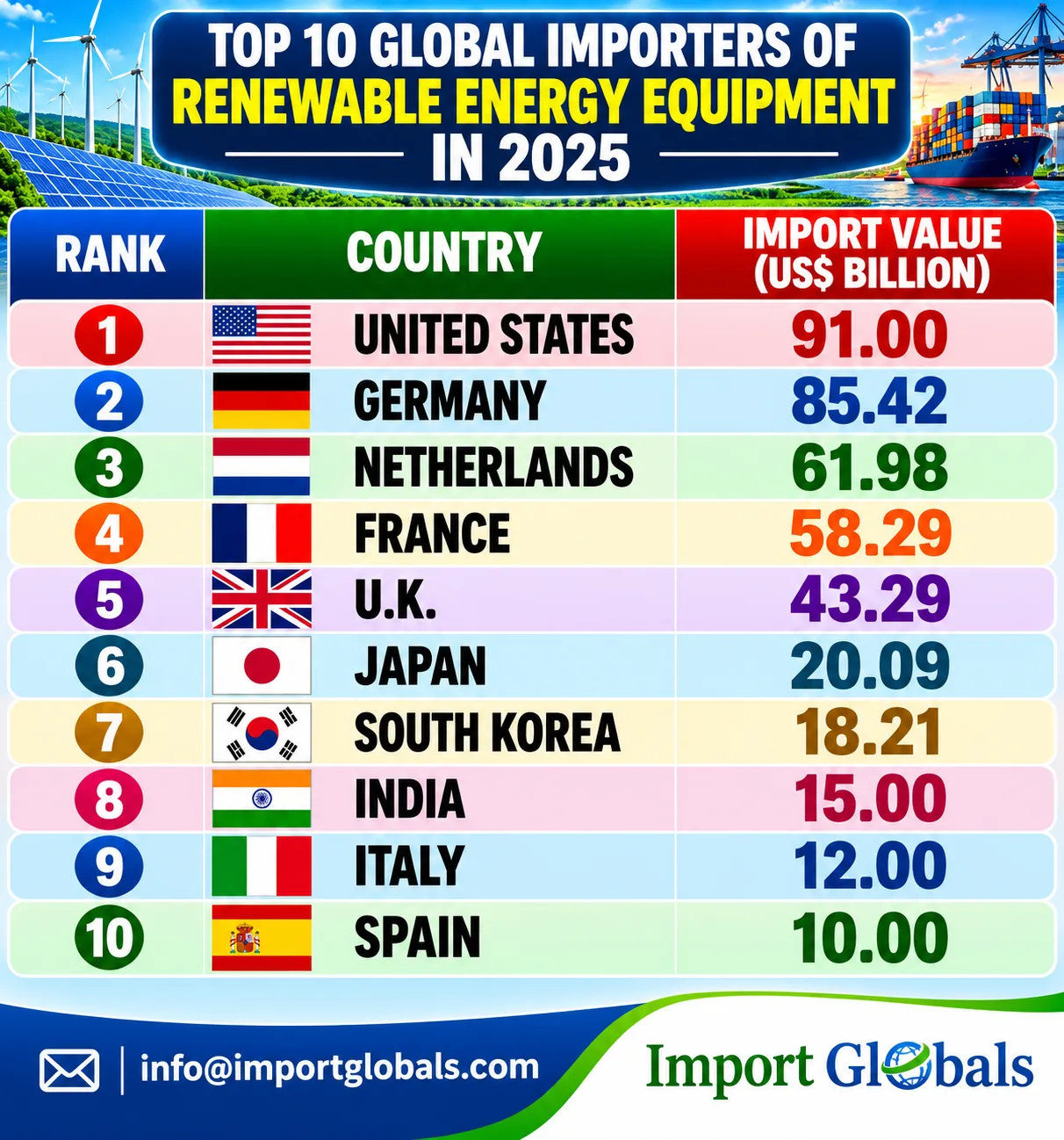
1. United States – Import Valuation: 91 billion US Dollars
The US is importing solar modules, batteries, power electronics, wind equipment, and heat pumps to enable the development of renewable projects in the electricity sector and to satisfy domestic needs.
2. Germany – Import Valuation: 85.42 billion US Dollars
Germany is importing solar panels, batteries, wind equipment, and power conversion systems to facilitate the transition to the green economy. The manufacturing base of the country and the targets for the production of renewable energy serve as a stimulus to investments in the sphere of clean energy equipment by foreign companies.
3. Netherlands – Import Valuation: 61.98 billion US Dollars
The Netherlands acts as a significant trade and logistical centre for clean energy equipment in Europe. The imports by the country include solar panels, batteries, electrical equipment, and equipment for related purposes.
4. France - Import Valuation: 58.29 billion US Dollars
France uses imported solar PV equipment, batteries, power electronics, and heat pumps to generate renewable energy. Imported technologies can supplement domestic-made technologies.
5. U.K.- Import Valuation: 43.29 billion US Dollars
The United Kingdom uses imported solar equipment, offshore wind technology, batteries, and electricity technologies to increase the amount of renewable energy produced in the country. Suppliers from abroad provide the necessary equipment for clean energy.
6. Japan- Import Valuation: 20.09 billion US Dollars
Japan imports of solar equipment, batteries, power electronics, and energy-efficient heating systems supports renewable energy. Imported equipment is considered necessary for energy security.
7. South Korea- Import Valuation: 18.21 billion US Dollars
South Korea imports some types of renewable energy components, electrical equipment, and energy-storing technologies to support clean energy projects in the country. Domestically produced equipment is used together with imported technologies, including batteries.
8. India – Import Valuation: 15 billion US Dollars
India imports equipment for solar energy, batteries, wind parts, and the following facilities and materials in support of the growing renewable energy capacity. High import activity is a supplement to the activities of domestic manufacturers as demand for electricity and investments in clean energy continue growing.
9. Italy – Import Valuation: 12 billion US Dollars
Italy is importing solar panels, batteries, inverters, and energy-saving appliances necessary for domestic usage, including different levels of projects. Its state of renewable energy development, as well as the links with other European countries, provides good possibilities for suppliers from other countries.
10. Spain – Import Valuation: 10 billion US Dollars
Spain is getting solar PV modules, batteries, wind components, and power electronics necessary for renewable energy projects through imports. Its good solar and wind resources create demand for the imported equipment as well as equipment necessary for grid connection.
Top Companies Boosting the Global Renewable Energy Equipment Trade
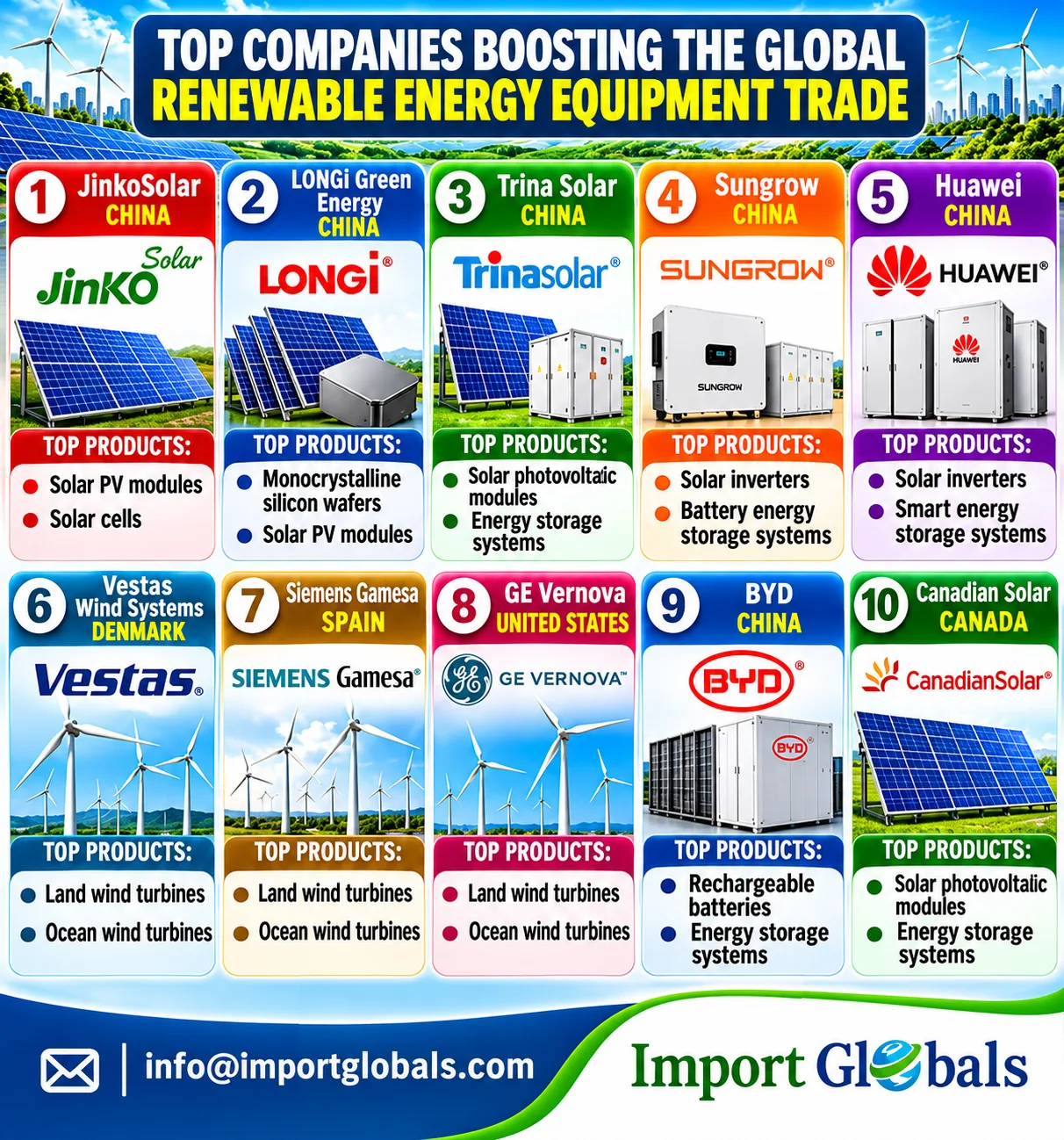
1. JinkoSolar - China
Top Products: Solar PV Modules; Solar Cells
A global leader in providing solar PV cells and modules for residential, industrial, and utility applications. Because of its large production capacity and distribution network, the company is an important player on the global solar equipment industry stage.
2. LONGi Green Energy - China
Top Products: Monocrystalline Silicon Wafers; Solar PV Modules
LONGi manufactures solar wafers and photovoltaic modules for O&M companies, distributors, and green energy businesses around the world. High-efficiency solar technologies developed by the company meet the worldwide demand for modern PV technologies.
3. Trina Solar - China
Top Products: Solar Photovoltaic Modules; Energy Storage Systems
Trina Solar produces solar photovoltaic modules and energy storage systems for utility-scale and distributed energy projects. As reported by the Global Import Export Data, the businesses involved in connectivity of solar energy equipment production has been supporting the project development of Trina Solar for maintaining the trade balance in the renewable energy equipment trade.
4. Sungrow - China
Top Products: Solar Inverters; Battery Energy Storage Systems
Sungrow Manufacturers is mainly investing their resources on proper production of solar inverters and battery energy storage systems because of the increasing global demand rate. The inverters that are manufactured in the company are popular for helping connect solar energy generation with electrical systems.
5. Huawei — China
Top Products: Solar Inverters; Smart Energy Storage Systems
Huawei is based in China and is a top manufacturer of solar inverters and smart energy storage systems. The electronic devices and monitoring tools produced in the company properly enhances the solar energy production and energy management throughout the globe.
6. Vestas Wind Systems — Denmark
Top Products: Land and Offshore Wind Turbines
Wind Systems in Denmark is popular for manufacturing wind turbines and other solutions that make wind projects. The utilization of the technologies in energy production systems helps maintain optimal turbine operation and performance.
7. Siemens Gamesa — Spain
Top Products: Land and Offshore Wind Turbines
Siemens Gamesa provides wind energy products in different countries. The company’s equipment can be used both at onshore and offshore power plants, contributing to the development of renewable power.
8. GE Vernova — United States
Top Products: Land and Ocean Wind Turbines
GE Vernova supplies technologies aimed at generating wind energy and establishing energy infrastructure. The company’s systems make power generation from wind possible, while GE Vernova’s engineers ensure their integration into existing energy systems.
9. BYD - China
Top Products: Rechargeable Batteries; Energy Storage Systems
BYD develops battery technologies and energy storage solutions applicable to vehicles and stationary power solutions. BYD’s manufacturing process supports battery technology across a variety of applications in the work of restoration and improvement of renewable electricity.
10. Canadian Solar - Canada
Top Products: Solar Photovoltaic Modules; Energy Storage Systems
Canadian Solar produces solar photovoltaic modules and storage solutions for the renewable energy sector. Canadian Solar’s production and its distribution initiatives help provide products to various markets worldwide.
Global Trade Statistics: The Renewable Energy Equipment Growth From 2016 to 2025
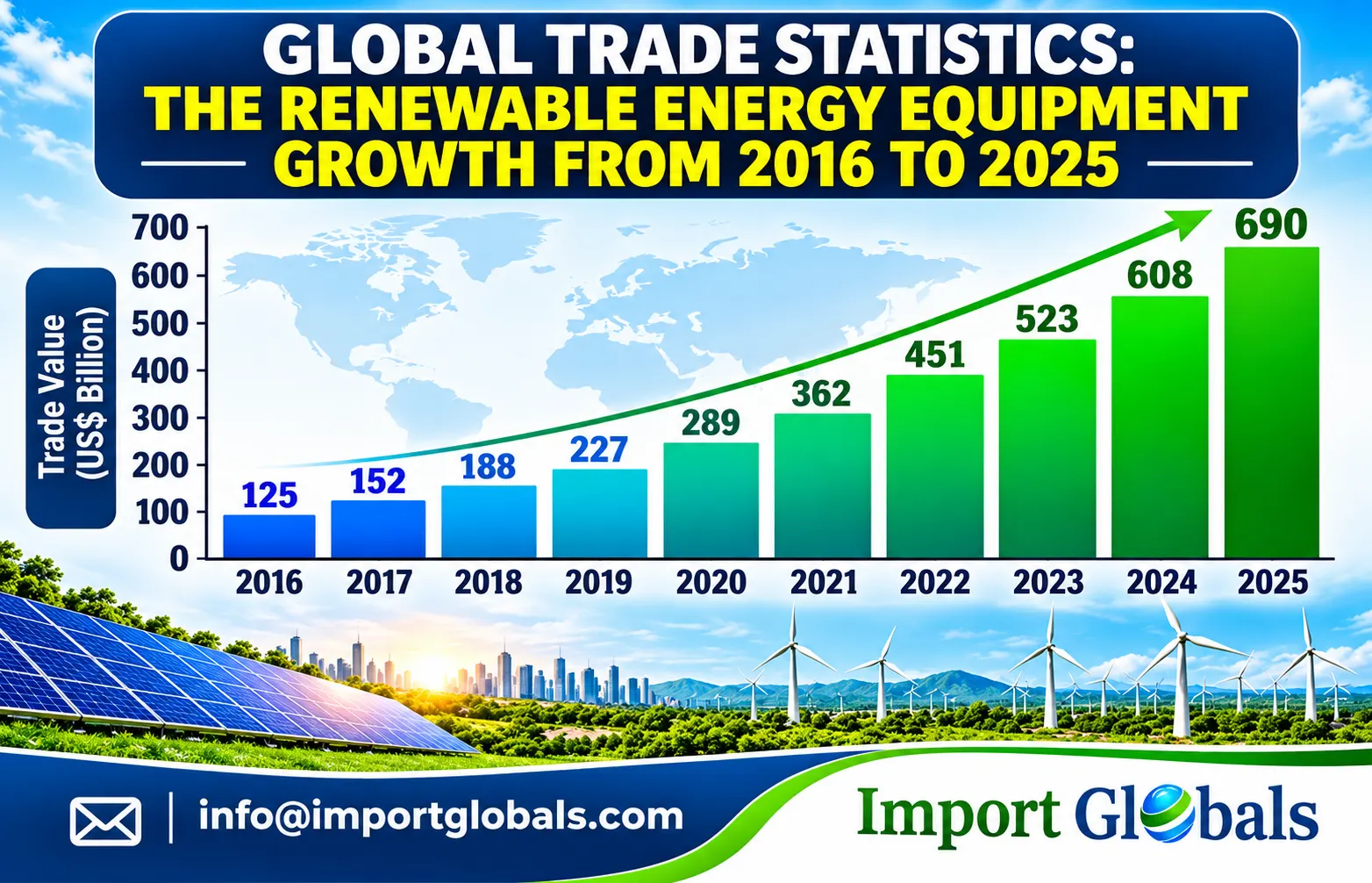
The world market of renewable energy equipment has shown remarkable growth from 2016 to 2025 due to increasing international demand for clean energy technologies and generation. The analysis of the Global Shipments Data shows that the total volume of trade has risen from US$125 billion in 2016 to US$690 billion in 2025, which indicates a big leap during the decade. The trade volume in 2017 was US$152 billion, increasing to US$188 billion in 2018 and to US$227 billion in 2019. The upward trend continued in 2020 when the figure reached US$289 billion. In 2021, the volume rose to US$362 billion.
The market was estimated to be US$451 billion in trade value in 2022, which illustrates the demand for solar panels, wind turbines, batteries, etc. The positive trend continued in 2023 when the trade value hit US$523 billion and reached US$608 billion in 2024, while the overall figure for 2025 is likely to indicate a market volume of US$690 billion and an increase of nearly 452% related to 2016. This trend can be interpreted as further growth in the significance of international supply chains for renewable energy development.
Challenges for the Global Renewable Energy Equipment Trade
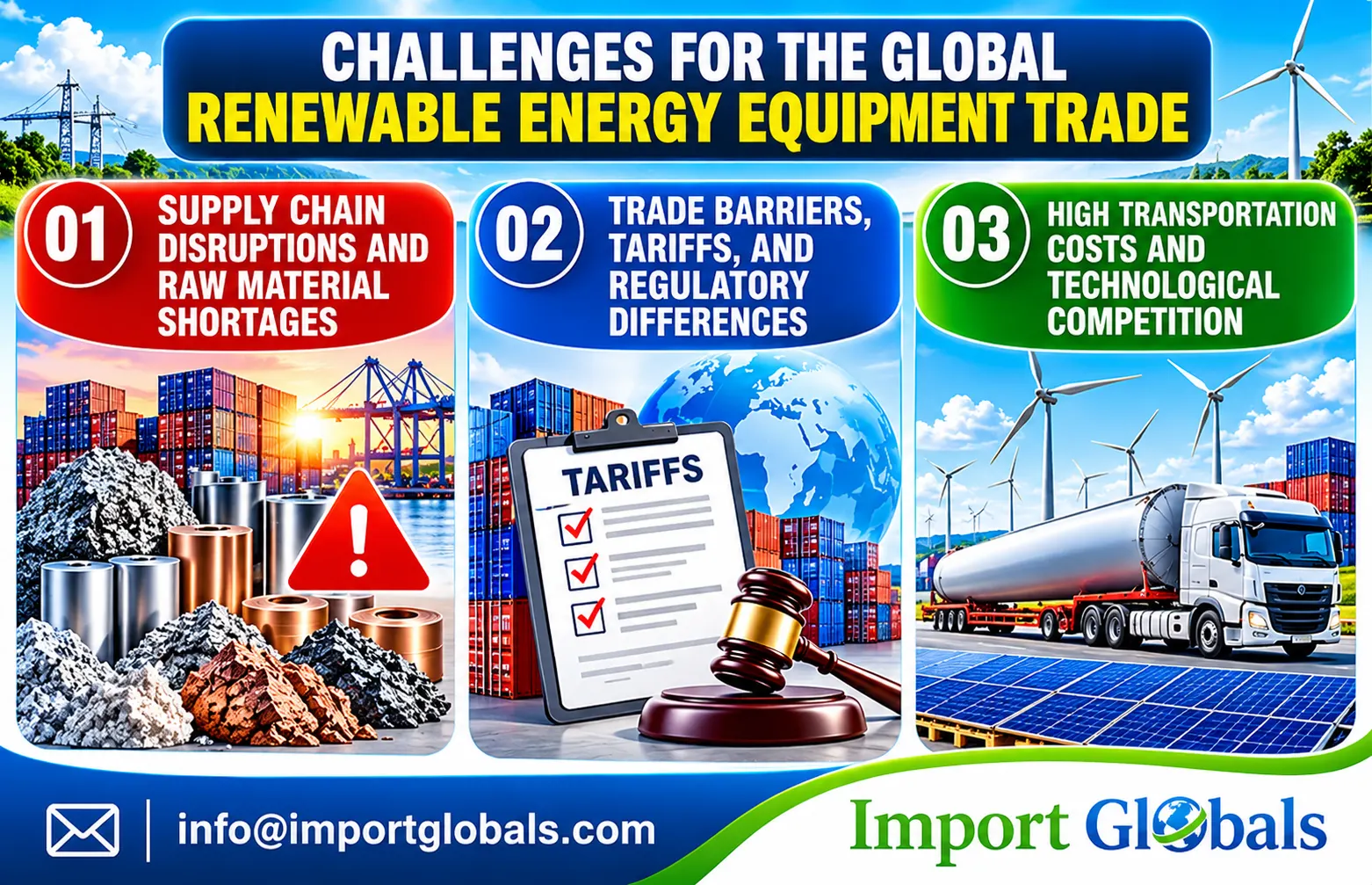
1. Supply Chain Disruptions and Raw Material Shortages
The use of significant metals and minerals such as lithium, copper, and rare earth elements helps to expose firms to supply chain risks. Shortages of materials, tensions in geopolitical relations, and transport difficulties lead to growth in production costs and delays in product delivery.
2. Trade Barriers, Tariffs, and Regulatory Differences
Taxation of imports, local content quotas, modification of trade policy, and standards of certification complicate trade of renewable energy devices. As a consequence, these complications lead to the increase in expenditure on compliance and non-competitiveness of firms in terms of market entry.
3. High Transportation Costs and Technological Competition
Transportation of large appliances such as windmills, solar panels, and battery systems can involve logistics costs. Also, fast development of technology, price competition, and varying infrastructure impede product delivery.
Future Trade Outlook for Global Renewable Energy Equipment
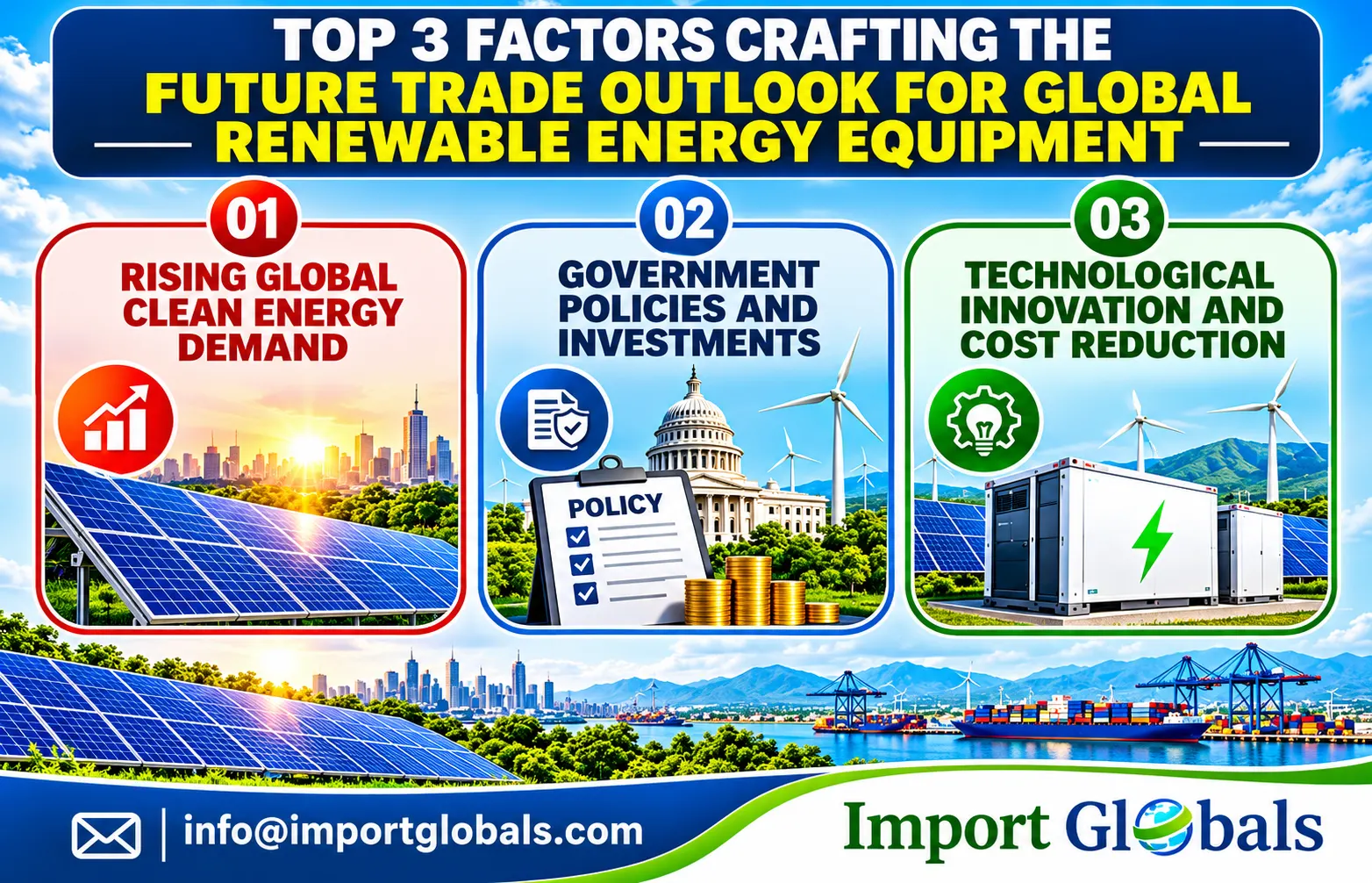
The future of the global renewable energy equipment trade is quite optimistic. The countries are going to invest more in the green energy generation along with technologies producing low emissions. The growth of solar and wind energy is on its way to assist the increasing global demand for solar panels. The Global Import Trade Data represents global energy equipment trade increased from 125 billion U.S. dollars to 690 billion U.S. dollars in 2025.
China is set to lead the supply of solar equipment, batteries, and various other clean energy technologies due to its developed production capacity. On the other hand, countries like Germany, the USA, Japan, and South Korea will continue to provide the market with state-of-the-art electrical equipment, batteries, power electronics, and wind power equipment. Moreover, the newly developed manufacturing centres in India, Vietnam, Malaysia, and Thailand are also likely to boost their positions in international trade.
Conclusion
By 2025, international trade in renewable energy equipment underwent a new phase of its development as the junk energy systems were introduced in many countries and gained momentum. The following types of equipment, including solar PV, lithium batteries, wind turbines, heat pumps, inverters, electrical transformers, and others, remained among the important types of equipment in the global renewable energy infrastructure. The growth of the industry from US$125 billion in 2016 to US$690 billion in 2025 signifies that the commercial importance of renewable energy technologies is increasing.
China was one of the world’s leading manufacturers and suppliers of renewable energy equipment, while Germany, the USA, Japan, South Korea, and other countries contributed to the development of the industry through technology development, equipment production, and selling renewable energy equipment abroad. Nevertheless, one can not underestimate the drawbacks arising from the supply chain disruptions, tariffs, raw material shortages, and costs related to logistics.
CTA
Looking for proper identification of international buyers and evaluation of competitors regarding renewable energy equipment trade, then you have come to the right platform here. Import Globals helps businesses research global trade flows with analysis of shipment-level reports and identification of trading partners. Subscribe to www.importglobals.com or drop an email at [email protected] for detailed classification of the renewable energy equipment trade of the nation to transform your international business growth.
FAQ’s
Que. What is the renewable energy equipment trade value in 2025?
Ans. The total renewable energy equipment trade valuation of 2025 is 811.24 billion U.S. dollars.
Que. Name the top company boosting the renewable energy equipment trade of 2025.
Ans. Jinko Solar is the top company boosting the renewable energy equipment trade of 2025.
Que. Name the top renewable energy equipment product traded globally.
Ans. Solar photovoltaic modules is the top renewable energy equipment products that are traded globally.
Que. What HS codes are important for renewable energy equipment?
Ans. HS 8541 and HS 8507 are the important HS codes for renewable energy equipment.
Que. Which is the top renewable energy equipment exporting region in 2025?
Ans. China is the top renewable energy equipment exporting region in 2025.
Que. Who is the top importer of renewable energy equipment?
Ans. United States and Germany are the top importers of renewable energy equipment.
Que. How does Global import-export data support business growth?
Ans. Global import-export data supports business growth via proper identification of buyers and suppliers, analysis of market demand, and development of effective market expansion strategies.
Que. What information is available in Global trade data?
Ans. Global trade data covers importer name, exporter name, shipment date, HS code, product details, quantity, pricing information, origin country, importing country, and port details.
Que. How frequently is the Global trade data updated?
Ans. Global trade data is updated on a monthly basis.
Que. Where can you obtain detailed information on Global trade data?
Ans. Visit www.importglobals.com or drop an email at [email protected] for detailed updates on Global trade data.
You Can Also Visit :-
