
The UK Steel Exports Performance of 2025: Trade Policies and Market Opportunities Promoting the Manufacturing Sector's Exports
- Jun 09, 2026
The UK Steel Exports Performance of 2025: Trade Policies and Market Opportunities Promoting the Manufacturing Sector's Exports
The United Kingdom has established its role as a leading contributor to the construction, automotive, defense, engineering, and infrastructure industries. The country is facing increasing competition from low-cost producers.
The UK Export Market Research Data reported the industrial output as a significant contributor to the export economy. UK Import Export Trade Data reported steel-related products as the factors generating billions of dollars in export revenue. The resilience of the manufacturing unit is quite different as it supports technological innovation and sustainable manufacturing practices.
The global infrastructure projects have been focusing on accelerating industrial production while renewing the opportunities despite ongoing geopolitical and economic challenges. The global steel market shipment level trade intelligence is considered increasingly valuable for the manufacturers and exporters trying to upgrade. The UK Statistical Data detailed information on Import Globals helps businesses identify active buyers with proper monitoring of competitor activities. The comprehensive UK steel trade helps businesses stay ahead while taking actionable trade insights backed up decisions with shipment-level analysis.
The Significance of the UK Steel Industry in 2025
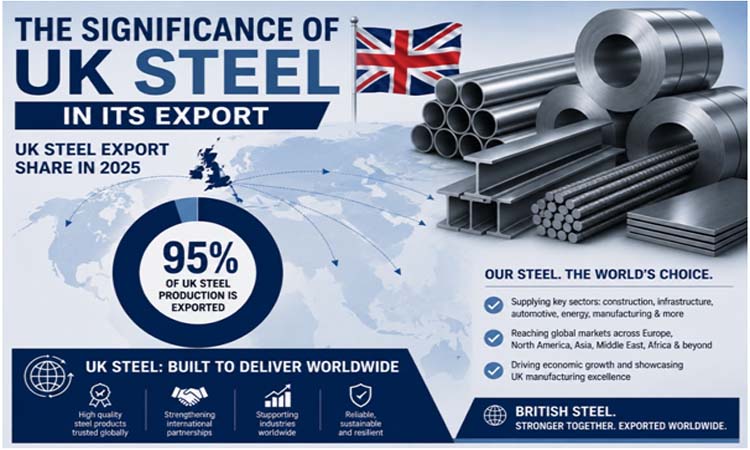
The steel products have been one of the most essential factors supporting the UK's export growth rate worldwide. The industry has been promoting its export ranking because of the manufacturing and infrastructure development. The steel industry contributes almost 1.26% of the export earnings because of the growing global demand rates and the increasing trade integrity with the nearby regions.
The supply chain industry level is maintaining compliance with the global demand standards for specific sectors like automotive manufacturing, construction and infrastructure projects, transportation systems, renewable and energy projects, aerospace manufacturing, shipbuilding, and marine engineering, along with oil and gas infrastructure. United Kingdom Export Statistical Data reported an increase in trade in recent years, as a result of the factors promoting infrastructure investment. The country has maintained its strong position as a top trader of specialized steel segments supporting premium quality product trade.
Why is the UK a Top Global Steel Exporter?
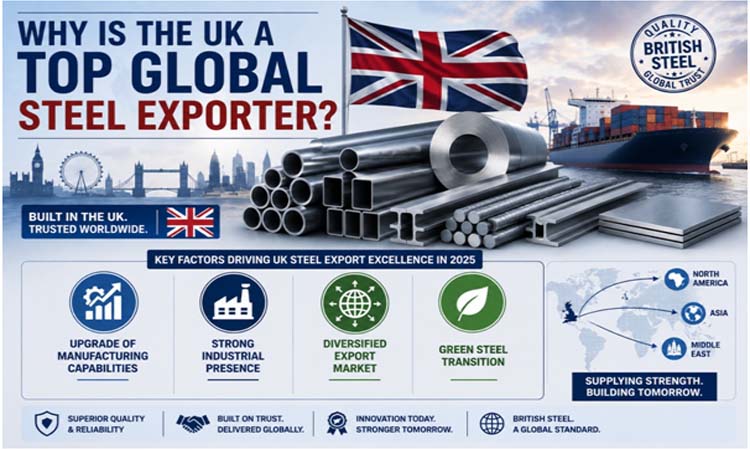
The United Kingdom Steel Export Shipment Data has positioned the country as one of the reliable suppliers of steel products on a worldwide scale. Despite the abundance of productivity rates in other sectors, the country has maintained its export integrity with the top trading regions. From the steel manufacturing units, while emphasizing the quality and upgrading the innovation and advanced engineering applications. The factors contributing to the country's manufacturing units' export excellence in 2025 are,
- Upgrade of the Manufacturing Capabilities - The British steel producers have maintained their continuity in investing and upgrading the technologies of their manufacturing units. The improvement in efficiency, product quality, and sustainability is a result of the increasing upgrades in the manufacturing sector. Specialized large production, advanced rolling mills, and precision finishing processes are the result of the manufacturing capabilities.
- Strong Industrial Presence - The excellence of the country in producing manufacturing essentials and the longstanding relationships with customers worldwide have maintained the thriving impression of the country as a reliable trader. Worldwide preference for British steel products is high at present because of the superior quality and reliability.
- Diversified Export Market - The broad range of international destinations has reduced the dependence on any single market for the marketing authorities. North America, the Middle East, and Asia have continued to offer growth opportunities.
- Green Steel Transition - The UK Export Data reported that the government's support for decarbonisation initiatives itself is maintaining the bilateral integrity. The transition is expected to improve the long-term competitiveness of the UK's steel exports.
What Information is Highlighted in the UK Steel Data of Import Globals?
The shipment-level trade intelligence of the UK Steel Export Data is categorized to cater to the visibility of the research analysts and business authorities towards international trade activities. The latest intelligence enables businesses and importers to take informed business decisions based on real market transactions.
The data set basically includes information regarding exporter name, importer name, product description, HS code classification, shipment quantity, unit price, trade value, origin country, destination country, port information, shipping date, buyer details, consignee information, transportation mode, and market trends. It allows businesses to properly identify opportunities while helping them evaluate competitors' activities to strengthen market positioning.
Top Exported Steel Products of the UK in 2025
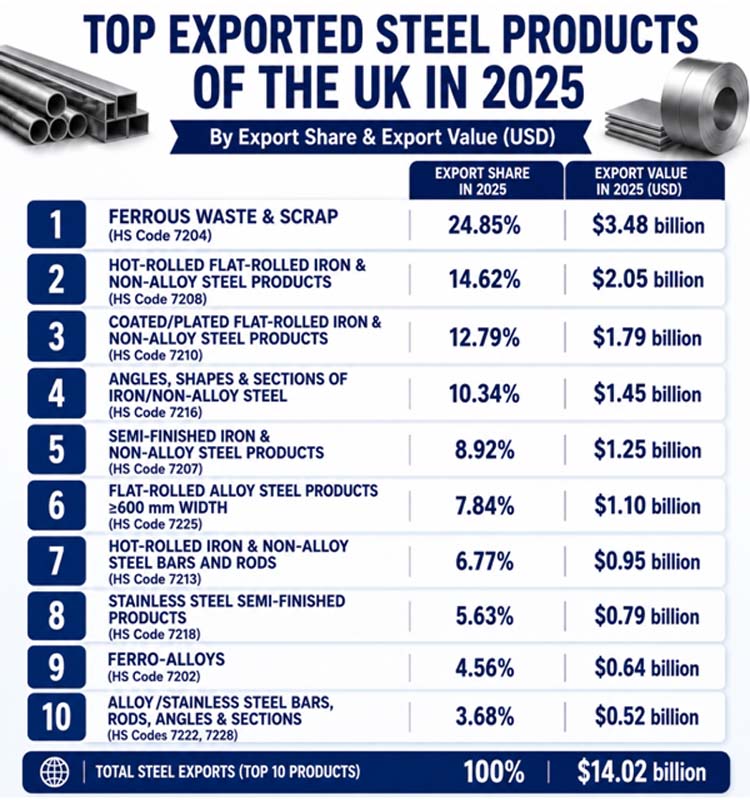
- Ferrous Waste & Scrap (HS Code 7204) 24.85% ($3.48 billion) - Ferrous-based scrap constitutes the largest segment of the steel exports of the United Kingdom. UK Steel Export Shipments Data reported the materials obtained from construction projects, demolition activities, and end-of-life industrial equipment as the top traded categories, mainly because of the growing emphasis of the global authorities on sustainability and circular economic practices.
- Hot-Rolled Flat-Rolled Iron & Non-Alloy Steel Products (HS Code 7208) 14.62% ($2.05 billion) - Hot-rolled, flat-rolled iron and non-alloy steel products also hold a significant position in the iron and steel export of the United Kingdom. The products manufactured through high-temperature rolling processes and the production efficiency are responsible for reducing the manufacturing costs. The strong engineering capabilities are directed towards the improvement of the quality standards.
- Coated/Plated Flat-Rolled Iron & Non-Alloy Steel Products (HS Code 7210) 12.79% ($1.79 billion) - Coated and flat-rolled steel products are utilized for household appliances, roofing systems, industrial equipment, and construction projects. The advanced coating technologies used in the manufacturing units have improved the product lifespan and resistance while increasing the global trade revenue.
- Angles, Shapes & Sections of Iron/Non-Alloy Steel (HS Code 7216) 10.34% ($1.45 billion) - Steel angles, shapes, and sections used in transportation projects and industrial facilities are in demand more. The international construction requirements and the infrastructure modernization are responsible for the proper upgrade of the industrial development across emerging and developed economies.
- Semi-Finished Iron & Non-Alloy Steel Products (HS Code 7207) 8.92% ($1.25 billion) - Semi-finished iron and non-alloy steel products. are traded at a valuation of 1.25 billion US dollars at present. The demand rate, influenced by the manufacturing growth and the industrial development worldwide, is responsible for establishing strong relationships with the specific product trade.
- Flat-Rolled Alloy Steel Products ≥600 mm Width (HS Code 7225) 7.84% ($1.10 billion) - Flat-rolled alloy steel products are manufactured in the United Kingdom's industrial sectors to enhance the strength and corrosion resistance of the iron and steel essentials traded from the country. The valuable trade from the export authorities is because of the reliability and performance of the manufacturing units in critical environments.
- Hot-Rolled Iron & Non-Alloy Steel Bars and Rods (HS Code 7213) 6.77% ($0.95 billion) - Hot-rolled iron and non-alloy steel bars account for 6.77% of the overall iron and steel export trade. The growing demand rate, backed up by the infrastructure development, residential construction, industrial expansion, and manufacturing activities, has maintained the quality assurance systems.
- Stainless Steel Semi-Finished Products (HS Code 7218) 5.63% ($0.79 billion) - Stainless steel ingots and semi-finished products are widely utilized in food processing, medical equipment, transportation, and energy industries. The export demand is backed up by the hygiene and resistance to corrosion, the advanced metallurgical expertise, and the production capabilities that operate in highly demanding industrial environments worldwide.
- Ferro-Alloys (HS Code 7202) 4.56% ($0.64 billion) - Ferroalloys account for 4.56% of the overall steel export trade share. Common varieties traded under these categories are Ferro-silicon, Ferro-manganese, and Ferro-chromium. The global steel production levels and the manufacturing growth have maintained the continuity in the overall demand rate.
- Alloy/Stainless Steel Bars, Rods, Angles & Sections (HS Codes 7222, 7228) 3.68% ($0.52 billion) - Alloy stainless steel bars, rods, angles, and sections are traded because of the growing demand rates from automotive component manufacturers, energy infrastructure, and industrial machinery traders. The support demand is mainly because of the technological advancements, industrial modernization, and the growing need for high-performance materials.
The Importance of the Shipment-level Trade Intelligence in UK Exports
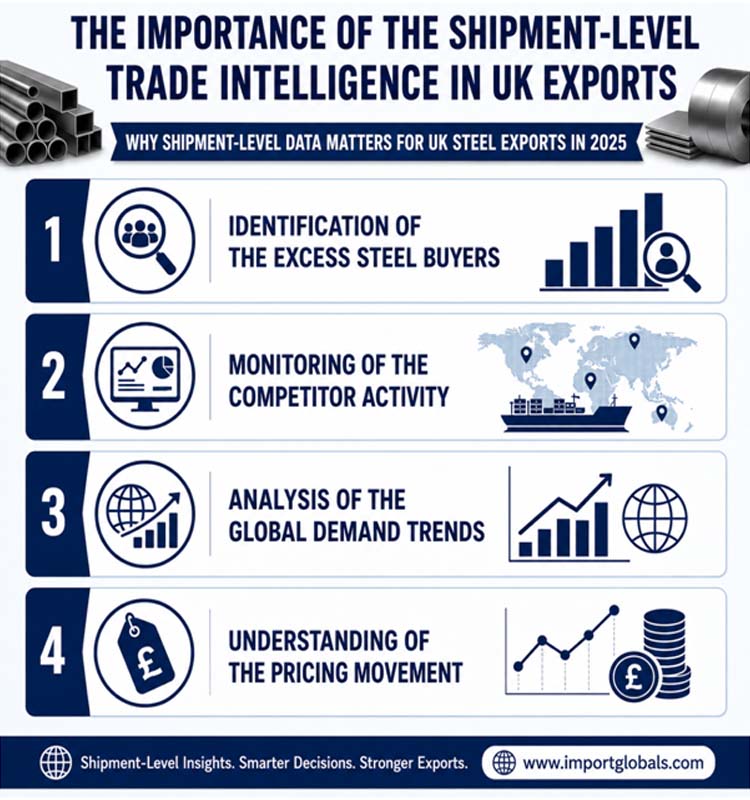
The steel market of the UK is getting highly competitive over time, mainly because of the rapid involvement of the top traders worldwide. The reliable access to the shipment-level intelligence via the UK Export Statistical Data of Import Globals helps businesses gain in-depth insights into the competitive steps taken by the authorities. As represented by the UK Export Trade Data, the topmost factors demonstrating the importance of the shipment-level trade intelligence regarding the steel exports of the United Kingdom in 2025 are,
1. Identification of the Excess Steel Buyers - The businesses with the latest insights highlighted are able to understand the buyer preferences while purchasing the volume to develop an effective sales strategy.
2. Monitoring of the Competitor Activity - The research analysts are even able to monitor the shipment record while gaining visibility into competitor exports. It even helps them analyse the pricing strategies with proper acknowledgement of the product portfolios.
3. Analysis of the Global Demand Trends - The trade intelligence highlighted helps the authorities and the businesses identify the steel products with export trade efforts towards the targeted categories.
4. Understanding of the Pricing Movement - Different pricing ranges are set up by the government authorities for attracting the global traders' attention. The steel prices are fluctuating depending on the raw material cost, energy prices, and economic conditions. The shipment-level data allows the authorities to track the real-world pricing trends.
How Does “UK Steel Export Data” of Import Globals Support Business Growth?
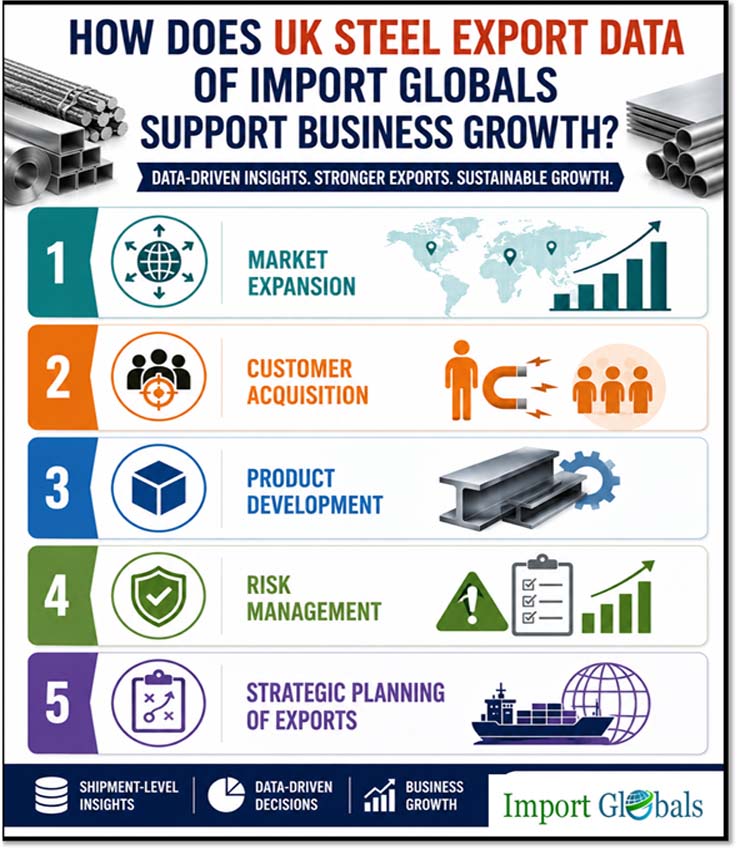
The UK Steel Export Data of Import Globals is considered a proper tool that has been promoting the market expansion of specific categories of trade, mainly because of the information highlighted regarding traders, distributors, and investors. Below are the factors that demonstrate how in-depth intelligence promotes business growth.
1. Market Expansion - Research analysts and the business authorities can identify the emerging export destinations. The steel product demand rates of different regions are highlighted, which helps businesses craft a strategic plan regarding the trade output.
2. Customer Acquisition - Information regarding importers and exporters are highlighted, which helps the research analysts set up a proper strategy for supporting the targeted sales.
3. Product Development - Understanding the demand rate as per the acquired categories helps businesses introduce the same type of products in their trade portfolio while maintaining the alliance with the consumer requirements.
4. Risk Management - The diversification of the export market is basically backed up by the understanding of the proper trade intelligence. The reduction in trade exposure to regional risk is reduced by navigating the trade complexities with the latest insights highlighted.
5. Strategic Planning of Exports - The shipment level insight is responsible for long-term investment and expansion decisions. It helps the authorities promote market decisions while understanding the top traded categories from different regions.
Export Destinations Crafting the UK Steel Trade of 2025
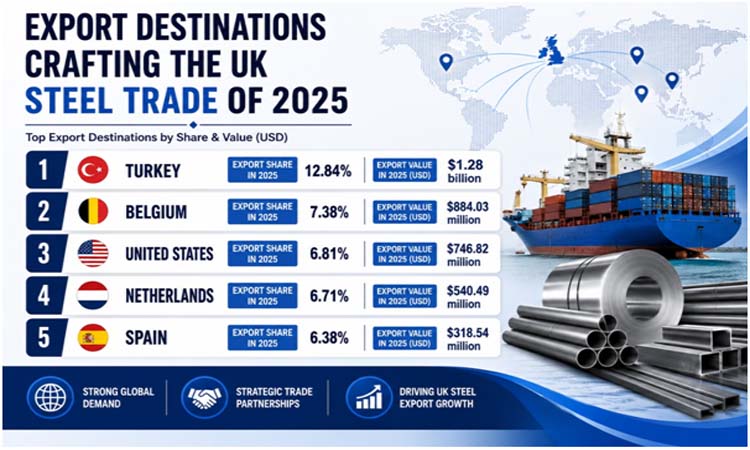
- Turkey - 12.84% ($1.28 billion) - As per Turkey Import Data; Turkey represents itself as one of the largest export partners for the United Kingdom's steel trade in 2025. The specific exchange of steel semi-finished products, alloy steel, and flat-rolled steel materials has maintained the integrity of both countries. The strong trade relationship is backed up by the efficient logistics networks and the establishment of commercial partnerships.
- Belgium - 7.38% ($884.03 million) - As per Belgium Import Data reports 7.38% of the overall iron and steel export trade share of the United Kingdom. The exported steel essentials from the UK to Belgium are used in industries like construction, engineering, automotive machinery, and manufacturing. The advanced port infrastructure is responsible for facilitating the redistribution of steel products to other European markets.
- United States - 6.81% ($746.82 million) - As per USA Import Data; United States plays a significant role in the aerospace, energy, defense, and construction industries in the export category of the United Kingdom. The materials imported are mainly utilized in advanced manufacturing applications, promoting the long-standing trade relationships.
- Netherlands - 6.71% ($540.49 million) - As per Netherlands Import Data; The Netherlands accounts for 6.71% of the UK's steel trade. Construction, manufacturing, engineering, transportation, and industrial equipment demand rates are promoting bilateral trade activities. The industrial development and the strategic importance will support the strong demand for UK steel exports.
- Spain - 6.38% ($318.54 million) - As per Spain Import Data Wrapping up the list of the topmost export partners, Spain stands in 5th place. Spain reports 6.38% of the total steel exports of the United Kingdom. The continuous investment in urban development, transportation networks, and renewable energy infrastructure has been promoting the proper establishment of commercial connections. The expanding industrial activities are responsible for creating valuable opportunities.
The Recent Policy Changes Impacting the UK Steel Trade
The export economy of the United Kingdom has come across a recent shift in its trade policies, impacting the influential steel trade of the nation. The developmental factors that have been impacting the overall steel export of the nation in 2025 are,
- Tariff Adjustments - The UK export market analysis reported the tariff adjustment as the main factor impacting the overall iron and steel trade. It has affected the competitiveness of the specific sector and the regulatory trade flows.
- Anti-Dumping Regulations - The strict anti-dumping measures implemented by different government authorities worldwide have imposed severe trade impacts on the iron and steel trade of the country. The specific regulations are imposed by the government authorities to protect the domestic industries from unfair competition.
- Carbon Border Adjustment Mechanisms - The environmental regulations and the carbon-related import requirements are responsible for influencing the export strategies. Due to the increasing importance of environmental regulations, the trade of iron and steel from the UK has become quite difficult.
- Supply Chain Compliance Requirements - Businesses in the United Kingdom steel trade are suggested to maintain compliance with the evolving documentation; in order to tackle the complexities imposed by government authorities worldwide toward maintaining proper market access.
Beneficial Factors to Resource From the UK Steel Export Data
1. Top steel-importing countries
2. Research analysts can even understand the fast-growing export markets' contribution
3. Product-specific shipment patterns
4. Average transaction prices
5. Identification of the emerging buyers' opportunities
6. Tracking of supplier concentration levels
Conclusion - The UK steel sector has been serving as a backbone for the entire export economy's growth. The ongoing challenges related to trade policies, energy costs, and global competition have been promoting supply chain disruptions. The British steel manufacturers have maintained their resilience in the global steel trade because of innovation, specialization, and market diversification.
The ongoing demand rate for infrastructure development, renewable energy projects, advanced machinery, trade, and sustainable industrial solutions has maintained the opportunistic sector's growth rate in different regions worldwide. The shipment-level trade intelligence caters to the proper understanding of the market dynamics. It even promotes the identification of effective buyers with capitalization of the emerging opportunities across different regions.
CTA
If you are looking for the latest updates on the United Kingdom steel export trade, then you have come to the right place. Import Globals here resolves all the complexities of the trade navigation strategies. Subscribe to www.importglobals.com for gaining a reliable access to the detailed shipment-level trade intelligence.Uncover the information with an enquiry on info@importglobals.com the buyer & supplier names, Product description, HS Codes, pricing trends, shipment volumes, port names, and destination markets are highlighted. Stay ahead of the global steel marketplace with Import Globals advanced UK statistical data and its trade solutions.
FAQ’S
Que. How does UK Steel Export Data help businesses grow internationally?
Ans. The UK Steel Export Data of Import Globals helps the business authorities gain visibility into the latest trade insights via acknowledgement of the supplier activity, pricing
trends, and market performance.
Que. How accurate is Import Globals “UK Steel Export Trade Data”?
Ans. Import Globals “UK Steel Export Trade Data“is efficient in delivering shipment details directly sourced from Customs trade providers.
Que. What is the export valuation of iron and steel products from the UK in 2025?
Ans. The United Kingdom traded iron and steel products worth 6.89 billion US dollars in 2025.
Que. How frequently is the United Kingdom’s iron and steel export data updated?
Ans. The United Kingdom’s iron and steel export data is updated as per country availability and reporting cycles.
Que. Which countries import iron and steel products from the United Kingdom the most?
Ans. Turkey, Belgium, and the United States import iron and steel products from the United Kingdom the most.
Que. Can I identify competitor suppliers of iron and steel through export records?
Ans. Yes, monthly shipment tracking helps in proper monitoring of iron and steel export demand and seasonal buying patterns.
Que. Which industries benefit from the UK’s iron and steel export trade intelligence?
Ans. Automotive industries, aerospace industries and defense industries benefit from the UK’s iron and steel export trade intelligence.
Que. Why choose Import Globals “UK Steel Export Data” over manual market research?
Ans. Import Globals trade data is beneficial because it provides measurable market activity regarding the specific shipments of iron and steel instead of assumptions.
Que. How does the UK iron and steel export trade intelligence of Import Globals reduce risks?
Ans. UK iron and steel export trade intelligence from Import Globals helps businesses properly evaluate supplier reliability, which reduces dependency on certain sourcing channels.
Que. Does Import Globals provide global trade coverage of the iron and steel export trade?
Ans. Yes, businesses can get reliable access to broad international trade insights with accurate trade updates from Import Globals.
