Japan Import Data

Japan Import Data

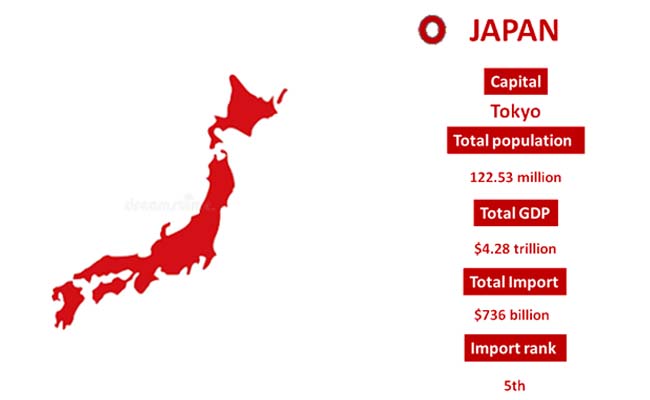
The third-biggest economy in the world, Japan, is a major importer of industrial machinery, electronics, and energy. Imports are essential to maintaining production and everyday consumption because of their sophisticated industrial foundation, high-tech manufacturing, and reliance on natural resources. The capital, Tokyo, serves as the main trade and financial center of Japan. As per Japan Import Data, with a population of over 125 million and a GDP of almost USD 4.4 trillion, Japan is expected to import almost USD 830 billion in 2024, highlighting its significant contribution to international commerce.

According to Japan Customs Data, Japan's main imports are concentrated on obtaining high-value technological inputs and key energy resources, which are essential for its globally competitive electronics sector and heavy industries.
5th

As per the reports of Japan import market research data, the country has solidified its position as the fifth-largest importer in the world, mainly due to the limited resources available for electricity generation.

3.4%

Japan Global Trade data has listed the estimated global import share of the country on a global scale at 3.42%, backed up by the huge purchases of mineral fuels and electronic components.

China

China dominates the import trade partners list of Japan, specifically due to the huge manufacturing capacity and the closer geographic proximity between the two regions.

Mineral Fuels

Mineral fuels are mostly imported in Japan because of the heavy reliance on foreign resources to sustain the industrial economy.


Top 10 Import Products of Japan

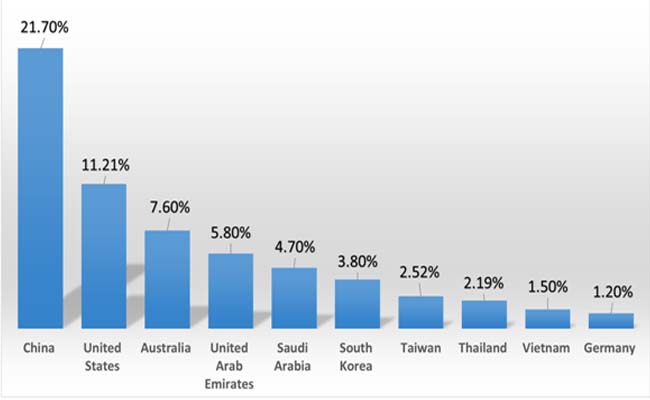
The import trade of Japan and the continuous trade upward trajectory are representative of the strong economic ties of the country with Asia, North America, and the Middle East. China, the United States, and Australia dominate the top import trade partners of the country. As listed by the Japan import data, the topmost import trade partners of the nation in 2025 are,

  • China — 21.7%, (US$ 178.2 BILLION)
  • United States — 11.21%, (US$89.6 BILLION)
  • Australia — 7.6%, (US$ 45.35 BILLION)
  • United Arab Emirates — 5.8%, (US$ 34.3 BILLION)
  • Saudi Arabia — 4.7%, (US$ 29.6 BILLION)
  • South Korea — 3.8%, (US$ 27.05 BILLION)
  • Taiwan — 2.52%, (US$ 24.66 BILLION)
  • Thailand — 2.19%, (US$22.47 BILLION)
  • Vietnam — 1.5%, (US$ 19.22 BILLION)
  • Germany — 1.2%, (US$ 18.03 BILLION)
Product Image
Product Image

Top 10 Import Trading Partners of Japan

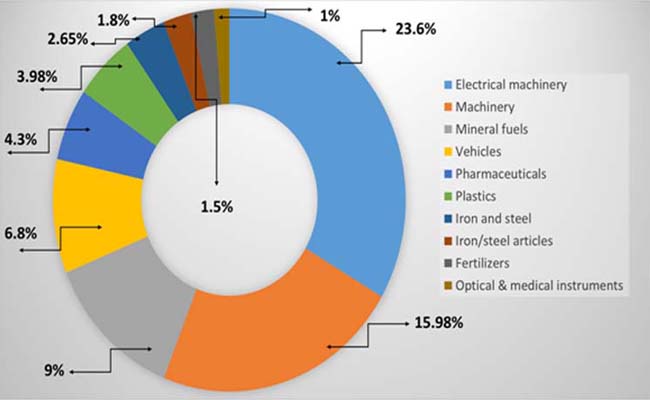
The proper diversification maintained in the import sources and the extensive growth in e-commerce imports have facilitated the overall revenue growth rate, as listed by the Japan Import Market Research Data. The strong currency management has also contributed to economic integrity. As per the Japan import data, the topmost variants of goods imported in the nation in 2025 are,

  • Electrical machinery (HS Code 85): 23.6% ($ 256 billion)
  • Machinery (HS Code 84): 15.98% ($ 148 billion)
  • Mineral fuels (HS Code 27): 9% ($ 109 billion)
  • Vehicles (HS Code 87): 6.8% ($ 56 billion)
  • Pharmaceuticals (HS Code 30): 4.3% ($ 49 billion)
  • Plastics (HS Code 39): 3.98% ($ 36 billion)
  • Iron and steel (HS Code 72): 2.65% ($ 28 billion)
  • Iron/steel articles (HS Code 73): 1.8% ($ 25 billion)
  • Fertilizers (HS Code 31): 1.5% ($ 18 billion)
  • Optical & medical instruments (HS Code 90): 1% ($ 16 billion)

What Details Contain In Japan Import Data?

Our services on Japan Import Data can be considered as one of the most valuable assets towards your trade expansion. All the information necessary for staying competitive, like the total amount of shipments, HS code, price ranges, trade partners, and currency rates, is highlighted in a reliable way. Users can directly access the set of details required within specific titles like “Japan Import Trade Data”. The data set highlights the proper growth rate of the research analysts as it helps them maintain their trade alliance as per the global trade regulations.

Irrespective of the type of business firm, if any user is facing difficulties in solving the complexities of global trade. They can simply refer to the trade assets like “Japan Customs Data”. Businesses can truly craft their market entry strategies with proper information on the trade outputs of the targeted country. The data sets highlighted are extracted from the active customs intelligence provider with their latest invoices and trade details.

  • Date 
  • HS Code
  • HS Code Description
  • Total Value in USD
  • FOB Value
  • Quantity
  • Weight
  • Way of Transport
  • Destination Country
  • Import Country
  • Port of Loading
  • Port of Unloading

Benefits of Japan Import data in your business

  • Helps you acknowledge the latest shipments of the targeted country.
  • Promotes your market entry strategies.
  • Keeps you updated with the latest data-driven insights.
  • Caters to the needs of your market expansion with exact shipment details.
  • Enhances your trade ranking with a strong trade database.

FIND OUT OTHER ASIA COUNTRIES IMPORT EXPORT DATA

Ask for Japan Import Sample Data and Demo

Whatsapp
TOP