
Indonesia Automotive Import and Export Trade: The Market Opportunities and Trade Statistics of 2025
- Sep 22, 2026
Indonesia Automotive Import and Export Trade: The Market Opportunities and Trade Statistics of 2025
The automotive industry is one of the top contributor of the Indonesia's overall trade in 2025. The exports of comprehensive merchandise accounted for approximately US$282.91 billion while imports amounted to US$241.86 billion, thereby constituting a trade surplus of about US$41.05 billion, reported Indonesia Shipments Data.
In this broad trade context, Indonesia Trade Data says that the automotive products that include passenger vehicles, trucks, motorcycles, automotive parts, and equipment continued to be sold through various regional and global supply chains. Additionally, the country experienced an increase in CBU exports from 472,000 to 518,000, and data collected by Indonesia Import Data indicates that the number of CBU exports increased in 2025 compared to 2024. Besides vehicles, automotive products are part of the demand for machinery, transportation, and manufactured goods in terms of imports. BPS states that, for example, China imported machinery, including vehicles, among others.
Significance of Automotive in Indonesia’s Economy in 2025
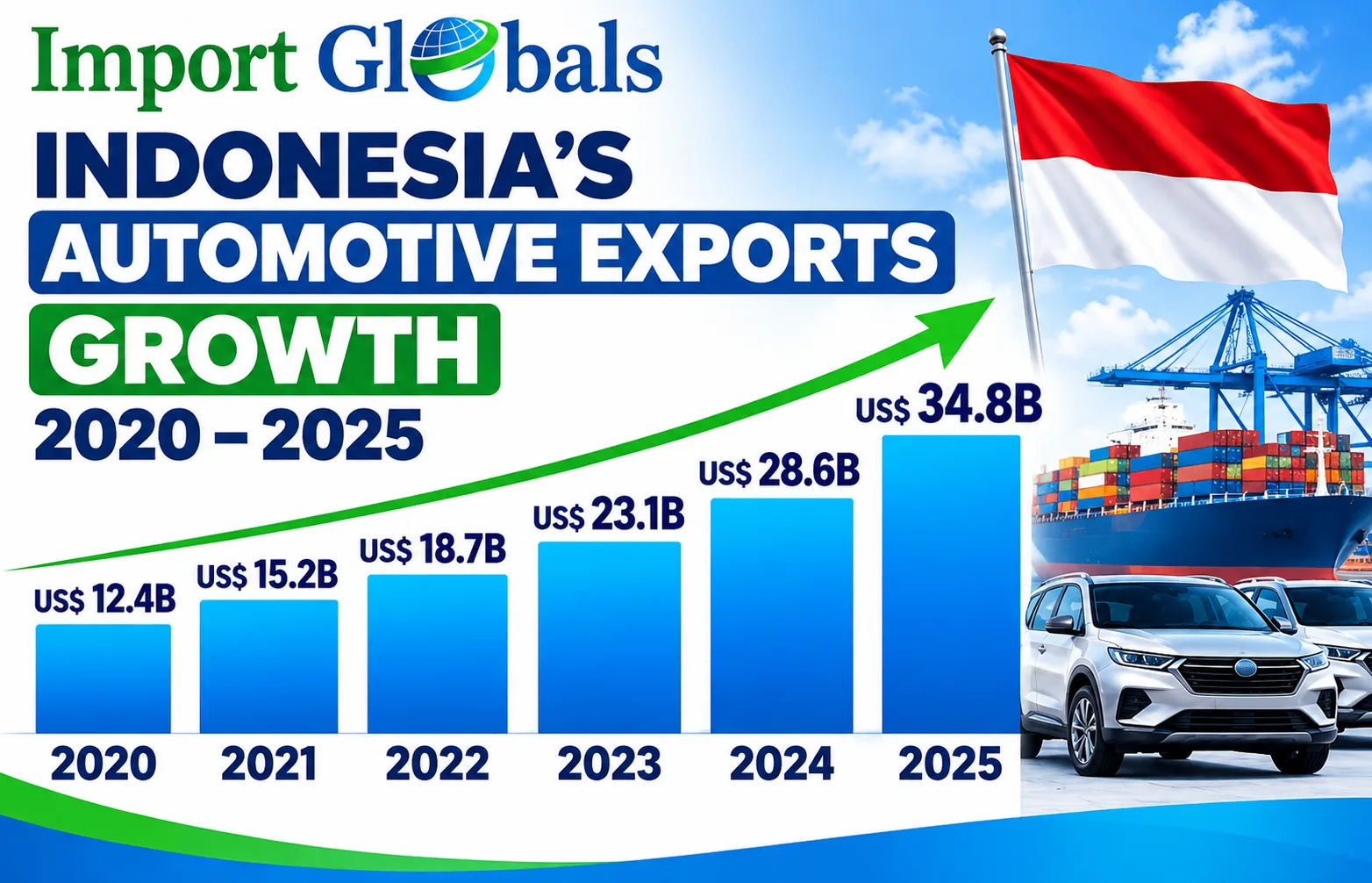
The Indonesian automobile industry remained a vital segment of the country’s manufacturing base during the year 2025. It made an important contribution to industrial output, investments, employment, domestic demand, and international trade. The economy of Indonesia Customs Data experienced a growth of 5% in the first half of 2025. The manufacturing and net export sectors contributed significantly to this economic growth. The automotive industry consists of more than vehicle assembly; it also includes raw materials and additional services such as manufacturing of parts and components, rubber and plastics, electronics, and logistics.
Due to its favourable geographical position, Indonesia has developed into a production and export hub of automobiles in the Southeast Asian market. The automobile makers in Indonesia serve both local and international consumers, which further increases Indonesia’s engagement in regional supply chains. The automobile sector can be regarded as an important factor in the economic development of Indonesia not only because of automobile sales but due to its significant contribution to other manufacturing sectors, reported Indonesia Export Data. The Indonesian automobile import/export statistics give important information about the volume and values of car exports, trade in commercial vehicles, motorcycles, and automotive components.
Top 5 Automotive Product Types Imported by Indonesia in 2025
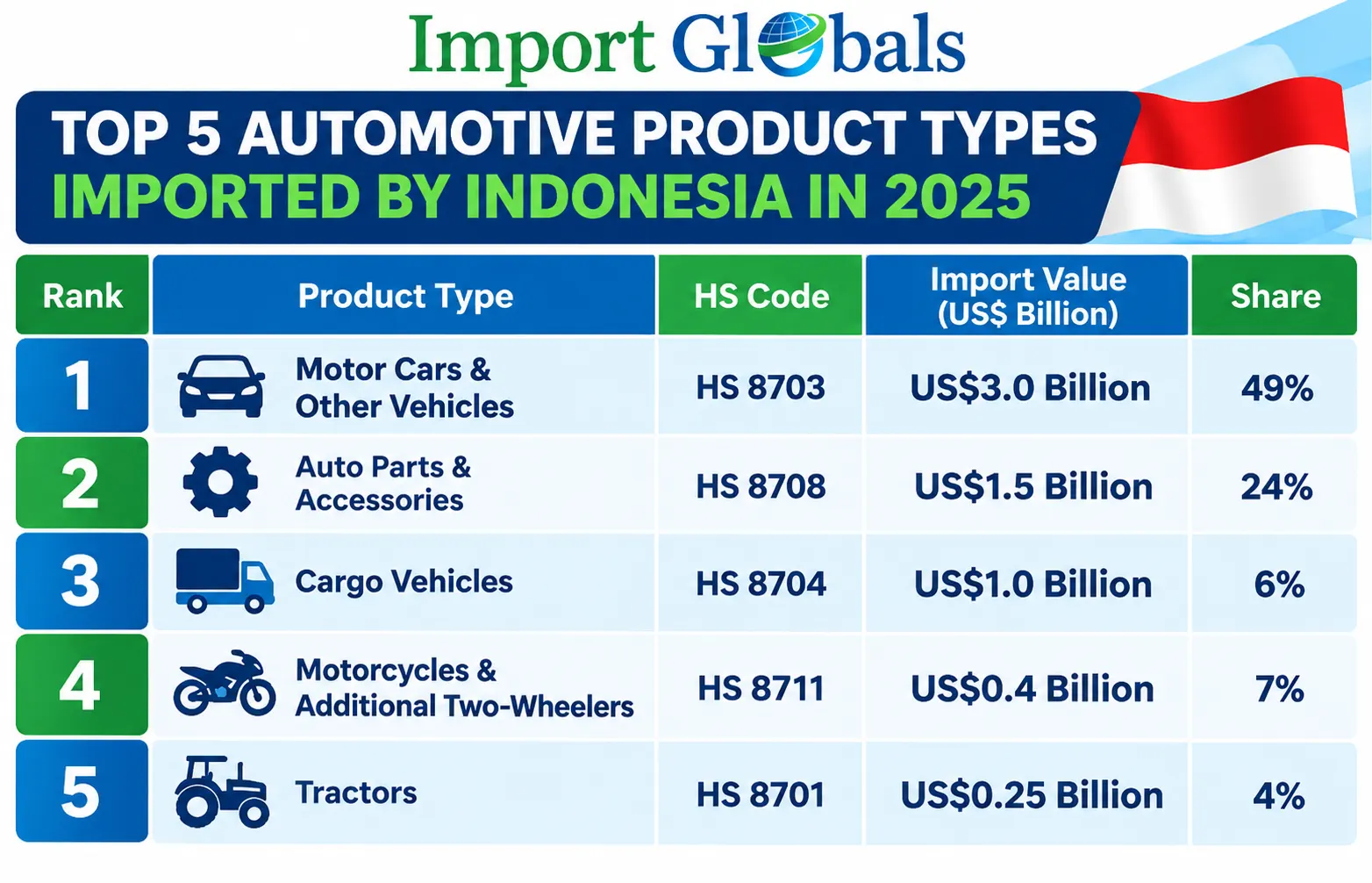
Motor Cars & Other Vehicles (HS 8703) — Import Value: US$3.0 Billion | Share: 49%
There was a large share of passenger cars and other vehicles designed for the transportation of passengers in Indonesia’s automotive imports in 2025. Both traditional passenger cars and hybrid and electric vehicles were included in this category under the code HS 8703, reported Indonesia Import Data.
Auto Parts & Accessories (HS 8708) — Import Value: US$1.5 Billion | Share: 24%
Mechanical parts such as the transmission, body parts, brake systems, axles, and other parts created another strong segment of automotive imports in Indonesia.
Cargo Vehicles (HS 8704) — Import Value: US$1.0 Billion | Share: 6%
The third segment of imports was trucks, pickups, and other vehicles designed for cargo transportation says Indonesia Statistical Data, which were strongly driven by the demand from industries such as logistics, construction, and commercial transportation.
Motorcycles & Additional Motor-Powered Two-Wheelers (HS 8711) — Import Value: US$0.4 Billion | Share: 7%
The fourth segment, motorcycles and other two-wheeled vehicles, also played an important role. Indonesia’s large market of two-wheeled vehicles creates a demand for both completely built units and special designs.
Tractors (HS 8701) Import Value: US$0.25 billion | Share: 4%
Tractors are a massive contributor to Indonesia's overall trade portfolio. It accounts for 4% of the overall revenue share. The increasing consumer demand rates have been mainly progressive because of the industrial requirements.
Top Exported Automotives of Indonesia in 2025
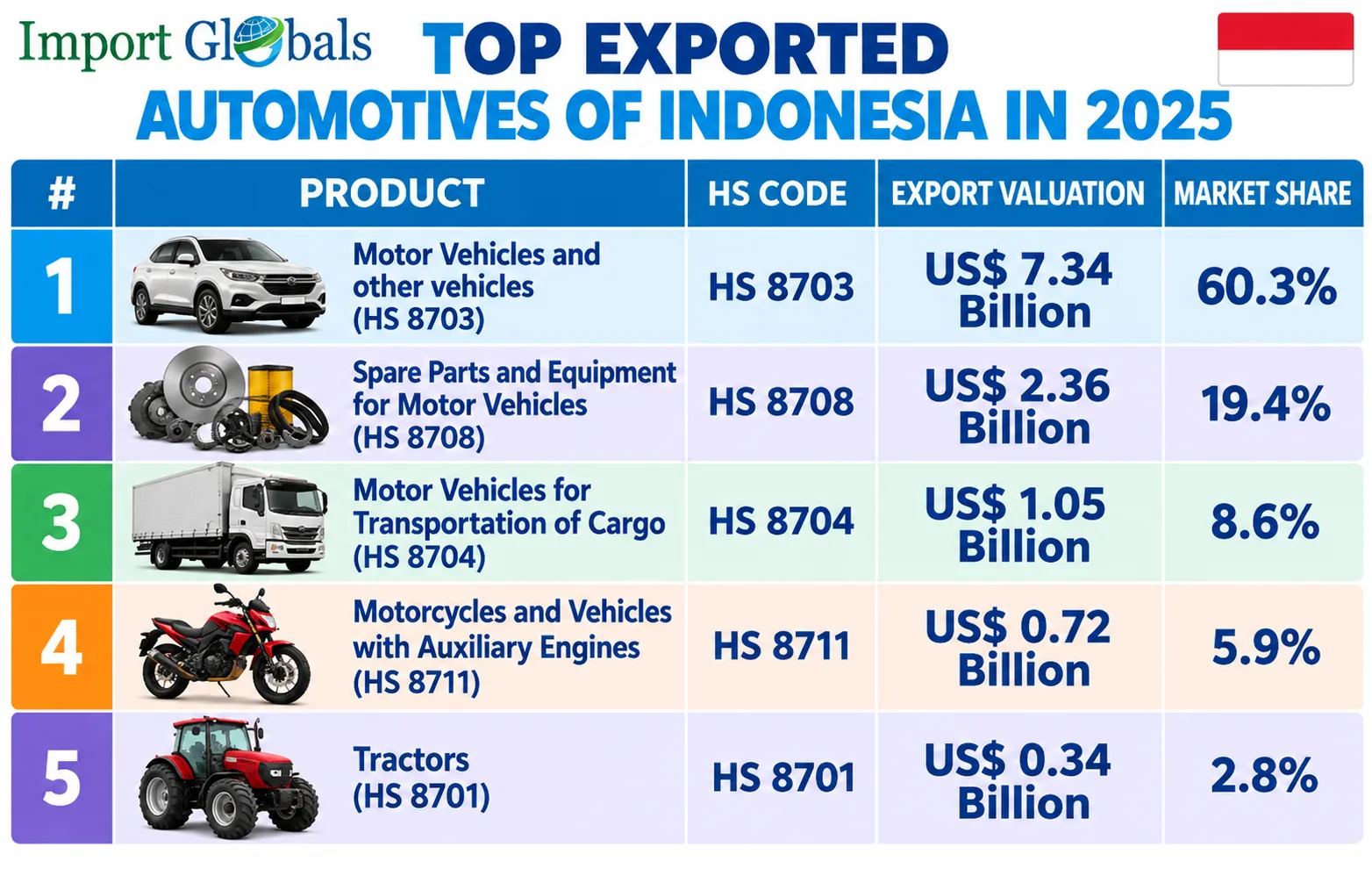
1. Motor Vehicles and other vehicles (HS 8703)- Export Valuation: US$ 7.34 Billion, Market Share: 60.3%
Motor Vehicles and other passenger vehicles account for the largest automotive export segment in Indonesia in 2025, reported Indonesia Export Trade Data. The category mainly encompasses typical passenger vehicles and advanced vehicle technologies.
2. Spare Parts and Equipment for Motor Vehicles (HS 8708)- Export Valuation: US$ 2.36 Billion, Market Share: 19.4%
Indonesia exports various car components such as chassis, braking systems, transmission equipment, axles, wheels, and other components. Strong automotive manufacturing attracts international demand for Indonesian components and strengthens Indonesia's position in different regional and global automotive supply chains.
3. Motor Vehicles for Transportation of Cargo (HS 8704)- Export Valuation: US$ 1.05 Billion, Market Share: 8.6%
Motor vehicles are one of a significant variant of the country's top exportedcategories. Indonesia Export Statistics reported the ongoing demand rate of the global consumer phase as the massive factor supporting the overall trade. The accountability of the specific product is 8.6% of the total exports.
4. Motorcycles and Vehicles with Auxiliary Engines (HS 8711) – Exports Worth: US$0.72 Billion | Market Share: 5.9%
Motorcycles and other forms of powered two-wheeled vehicles play a crucial role in the automotive exports of Indonesia. It has a sizeable two-wheeler manufacturing industry fuelled by the setup of suppliers and manufacturing units, says Indonesia Shipment Trade Data. The motorcycles manufactured in Indonesia are exported to different regions like Asia and Africa.
5. Tractors (HS 8701) – Exports Worth: US$0.34 Billion | Market Share: 2.8%
Tractors and tractor-like vehicles help boost Indonesia’s automotive exports through their sales in the industrial sector, agriculture sector, and commercial sector. These vehicles promote the use of mechanized farming practices.
