
Kenya's Tea Exports on the Global Market in 2025

- Sep 19, 2026
Kenya's Tea Exports on the Global Market in 2025
Kenya's tea exports ranked among the top in the world thanks to the country's ability to produce a high quantity of premium-quality black tea. The country has developed enough processing capabilities for its teas and established export logistics through Mombasa, reported Kenya Trade Data. The vast network of Kenyan tea buyers also contributed significantly to making this feat possible.
The data from the Tea Board of Kenya shows that the country's amount of tea exported in 2025 is about 652.8 million kilograms, as compared to 594.5 million kilograms in the year 2024, showing an increase in volume by approximately 9.8%. Kenyan tea exports grew to reach KSh 186.91 billion in 2025, representing also about US dollars 1.44 billion from the given average Kenya Shipments Data.
In addition to geographical expansion, the sector has made strides in geographical product outreach. In 2025 alone, Kenyan tea was shipped to a total of 100 destinations compared to 96 in 2024. Pakistan continued to lead in terms of the biggest destination, while Egypt, the United Kingdom, the UAE and Russia remained crucial commercial hubs. Newcomers, including Kazakhstan and Oman, have also opened fresh avenues for exporting tea from Kenya, says Kenya Customs Data.
Kenya's Significance in the Global Tea Market
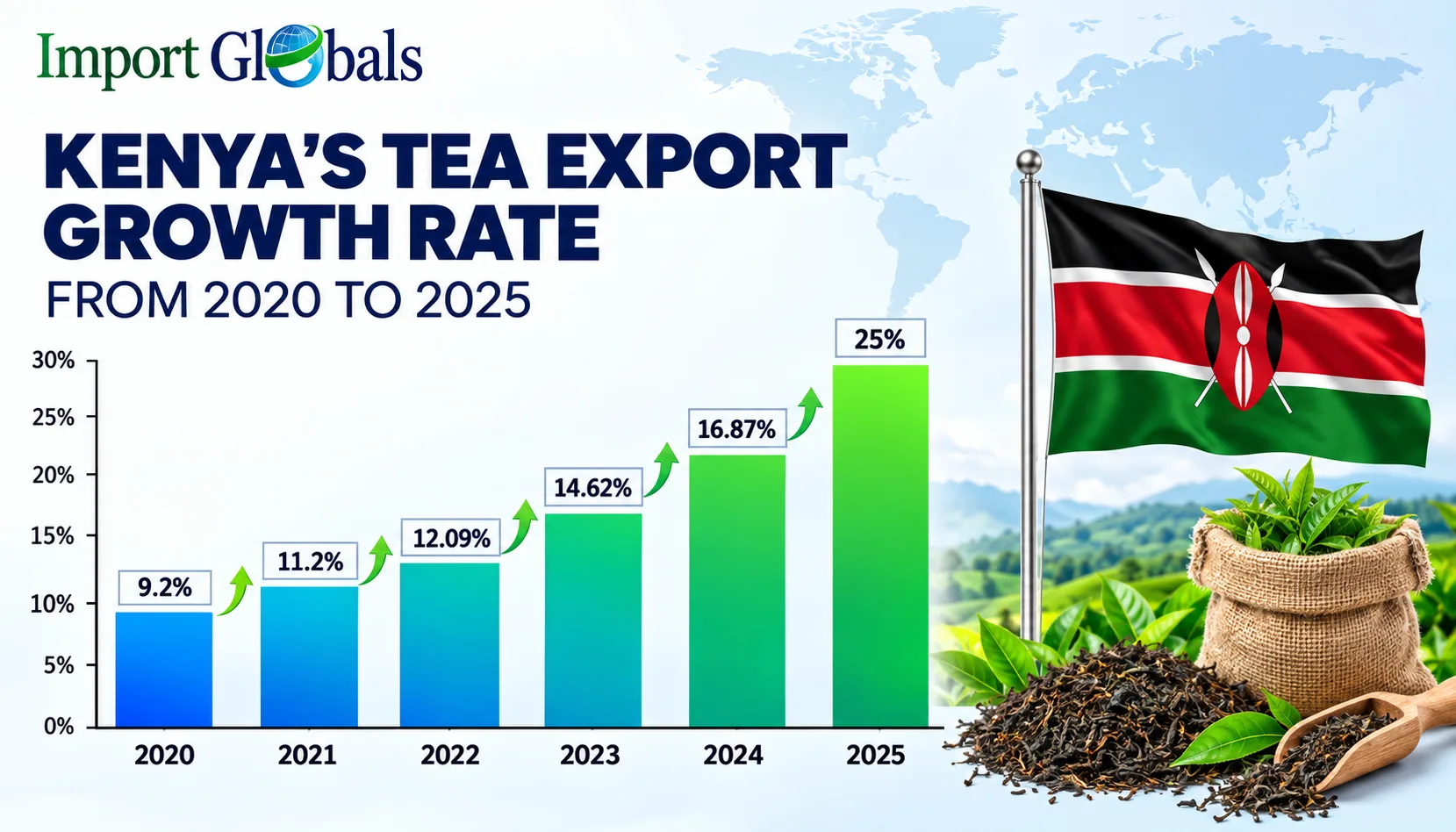
Kenya has established itself in the international tea industry through its ideal highland growing environment, its strong support for its smallholder farms, its well-established tea factories, and an effective export-oriented supply chain. Tea is grown at high altitudes at 1,500-2,300 metres above sea level, with the major growing counties being Nandi, Kericho, Bomet, Kisii, Nyamira, Narok, Nakuru, Kiambu, Murang'a, Nyeri and other areas.
The agricultural sector has very strong connections with smallholder farmers. According to the Kenya Customs Trade Data of industry assessment, the tea sector had more than 680,000 smallholder farmers in the year 2025, while the Tea Board's performance reports for 2025 confirm that hundreds of thousands of growers contributed to the sector.
Kenya's competitiveness away from home is achieved mainly in black tea. The country relies mainly on the export of both bulk and processed forms of black tea since foreign buyers are able to use its tea for their blends and products in all parts of Asia, the Middle East, Africa, and Europe.
Kenya's Top 5 Exported Tea Types in the Year 2025
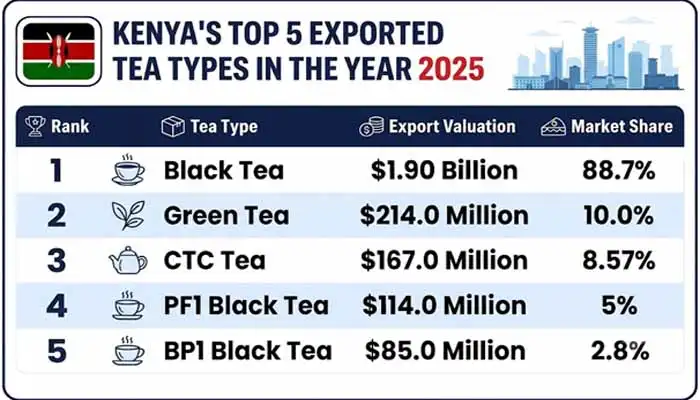
1. Black Tea (HS Code 090240) - $1.90 Billion, 88.7% Market Share
Black tea established itself as the leading tea type exported from Kenya in terms of shipment volume. The statistical records reveal that Kenya exported tea worth almost $1.896 billion during this year. The main destination countries were Pakistan, the UK, and Afghanistan. The Kenyan black tea exports mostly contained CTC varieties like PF1, BP1, PD, and Dust types, says Kenya Statistical Data.
2. Green Tea (HS Code 090220) - $214.0 Million, 10.0% Market Share
Green tea is another noted tea type exported by Kenya in 2025. Various source records provide us with the statistics of tea worth almost $214 million in shipments during the year. The main buyer countries reported are Pakistan, the UK, and Japan.
3. CTC Tea (HS Code 090240) - $167.0 Million, 8.57% Market Share
CTC tea has been recognized as one of the main forms of Kenyan export within the class of black tea. The records of shipments indicate that Kenyan CTC black tea is being sold to countries like Pakistan, UAE, China, Hong Kong, and Ireland in the year 2025. Since CTC is categorized in the black tea HS category, the valuation and share in the market should not be disclosed separately.
4. PF1 Black Tea - $114.0 Million, 5% Market Share
PF1 was recorded among the most popular Kenyan grades of black tea in the 2025 shipments, especially when it comes to exporting to Pakistan. The records of separate shipments show that PF1 has been shipped from many different Kenyan tea plantations, which is an indicator of the growing popularity of the grade.
5. BP1 Black Tea - $85.0 Million, 2.8% Market Share
BP1 is yet another major Kenyan black tea category exported that was recorded in the year 2025. Kenya Trade Data says that Some records confirm the exportation of BP1 to the international market, such as Pakistan. Just as PF1, BP1 is classified within the overall Kenyan black tea trade and thus will not be treated as a separate annual HS code category whereby separate monetization or percentage prices could cause double counting.
Top Export Partners of Kenya for Tea Exports
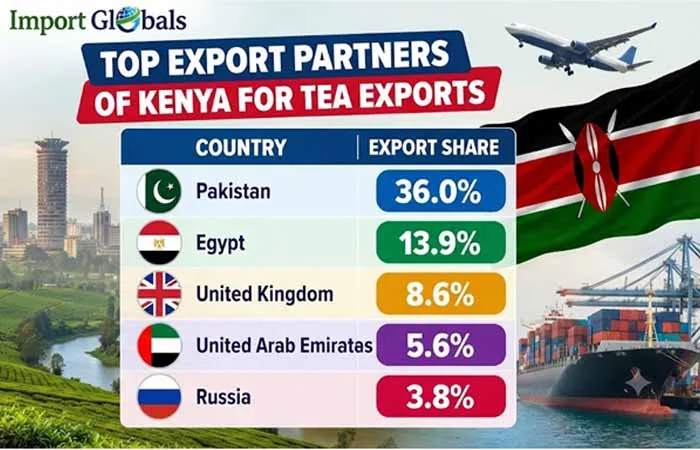
Pakistan – 36.0% Market Share
Kenya's leading tea export market in 2025 was Pakistan, which comprised nearly 36% of total Kenyan tea exports. Strong domestic tea consumption and demand for Kenyan black tea continued to drive this market.
Egypt – 13.9% Market Share
Egypt stood as Kenya's second-largest tea export market, comprising almost 13.9% of the total export volume, reported Kenya Shipment Statistics. Its established blends and imported tea industry make it a significant market for Kenyan black tea.
United Kingdom – 8.6% Market Share
The United Kingdom represented almost 8.6% of Kenyan tea exports in 2025. The presence of an established tea processing, blending, packaging, and distribution sector keeps Kenyan tea in demand.
United Arab Emirates – 5.6% Market Share
The United Arab Emirates was one of Kenya's top tea export markets in 2025. It is significant not only for domestic consumption but also as a trading and distribution centre facilitating the trade of Kenyan tea to buyers in the Middle East and other global markets.
Russia – 3.8% Market Share
In 2025, Russia continued to be one of the major tea markets for Kenya, reported Kenya Statistical Shipments Data. The country's tea exporters have a long history of presence in the Russian market, making it a significant market alongside Pakistan, Egypt, the UK, and the UAE.
Top 3 Companies That Promote the Export of Kenya Tea

1. Kenya Tea Development Agency (KTDA)
Kenya Tea Development Agency (KTDA) is one of the largest organizations in Kenya's tea industry representing over 600,000 smallholders and is responsible for more than 60% of tea produced in Kenya. KTDA coordinates smallholder tea produced in Kenya with international buyers through its wide network of factories, marketing, warehousing, and export activities. Kenya Trade Statistics reported that its engagement reduces the costs of production as well as allows value addition and global promotion of Kenya tea.
2. Browns Plantations Kenya
Browns Plantations Kenya, previously known to be connected with James Finlay Kenya's tea estates, is a key tea producer and supplier of Kenyan tea. The company has known tea estates in the tea-growing areas, such as Kericho and Bomet, with a focus on producing good quality tea for the international market. The purchase of James Finlay Kenya's assets allowed the company to have a more active role in the Kenyan tea industry, says Kenya Import Data.
3. Kenya Tea Packers Ltd. (KETEPA)
Kenya Tea Packers Limited, also known as KETEPA, is a key player in the field of tea packaging and marketing, primarily in connection with the tea industry of Kenya. The company contributes to the promotion of Kenyan tea by means of blending, packing, and distribution of tea to local and international markets. KETEPA, being a member of the KTDA family of companies, has extended its product range beyond the common tea, which leads to the development of value-added tea products from Kenya and greater presence of the country’s industry on the international market.
Top 3 Factors Influencing Trade of Kenyan Tea by 2025
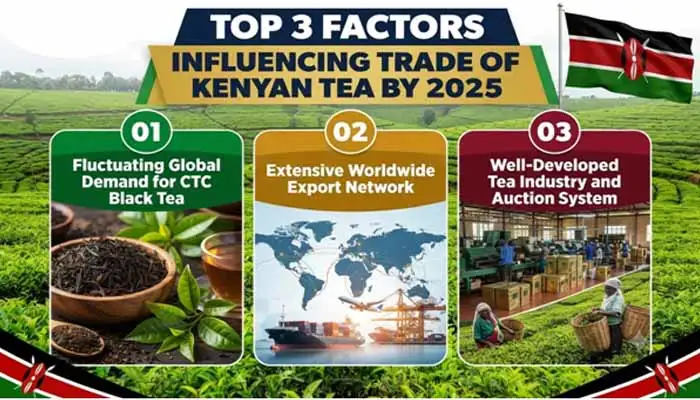
1. Fluctuating Global Demand for CTC Black Tea from Kenya
Kenya’s reputation for the quality of black CTC tea is important for its exports in 2025. Due to the colour, briskness, and flavour, Kenyan tea is in great demand by international blending companies. An established reputation supported the demand in Pakistan, the UK, Egypt, the UAE, and elsewhere.
2. Extensive India-Wide Export Network
Kenya continued to expand its presence on the global tea market in 2025, exporting tea to around 100 destinations around the globe. Established demand in developed markets, along with new opportunities, allowed the exporters to diversify the customer base. A wide range of destinations reduced the dependence on a single market, which allowed the growth of the export volume, says Kenya Import Customs Data.
3. Well-Developed Tea Industry, Auction and Export System
Kenya enjoys a well-developed tea value chain, which involves the farmers, tea processing factories, exporters and the Mombasa auction, which is one of the world’s biggest tea trading platforms. Other organizations, such as KTDA, also assist the smallholders in processing and marketing, creating higher availability of Kenyan tea on the international market.
Challenges Affecting Kenya’s Tea Trade of 2025
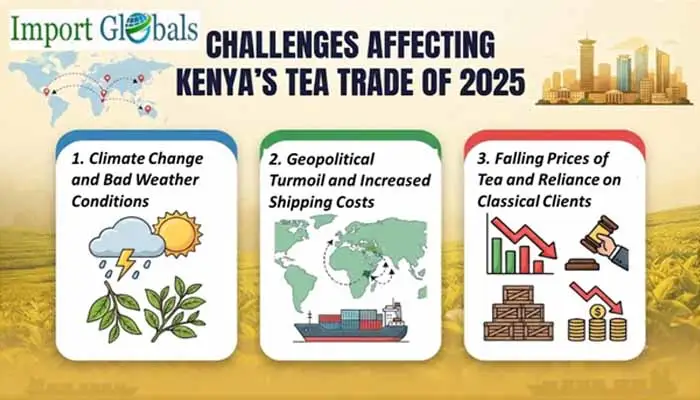
1. Climate Change and Bad Weather Conditions
In 2025, Kenya's tea production was negatively impacted by bad weather conditions, leading to a reduction in available green tea leaves for processing. According to Kenya Export Data projections, processed tea production will drop by approximately 5.8% owing to reduced supply of raw materials. Expected alterations in rainfall patterns, droughts, and temperature variations will create crucial threats to tea yields and quality.
2. Geopolitical Turmoil and Increased Shipping Costs
During 2025, the ongoing war between Russia and Ukraine, attacks in the Red Sea, and instability in Sudan have caused interruptions in tea trade and logistics. Disruptions in shipping led to an increase in transportation prices and created uncertainty among exporters offering their goods in Europe, Middle Eastern countries, and other neighbouring areas. All these factors will negatively affect exporters’ profits and lead to worse market positions of Kenyan tea as compared to more price-sensitive competitors.
3. Falling Prices of Tea and Reliance on Classical Clients
Kenyan tea exporters undergo challenges stemming from international price variations and reliance on very few buyers. Although total tea export volumes remain high, lower auction prices reduce the income of farmers and exporters. Therefore, it is necessary to create value-added products out of tea and build new international markets to enhance the resilience of the industry in the long run.
The Future Trade Outlook of Kenya’s Tea Export
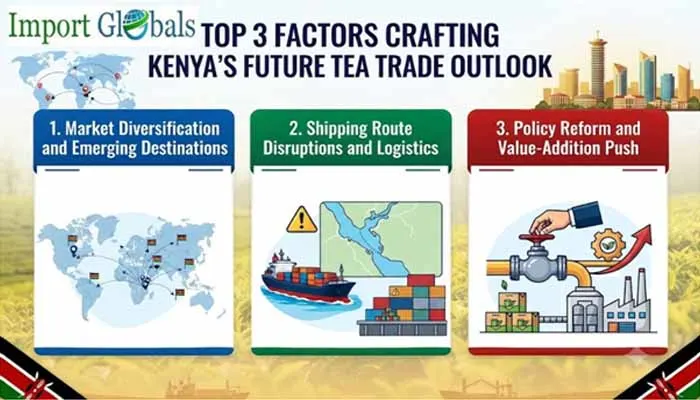
Kenya’s tea trade in the future will be backed up by strong international demand, the establishment of the export network, and the country’s reputation for quality black tea. The industry will reach a valuation of 100 international markets and a supply rate in 2025, creating a broad foundation for export opportunities. The future of tea exports will be dependent upon increasing value addition, market diversification, and product innovation. The reliance predominantly on bulk tea exports has limited Kenyan producers' ability to increase export earnings by developing branded packaged, specialty, green, purple, and other premium tea products.
The need of the consumer base regarding greater value addition has represented an important long-term priority for the sector. Kenya Shipments Data listed market diversification as the main factor that will remain important for overall trade growth. Pakistan, Egypt, the United Kingdom, the UAE, and Russia are represented in the Kenya trade statistics for the establishment of destinations with new markets across the Middle East. Climate resilience will also maintain its role as a major factor disrupting the trade flow. The Kenyan exporters are on the way to focusing more strongly on traceability, sustainability and premium positioning.
Conclusion
The Kenyan tea industry will be an important contributor to the country’s international trade, supported by strong global demand, trade, and the extensive network of export destinations. Value addition, premium product development, and market diversification will centralize the future tea competitiveness. Expansion of the nation into new international markets provides the exporters with additional opportunities while reducing the reliance on traditional destinations. International buyers, distributors, exporters, and investors are monitoring the Kenya Export Trade Data to provide a clearer understanding of the changing demand rate, buyer activity, and supply networks.
CTA
Trying to expand your business regarding Kenya’s tea trade on a global scale? You have come to the right platform here. Import Globals helps the authorities with detailed Kenya Import Data to help them understand national trade activities. Businesses can use the latest trade intelligence to identify potential tea buyers and suppliers, along with analysis of competitor activities for tracking shipment volume. Subscribe to www.importglobals.com or drop an email at info@importglobals.com for detailed updates on Kenya Trade Data to craft your international business growth.
FAQs
Que. Name the major markets for Kenyan tea.
Ans. Pakistan, Egypt, and the United Kingdom are some of the major markets supported for Kenyan trade.
Que. Why is value addition considered important for the Kenya tea industry?
Ans. Value addition is considered important for the Kenyan tea industry because it provides information regarding specialty and premium teas, creating opportunities for higher export revenues.
Que. How can Kenya diversify the tea export markets?
Ans. Kenya can diversify the tea export markets by exploring the Middle East, Central Asia, Europe, and Asia, with the strengthening of its existing relationships.
Que. Name the top challenges creating disruption in Kenya’s tea export.
Ans. Climate change and international price fluctuations are some of the top challenges creating disruptions in Kenya's tea export.
Que. How does climate change impact Kenyan tea exports?
Ans. The changes in rainfall and temperature affect the crop quality and supply consistency, causing disruption in Kenyan tea exports.
Que. What is the total amount of tea exported from Kenya in 2025?
Ans. Kenya has exported tea worth 1.44 billion U.S. dollars in 2025.
Que. How does Kenya tea import-export data support business growth?
Ans. Kenya tea import-export data support business growth via proper identification of buyers, suppliers, analysis of market demand, and development of effective market expansion strategies.
Que. What information is available in Kenya trade data?
Ans. Kenya trade data covers importer name, exporter name, shipment dates, export product details, quantity, values, pricing information, origin country, importing country, and port details.
Que. How frequently is the Kenya trade data updated?
Ans. Kenya trade data is updated on a monthly basis.
Que. Where can you obtain detailed information on Kenya trade data?
Ans. Visit www.importglobals.com or drop an email at info@importglobals.com for detailed updates on the Kenya trade data.
You Can Also Visit :-
