
Philippines Semiconductor Trade: Global Supply Chain Insights
- Oct 12, 2026
- 62 Views
Philippines Semiconductor Trade: Global Supply Chain Insights
Semiconductors are the topmost traded products of the Philippines, mainly because of the driving demand rate from the global consumer base and the global appetite for AI chips.
According to Philippines Shipments Data from the Philippine Statistics Authority, the country’s semiconductor exports soar by 18.7% and reach $34.62 billion; total electronic products’ exports reach around $46 billion. On the import side, the import of semiconductors and their components grows by 20.07% to $22.22 billion in 2025 compared to $18.50 billion in 2024. Bringing both data together, one can conclude that the total trade in semiconductors is approximately $56.84 billion, with an effective surplus of almost $12.4 billion. This even balance between export and import transactions proves the place of the Philippines in the global value chain.
The country imports semi-products and tests them, adds value to the packaging before re-exporting finished components. This situation allows the Philippines to be greatly vulnerable to the global semiconductor production cycle. However, this model allows the country to react quickly to international market trends as the need for semiconductors increases. The future plans for the development of the semiconductor industry suggest $110 billion worth of semiconductor exports by 2030, which means that the Philippines moves to a new level as a key link in semiconductor supply chain strategies.
Philippines Semiconductor Trade Overview of 2025
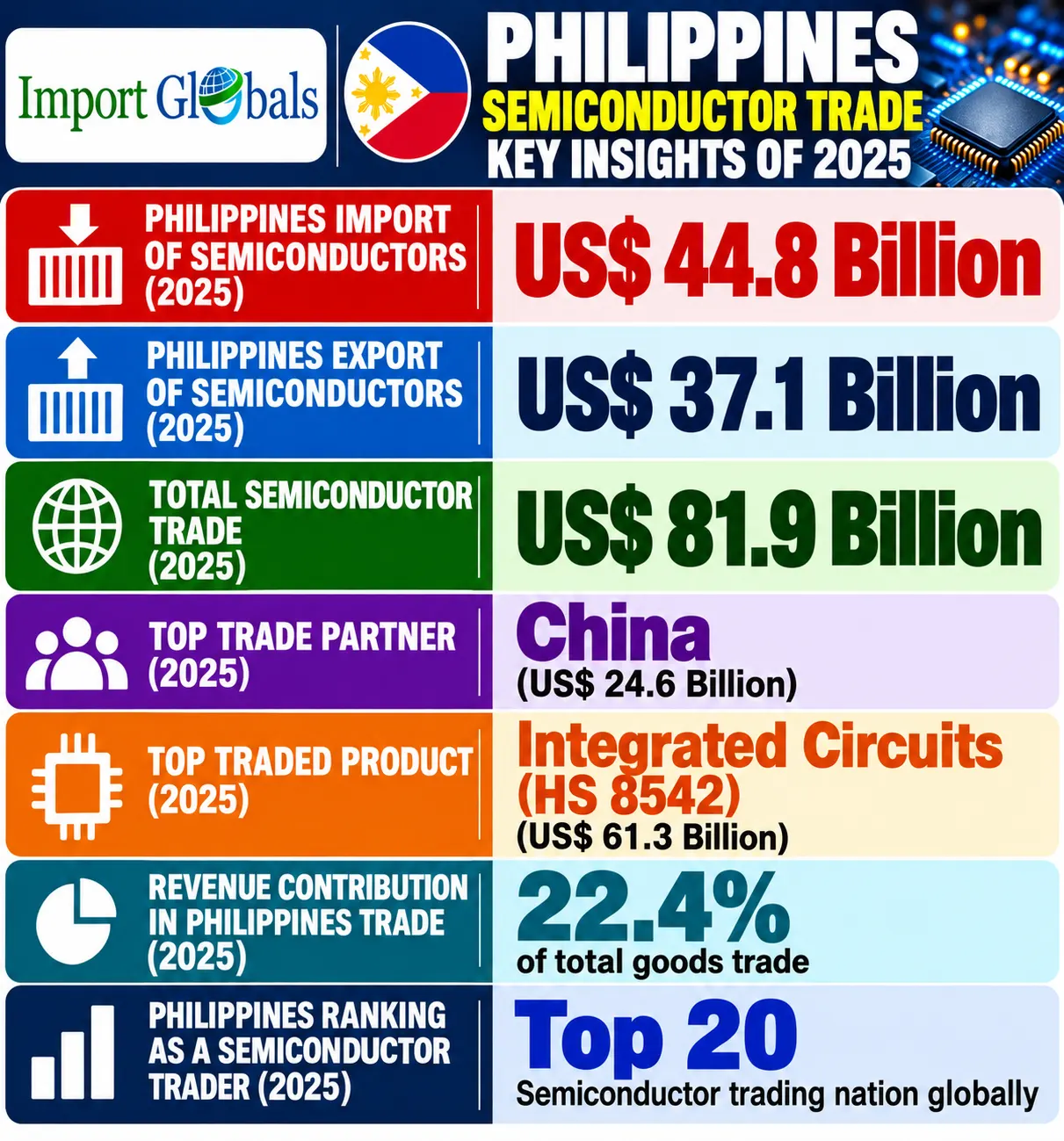
In 2025, the Philippines boosted its position in the global semiconductor supply chain with total semiconductor trade hitting an impressive US$ 81.9 billion. The imports of semiconductors reached US$ 44.8 billion; while the exports were US$ 37.1 billion.
The biggest trade partner was China, which produced US$ 24.6 billion in trade, indicating that the Philippines is tightly connected to the local supply chains within Asia. Integrated circuits (HS 8542) were the most intensively traded good with a value of US$ 61.3 billion. Therefore, the sector is highly dependent on this product, reported Philippines Customs Data. The semiconductors comprised 22.4 % of the total trade in goods done by the Philippines. Thus, the industry can be recognized as one of the major pillars of the national economy.
Top 10 Semiconductors Imported Into the Philippines in 2025
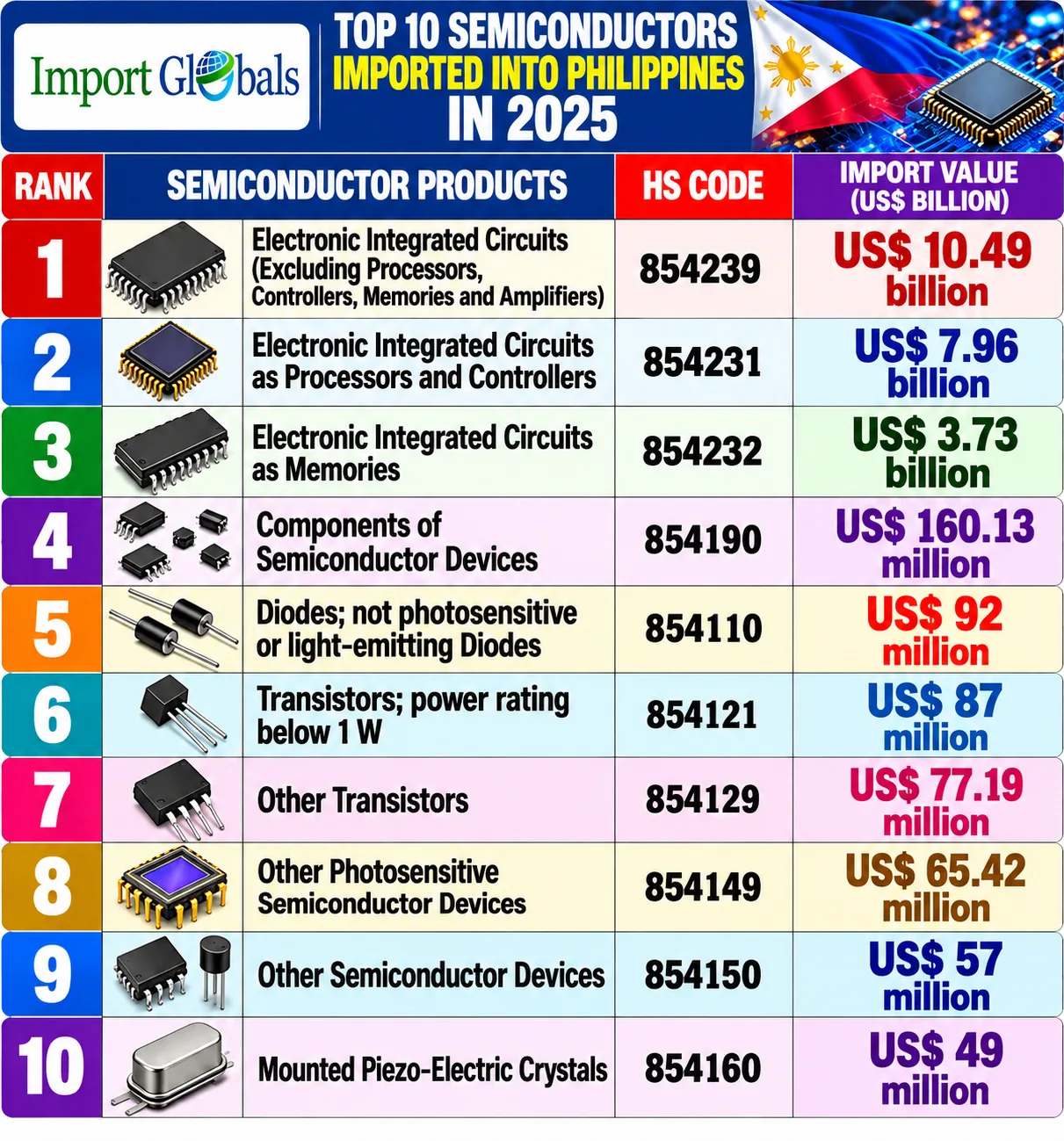
1. HS Code 854239: Electronic Integrated Circuits (Excluding Processors, Controllers, Memories and Amplifiers) — US$10.49 Billion
These integrated circuits perform a variety of electronic functions in telecommunications, computing applications, industrial machinery, and consumer goods. They are crucial for the electronics manufacturing industry of the Philippines; where imported chips support assembly, testing, and manufacture of circuits and components used in international supply chains.
2. HS Code 854231: Electronic Integrated Circuits as Processors and Controllers — US$7.96 Billion
Electronic integrated circuits like processors and controllers are the top second imported semiconductors of the Philippines in 2025. They are widely used in computer systems and mobile phones, which has driven its demand rate in the Philippines consumer base.
3. HS Code 854232: Electronic Integrated Circuits as Memories — US$3.73 Billion
Memory integrated circuits have the capacity to store as well as retrieve digital information in computers, smartphones, servers, and some other electronic devices. These components are being imported to the Philippines by manufacturers to facilitate the production of electronics and processing of semiconductors. Their use is widely spread from consumer products to enterprise technologies and telecommunications.
4. HS 854190: Components of Semiconductor Devices - US$160.13 Million
The components of semiconductor devices play a significant role in the manufacturing, processing, and assembling of electronic products. These components find application in the electronics manufacturing industry and semiconductor manufacturing units. The imports are necessary for the firms in the Philippines to continue with the process without any interruptions and for the local companies to connect with suppliers from abroad.
5. HS 854110: Diodes; not photosensitive or light-emitting Diodes - US$92 Million
Diodes are the top fifth imported variant of semiconductors in Philippines. It basically governs the flow of current and are utilized in rectifiers. These are significant parts in the production of consumer goods, electronic equipment, and communication devices. The imports ensure that the manufacturers of goods receive parts that are needed for the proper functioning of electronic circuits.
6. HS 854121: Transistors; power rating below 1 W - US$87 Million
Transistors are the top sixth imported variants of semiconductors in the Philippines. The use in numerous electrical devices, communication equipment and electronic control devices has supported its trade in the Philippine authorities, reported Philippines Import Data.
7. HS 854129: Other Transistors — US$77.19 Million
Other transistors are mainly used for switching, amplification and technology control. The specific devices are implemented for allowing the creation of complex variation, which has maintained the collaborative trade in the Philippines authorities from the foreign traders.
8. HS 854149: Other Photosensitive Semiconductor Devices — US$65.42 Million
Photosensitive semiconductor devices are at an import valuation of 65.42 million. The effective use in devices for sensing, control and monitoring has maintained the resourcing of the specific essential.
9. HS 854150: Other Semiconductor Devices — US$57 Million
This category includes devices classified nowhere else in HS 8541. Such devices provide technological solutions for switching, sensing, and control tasks. The component imports are necessary for producers to develop electronic assemblies for their equipment, including industrial and commercial types.
10. HS 854160: Mounted Piezo-Electric Crystals — US$49 Million
Mounted piezo-electric crystals are the units that generate and react to electric signals on the basis of mechanical vibrations. They are applied in time control circuits, communication equipment, and electronic devices. Local producers need to get the raw materials for precise signal generation within devices through imports.
Top 10 Semiconductors Exported From Philippines in 2025
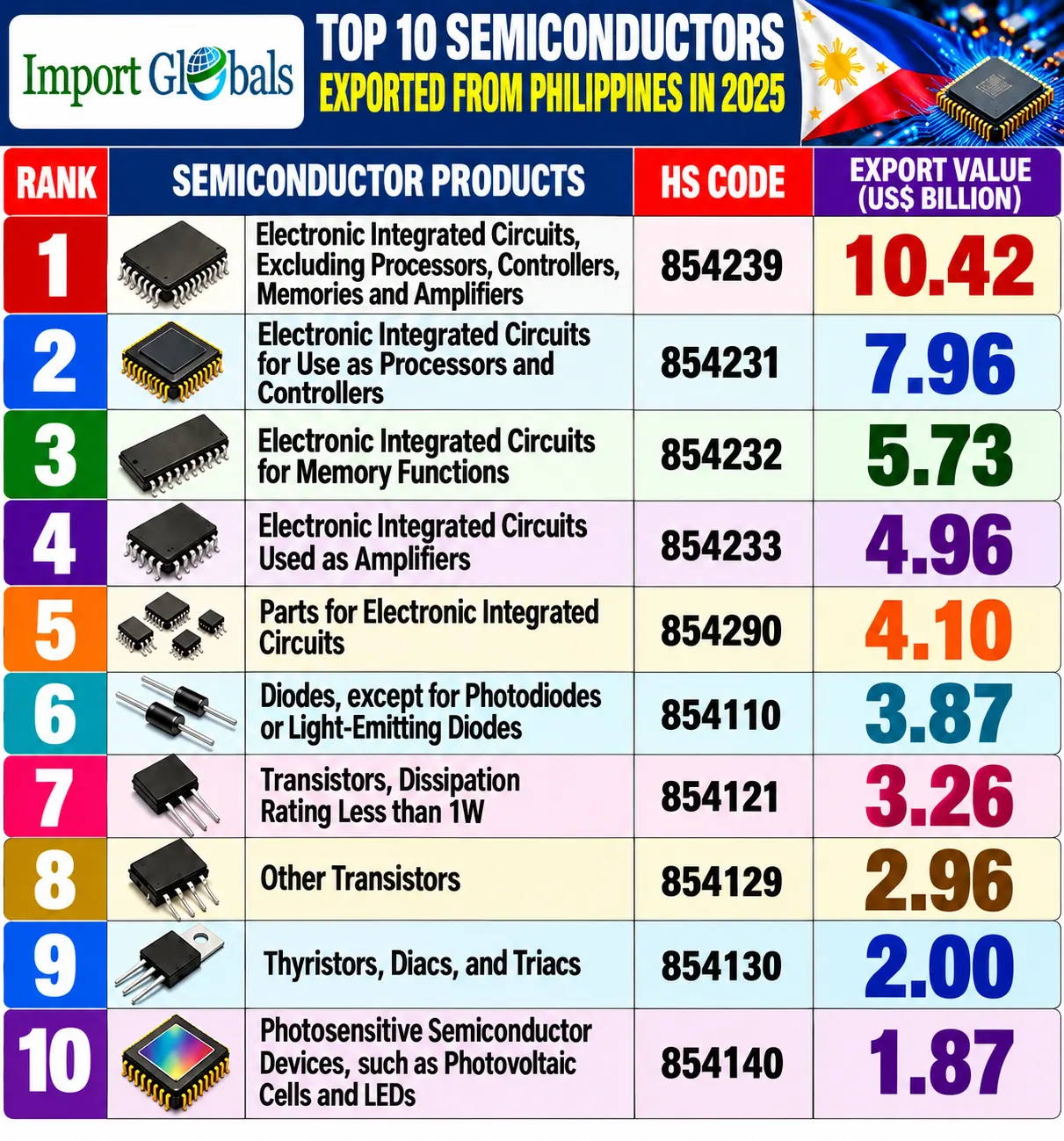
1. HS 854239: Electronic Integrated Circuits, Excluding Processors, Controllers, Memories and Amplifiers - US$10.42 Billion
These integrated circuits carry out their respective functions in electronic equipment, telecommunications, industrial systems, and consumer items. The semiconductor plants in the Philippines sell these components to foreign manufacturers for use in completed electronic devices.
2. HS 854231: Electronic Integrated Circuits for Use as Processors and Controllers - US$7.96 Billion
Electronic integrated circuits are the top second exported products of the Philippines. They are mainly used for managing data and carry out electronic processes. Being effectively used in laptops, automotive electronics and industrial machines, it contributes to a majority share of the Philippines semiconductor exports says Philippines Export Data.
3. HS 854232: Electronic Integrated Circuits for Memory Functions - US$5.73 Billion
Memory integrated circuits provide access to digital information on computers, mobile phones, servers, as well as any other electronic devices.
4. HS 854233: Electronic Integrated Circuits Used as Amplifiers - US$4.96 Billion
Amplifier integrated circuits amplify electrical signals in telecommunication devices, audio equipment, and measuring devices. These devices are of great importance for signal processing and communication in personal electronics and industrial devices.
5. HS 854290: Parts for Electronic Integrated Circuits —US$ 4.10 Billion
The integrated circuit parts are used in the manufacturing of semiconductors and other electronic components. They connect the component producers to the manufacturers that require the electronic parts and ensure efficiency in the production of semiconductors.
6. HS 854110: Diodes, except for Photodiodes or Light-Emitting Diodes — US$ 3.87 Billion
Diodes regulate electric current and help in the process of rectification of current, protecting circuits and regulating voltage. They are utilized in power supply systems as well as in electronic devices, industrial machinery, and telecommunications systems that are manufactured for foreign markets.
7. HS 854121: Transistors, Dissipation Rating Less than 1W — US$ 3.26 Billion
The low-rated transistors are the devices that amplify and switch electrical signals in compact circuits. They are significant parts of household electrical appliances, telecommunication devices, and other control electrical circuits, which are characterized by high energy efficiency and performance.
8. HS 854129: Other Transistors — US$ 2.96 Billion
Other types of transistors change current, amplify it, and control its usage. Other transistors are used in several areas of production. The effective use in electronics industry and automobiles has maintained the supportive trade.
9. HS 854130: Thyristors, Diacs, and Triacs — $2 Billion
Thyristors, diacs, and triacs have the important role of controlling electrical power and switching. Devices like thyristors and triacs are mostly found in motor drives and power supplies due to which the demand rate is increasing.
10. HS 854140: Photosensitive Semiconductor Devices, such as Photovoltaic Cells and LEDs — $1.87 Billion
Photosensitive semiconductor devices are the adopted exported variant of semiconductor from the Philippines in 2025. The overall trade is allowing the use in various applications with involvement in the use of electronic sensors and photovoltaic cells.
Top 10 Philippines Import Partners for Semiconductor Trade of 2025
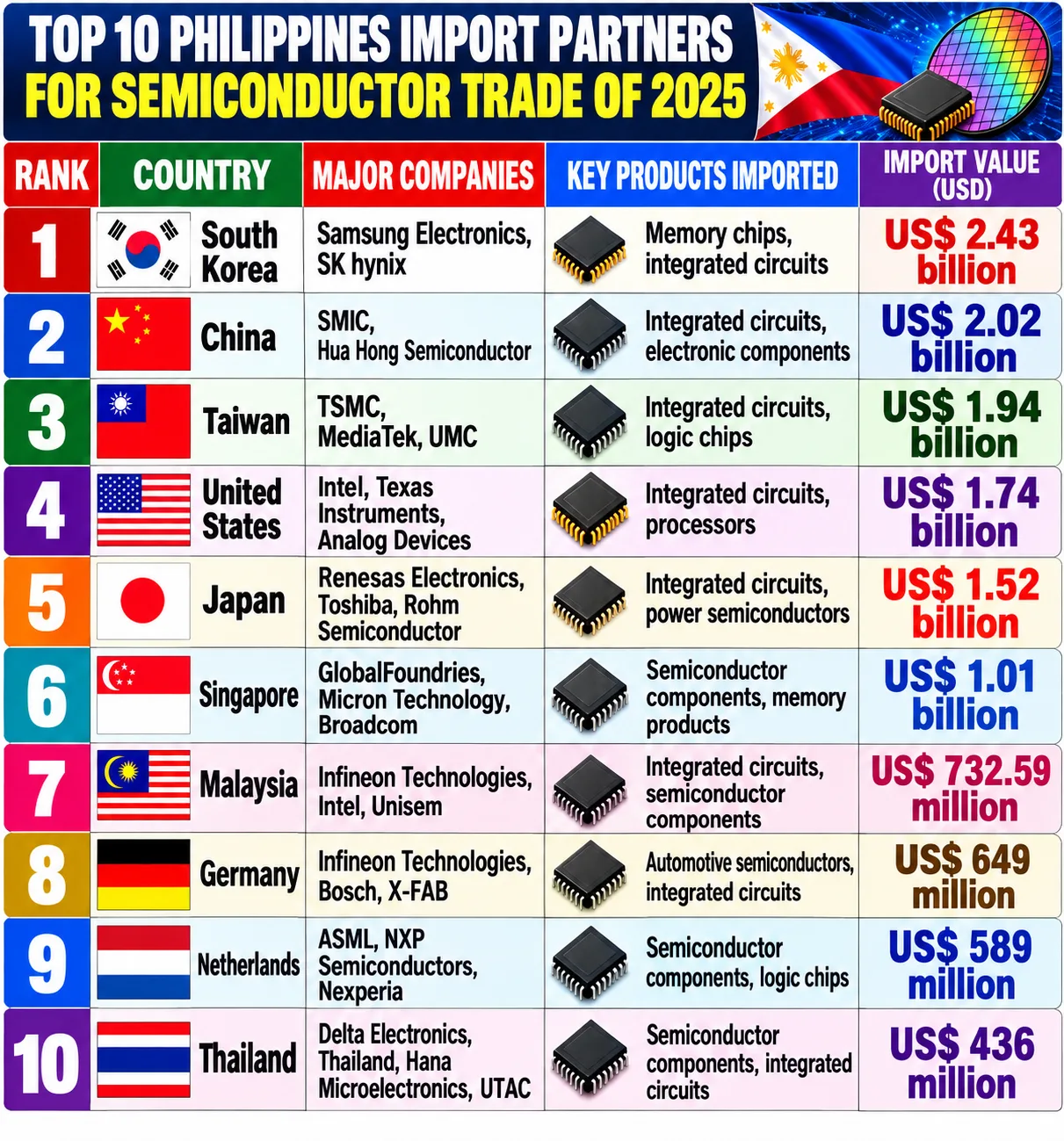
1. South Korea - South Korea is the top import partner of the Philippines for the semiconductor trade, mainly because of the integrated circuits supplied to the Philippines, because of the semiconductor industry.
Notable Companies: Samsung Electronics and SK Hynix.
Key Products Imported: Memory chips, integrated circuits, and semiconductor parts
Import Amount: US$2.43 billion.
2. China — China is the second import partner of the Philippines for the semiconductor trade. The wide range of electronic components supplied to the electronic industry, because of the processing ability, has maintained the bilateral integrity.
Notable Companies: SMIC and Hua Hong Semiconductor.
Key Products Imported: Integrated circuits, electronic components, and semiconductor equipment.
Import Amount: US$2.02 billion.
3. Taiwan – Taiwan is the top import partner of Philippines semiconductor trade. The effective import supply of sophisticated chips and integrated circuits has maintained the transport of computing, communications and electronic machines.
Notable Companies: TSMC, MediaTek, UMC.
Key Products Imported: Integrated circuits, logic chips, and other semiconductor items.
Import Amount: US$1.94 billion.
4. United States – The suppliers of the United States provide semiconductor technologies for the manufacturing of industrial machines, computing, and communications, reported Philippines Trade Data.
Notable Companies: Intel, Texas Instruments, and Analog Devices.
Key Products Imported: Integrated circuits, processors, controllers, and analog chips.
Import Amount: US$1.74 billion.
5. Japan — Japan is the top 5th import partner of the Philippines; it is an important supplier of semiconductor and electrical materials for industrial and consumer electronics, reported Philippines Customs Data.
Notable Companies: Renesas Electronics, Toshiba, and Rohm Semiconductor
Key Products Imported: Integrated circuits, power semiconductors, and electrical elements
Import Amount: US$1.52 billion
6. Singapore — Singapore is the top sixth import partner of Philippines because of the increasing demand rate for semiconductor manufacturing, logistics and distribution in the region. The closer proximity on a geographical manner has supported the bilateral integrity.
Major Companies: Global Foundries, Micron Technology, Broadcom
Top Imported Products: semiconductor components, memory products, and integrated circuits.
Import Value: $1.01 billion
7. Malaysia — Malaysia is the top 7th import partner of the Philippines for its semiconductors trade of 2025. The growing demand rate in the consumer population has effectively maintained the bilateral integrity.
Major Companies: Infineon Technologies, Intel, Unisem
Top Imported Products: integrated circuits, semiconductor components, and electronic devices
Import Value: $732.59 million.
8. Germany — This country’s semiconductor industry provides components that can be used in industrial automation, automotive electronics, and power management.
Major Companies: Infineon Technologies, Bosch, X-FAB.
Top Imported Products: automotive semiconductors, integrated circuits, and power chips
Import Value: $649 million.
9. Netherlands — Netherlands is the top ninth import partner of the Philippines. The country has been an important role there regarding semiconductor technology and machinery because of the firms that are mainly supplying the global chip essentials.
Major Companies: ASML, NXP Semiconductors, Nexperia.
Top Imported Products: semiconductor components, logic chips, and integrated circuits.
Import Value: $589 million.
10. Thailand — Wrapping up the list of the top import partnerts list of Philippines semiconductor imports. Thailand is the top 10th partner of the nation, the country is participating in the supply chain of semiconductor components and electronics manufacturing.
Major Companies: Delta Electronics Thailand, Hana Microelectronics, and UTAC.
Top Imported Products: semiconductor components, integrated circuits, and electronic devices.
Import Value: $436 million.
Top 10 Philippines Export Partners for Semiconductor Trade of 2025
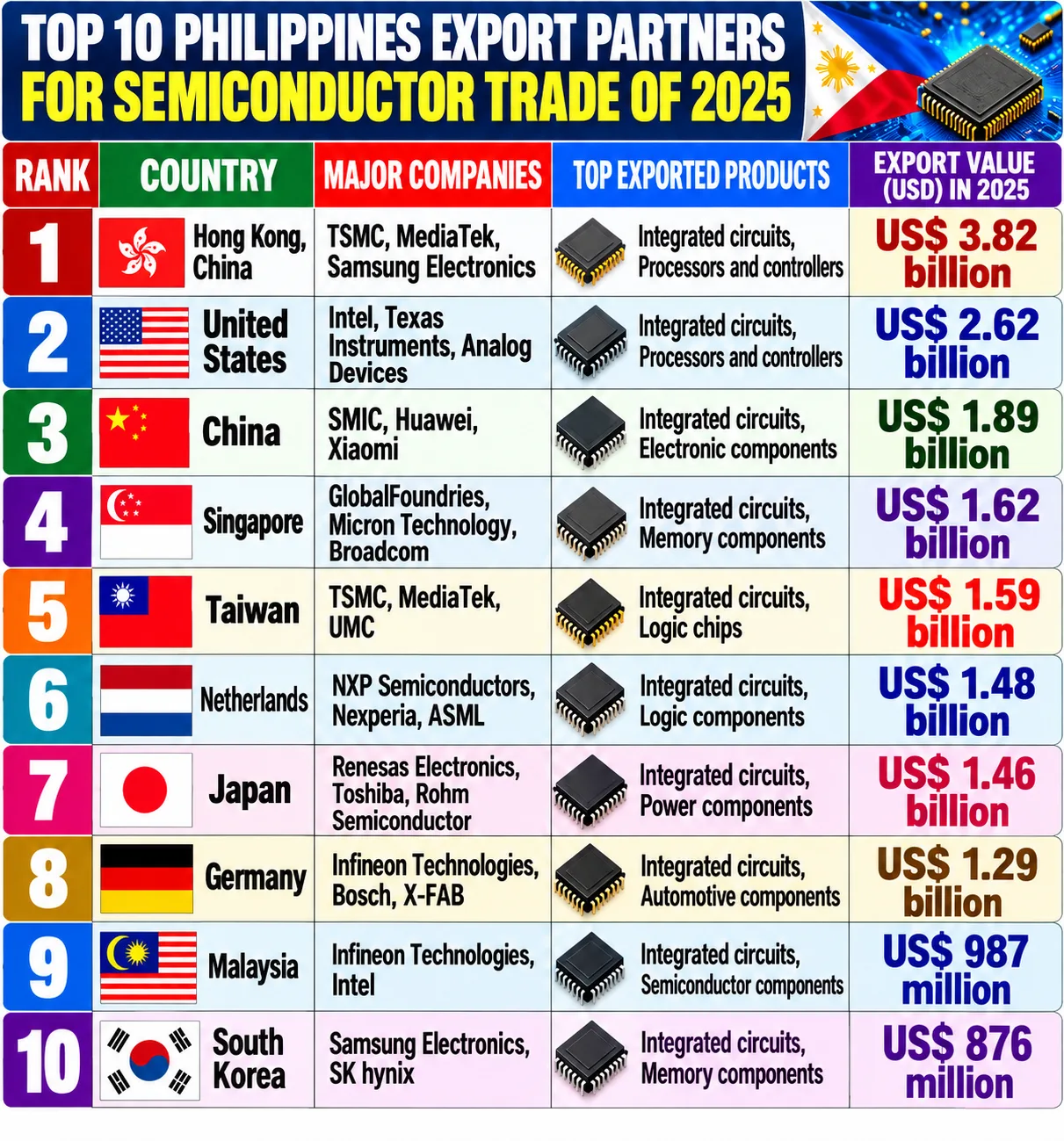
1. Hong Kong, China — US$6.49 Billion (2024)
Hong Kong is the top export partner of Philippines for the semiconductor trade of 2025. The growing productivity of the country as per the booming demand rate has maintained the effective trade.
Major Company Examples: TSMC, MediaTek, Samsung Electronics, and other regional electronics distributors.
Top Exported Products: Integrated circuits, processors and controllers, and multichip integrated circuits.
2025 Valuation: US$3.82 billion
2. United States
The USA naturally becomes a leading market for semiconductor components used in manufacturing because the semiconductor components are utilized in computing, telecom, industrial machinery, as well as consumer electronics. The Philippine-made electronic components can perfectly fit into the supply chains of manufacturing and technology companies that operate in these sectors, reported Philippines Customs Shipment Data.
Major Company Examples: Intel, Texas Instruments, Analog Devices
Top Exported Products: Integrated circuits, processors, controllers, and analog semiconductor components.
2025 Valuation: US$2.62 billion
3. China
China plays a major role in electronics manufacturing and assembly of integrated circuits. They make it possible to manufacture computers; telecommunications equipment, and various other electronic devices.
Major Company Examples: SMIC, Huawei, and Xiaomi
Top Exported Items: Integrated circuits, electronic parts, processors, and controllers.
2025 Valuation: US$1.89 billion
4. Singapore
Singapore is another centre of semiconductor manufacturing, logistics, and distribution in the region that connects semiconductor suppliers and manufacturers in Southeast Asia
Major Company Examples: GlobalFoundries, Micron Technology, and Broadcom.
Top Exported Products: Integrated circuits, related items for memory, and semiconductor devices
2025 Valuation: US$1.62 billion
5. Taiwan
Taiwan is an important part of the semiconductor ecosystem, as it possesses a well-developed capacity in chip design, manufacturing, and electronics production.
Major Company Examples: TSMC, MediaTek, and UMC
Major Exported Products: Integrated circuits, logic semiconductors, processors, and regulators.
2025 Valuation: US$1.59 billion
6. Netherlands
The Netherlands is in Europe’s semiconductor and electronics supply chain as a result of demand driven by industrial electronics, computing, and technology manufacturing. The ranking in actual data reflects the trade in integrated circuits rather than any other semiconductor machinery.
Key Company Examples: NXP Semiconductors, Nexperia, and ASML. Main exported products: Integrated circuits, logic parts, and other electronic semiconductor parts.
Valuation by 2025: US$1.48 billion
7. Japan
Japan has a large market for semiconductor parts that are used in automotive electronics, industrial systems, consumer electronics, and precision devices. Thus; Philippine exports can support electronics manufacturing and regional supply chains
Key Companies: Renesas Electronics, Toshiba, and Rohm Semiconductor
Main Exported Products: Integrated circuits and semiconductor devices
Valuation by 2025: US$1.46 billion
8. Germany
Germany's electronics sector caters to automotive production, industrial automation, and energy-management tasks. Electronic components imported from the Philippines can find application in these extensive electronics supply lines.
Major Company Examples: Infineon Technologies, Bosch and X-FAB.
Top Exported Products: Integrated Circuits, automotive-related electrical items, and semiconductor materials.
2025 Valuation: US$1.29 billion
9. Malaysia
Malaysia and the Philippines are participants in regional electronic production networks. Trade among nations might include integrated circuits and other parts for the assembly, testing, and manufacture of finished electronics.
Major Company Examples: Infineon Technologies, Intel.
Top Exported Products: Integrated circuits, semiconductor parts, and electronic items
2025 Valuation: US$987 million
10. South Korea
South Korea is one of the leading manufacturers of semiconductors and one of the key links in the regional electronics industry supply lines. Philippine trade can feature integrated circuits and components involved in the electronics production business.
Major Company Examples: Samsung Electronics and SK hynix.
Top Exported Products: Integrated circuits, memory-related materials, and other semiconductor materials
2025 Valuation: US$876 million
Past 10 Years Trade Analysis of Philippines Semiconductor Trade of 2025
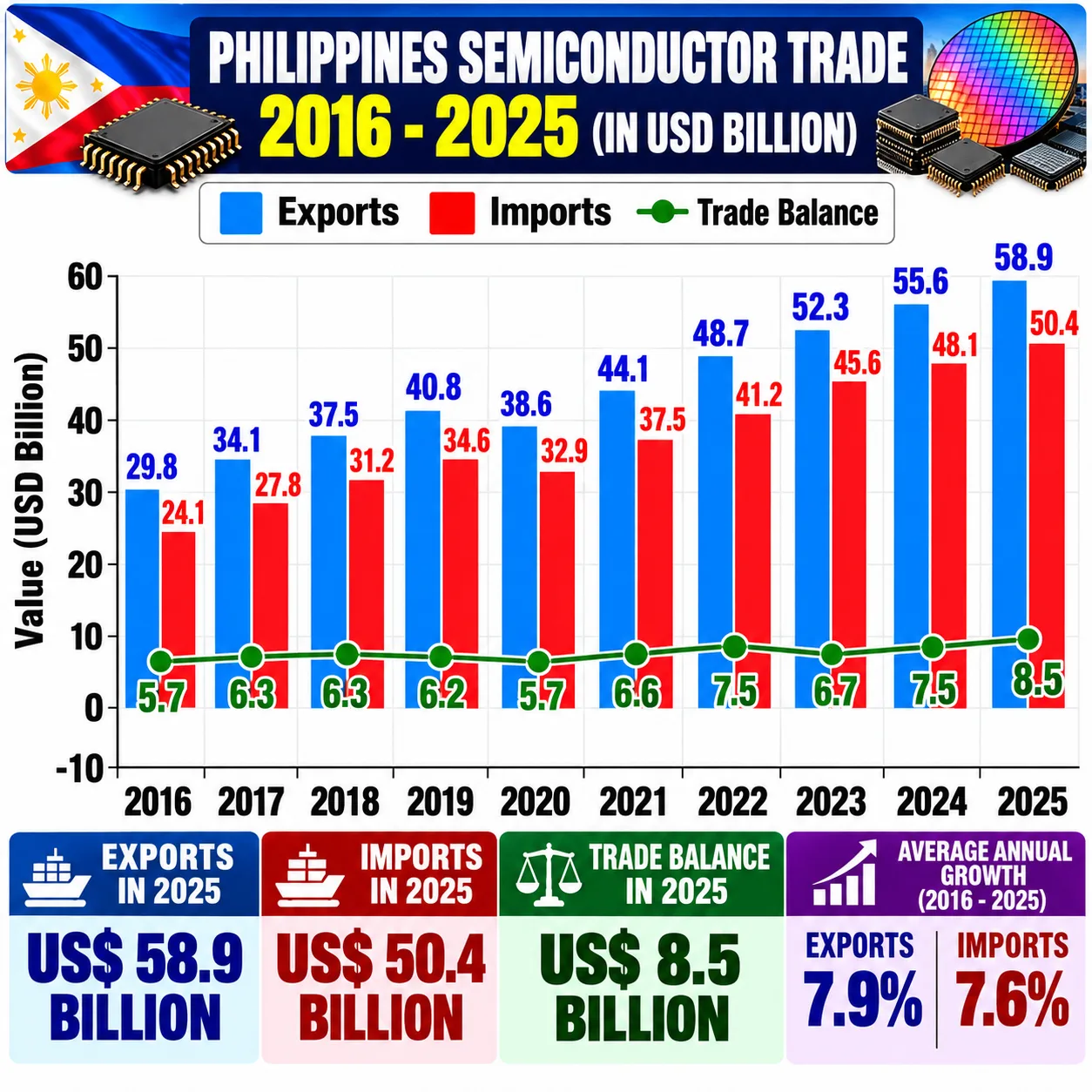
The past ten years’ trade analysis of Philippines semiconductor has been quite impactful. The growth in the trade of semiconductors has resulted in a surplus every year. The export sales increased from 29.28 billion in 2026 to 58.9 billion in 2025. The imports are at a specific rate of 24.1 billion in 2016 to 50.4 billion in 2025. This has led to an effective trade balance of US dollar 8.5 billion in 2025. The minor setback in the year 2020 has recorded the trade fall from 40.8 billion in 2019 to 38.6 billion in 2020, says Philippines Trade Statistics.
The average growth rate for the trade of semiconductors was 7.9% for exports and 7.6% for imports. The growth of exports was slightly higher than the growth of imports; thus, the total trade surplus also increased from US$ 5.7 billion in 2016 to US$ 8.5 billion in 2025. This shows that the role played by the Philippines has substantially improved in terms of assembly, testing, and packaging within the semiconductor supply chain.
Significant Drivers of Philippines Semiconductor Trade in 2025
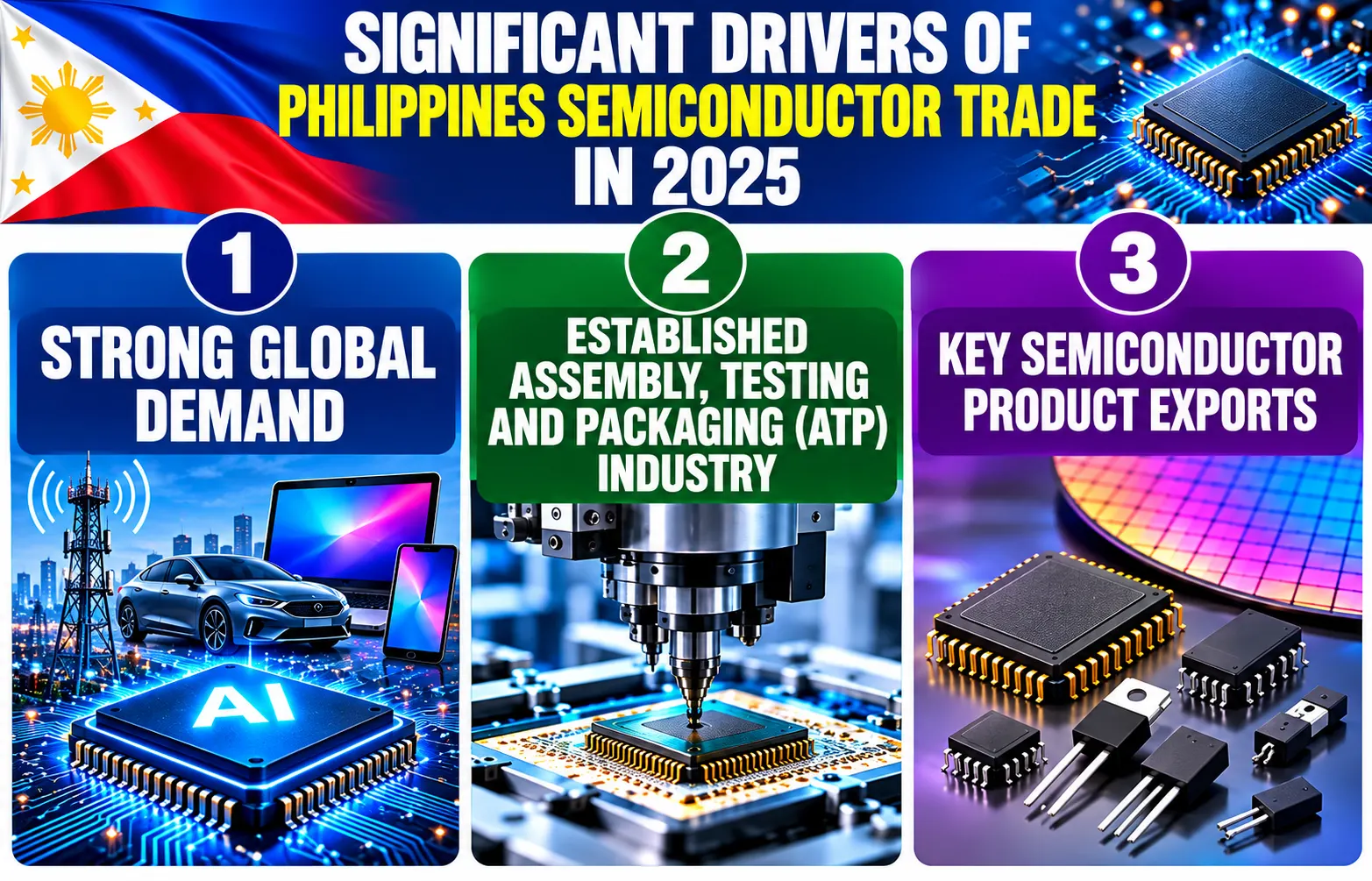
Various factors helped the sector thrive in 2025. The requirement for AI chips, telecommunication devices, automobile electronic components, and consumer electronic devices maintained a high level of global orders. The Philippines also has the advantage of the already existing assembly, testing, and packaging (ATP) industry, which processes imported wafers and integrated circuits locally and supplies the products to foreign manufacturers.
In terms of exports, integrated circuits (HS 8542) rank first, while diodes, transistors, and thyristors provide a constant basis of power and control components, says Philippines Import Trade Data.
Drawbacks and Risks
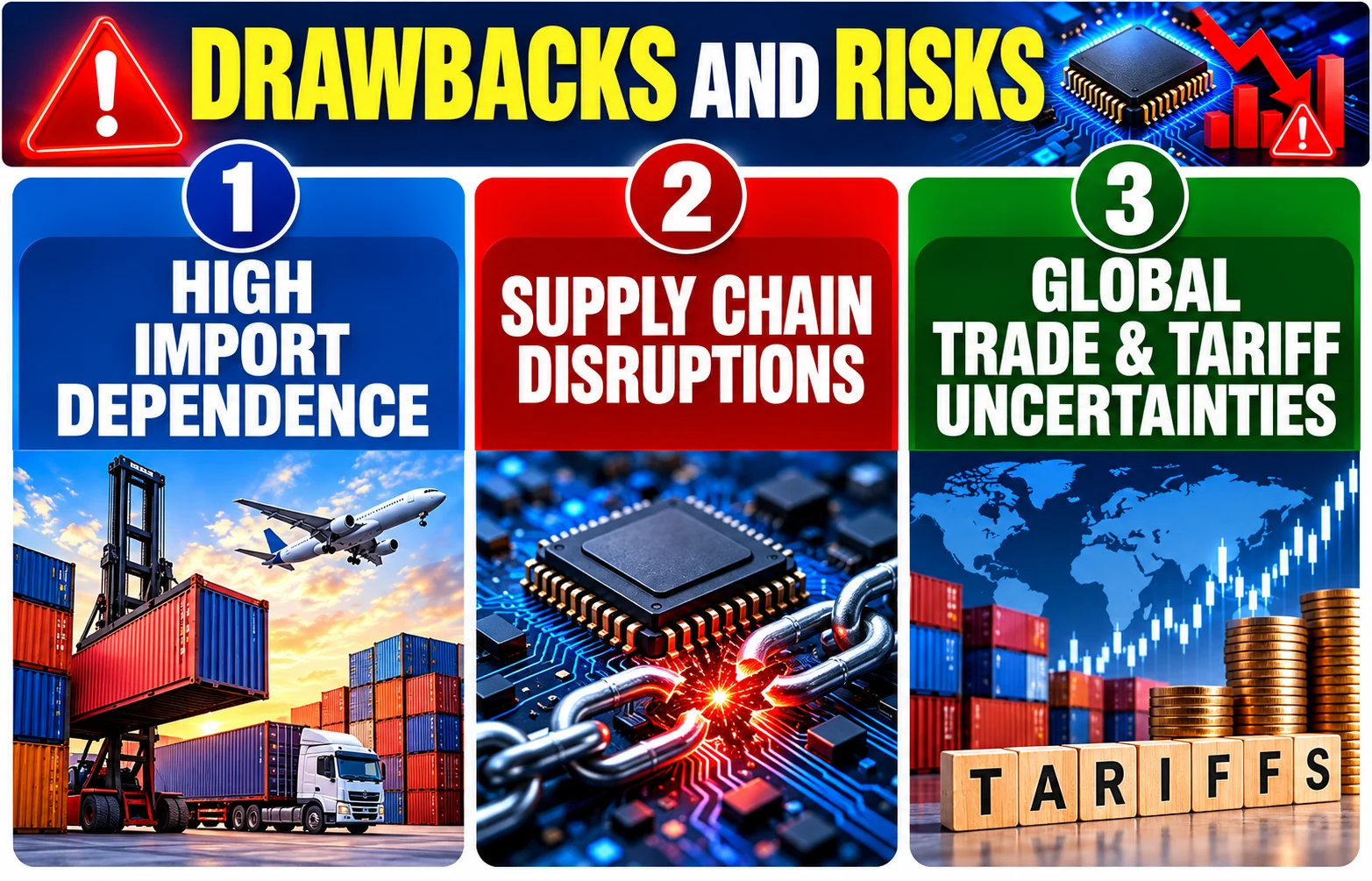
The industry also has its shortcomings. The sector is heavily dependent on integrated circuits, which makes a drop in demand for chips affect trade volumes quickly.
The dependency on imported semi-finished products means that the dependency on changes in supply chains and trading policies is huge. Nevertheless, the processing-based model allows for a quick response to changes in demand in case the demand spike happens.
Future Outlook of Philippines Semiconductor Trade
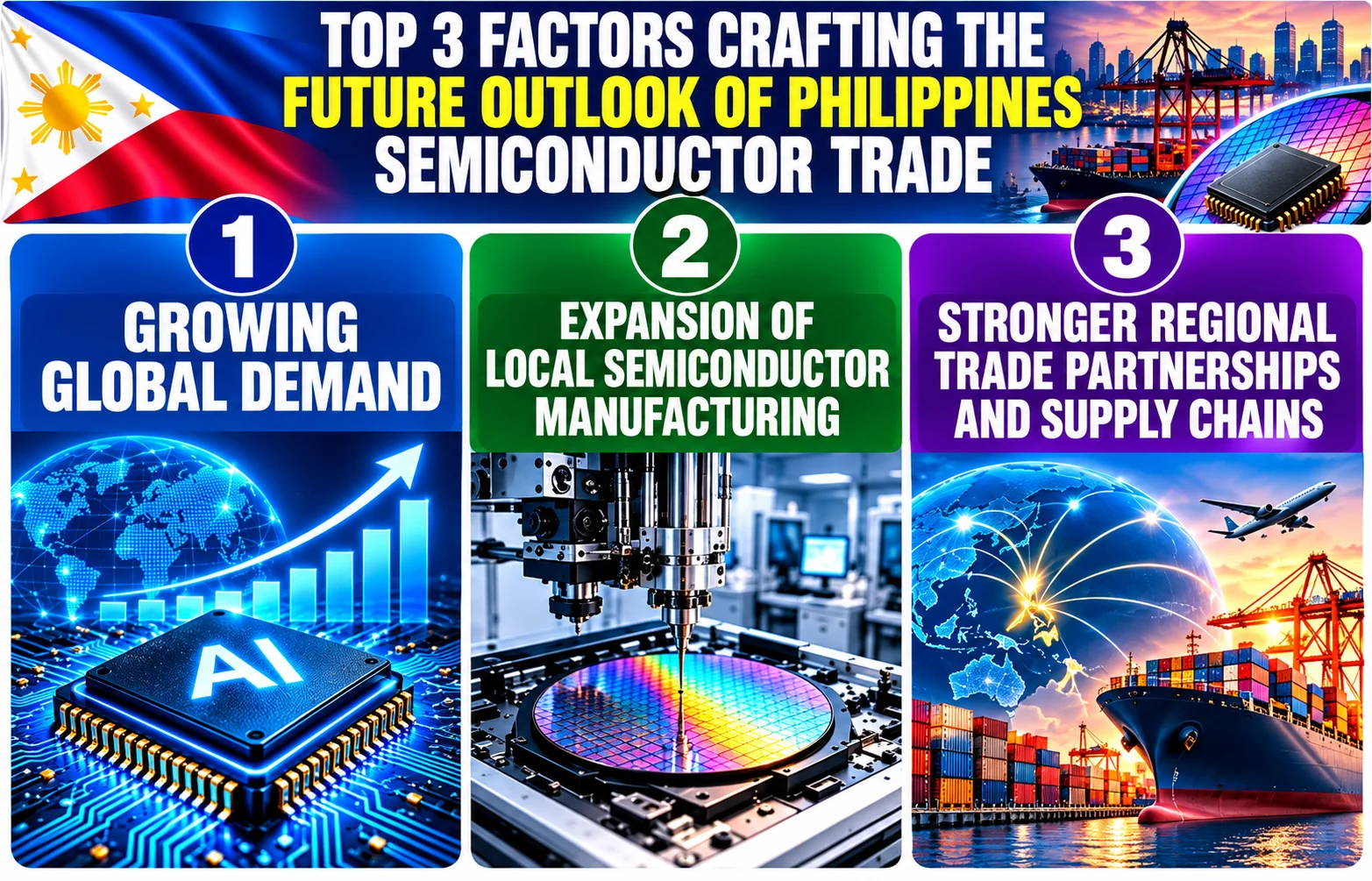
The future of the semiconductor industry in the Philippines looks promising, with the aim to reach $110 billion in exports in the next 10 years. The country has enough advantages to achieve that goal: a proven roadmap to success, consistent growth, a favourable trade balance every year since 2016, and a proven reputation in assembly, testing, and packaging.
Reaching that level of exports will depend on investing in a skilled workforce, advanced capacity in packaging, and reliable infrastructure consisting of power, logistics, and industrial zones. The demand for AI, automotive, and telecom chips will help to get orders from factories in the Philippines. Successfully implementing these plans will allow the country to move from simple assembly and testing to more complex tasks in the global supply chain.
Conclusion
The semiconductor industry of the Philippines in 2025 displays a field that has been developing slowly but steadily in the last 10 years and is now the focus point of the country’s international trade.
Integrated circuits are the largest products imported and exported; the country receives and sends goods to a number of Asian, American, and European partners, plus the trade surplus has widened since 2016. Philippines is already known for being a leader in assembling, testing, and packaging semiconductor products.
CTA
If you are trying to get updated information regarding the semiconductor export trade of the Philippines, then you have finally landed on the right platform here. Import Globals helps businesses get detailed analysis of the semiconductor trade of the nation. The dataset transforms the strategies into active market insights. Subscribe to www.importglobals.com or drop an email at info@importglobals.com for detailed analysis of the semiconductor trade of the Philippines to transform your international business growth.
FAQ’s
Que. What is thetop traded semiconductor product of the Philippines in 2025?
Ans. Integrated circuits are one of the top semiconductor traded products of the Philippines in 2025.
Que. Name the country that is the top trade partner of the Philippines' semiconductor trade in 2025.
Ans. China is the top trade partner of the Philippines for its semiconductor trade in 2025.
Que. Name the market that buys the most Philippine semiconductors.
Ans. Hong Kong and China are the markets that are responsible for buying the most Philippine semiconductors.
Que. How much of the Philippines' goods trade is covered by semiconductors?
Ans. Semiconductors account for 22.4% of the country's total goods trade.
Que. Has the Philippines recorded a trade surplus?
Ans. Yes, the Philippines has recorded a trade surplus from 2016 to 2025 of 8.5 billion U.S. dollars, which is the highest in that period.
Que. What is the total semiconductor export value of the Philippines in 2025?
Ans. The total semiconductor export value of the Philippines in 2025 is 58.9 billion U.S. dollars.
Que. How does the Philippines' import-export data support business growth?
Ans. The Philippines import-export data support business growth via proper identification of buyers, suppliers, analysis of market demand, and development of effective market expansion strategies.
Que. What information is available in Philippines trade data?
Ans. Philippines trade data covers importer name, exporter name, shipment date, HS code, product details, quantity, pricing information, origin country, importing country, and port details.
Que. How frequently is the PHILIPPINES trade data updated?
Ans. Philippines trade data is updated on a monthly basis.
Que. Where can you obtain detailed information on PHILIPPINES trade data?
Ans. Visit www.importglobals.com or drop an email at info@importglobals.com for detailed updates on Philippines trade data.
You Can Also Visit :-
