
Russia Extends Diesel Export Ban in 2026: Export Quotas, US Supply Deal and Global Trade Impact

- Oct 30, 2026
- 216 Views
Russia Extends Diesel Export Ban in 2026: Export Quotas, US Supply Deal and Global Trade Impact
In 2026, Russia’s diesel export policy has changed dramatically as the government tries to balance domestic fuel security with international supply obligations. The curbs were put in place during the fuel shortages and refinery disruptions and have now been extended to help stabilize the domestic market especially during the agricultural harvest season.
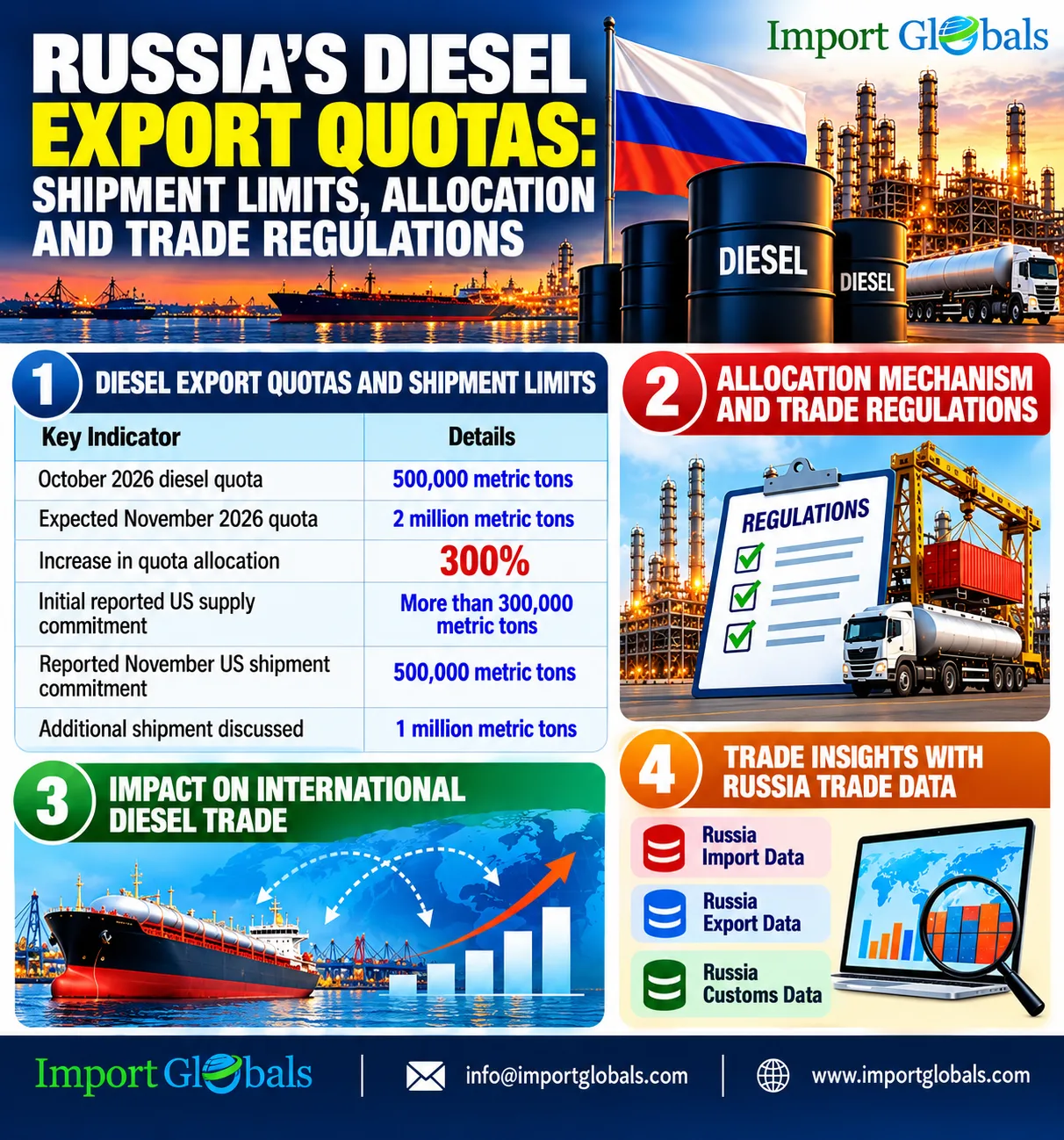
Russia is reported to continue its ban on diesel exports until year-end, but will allow controlled shipments through an export quota system, according to reports published Oct. 29, 2026. Current restrictions on direct exports by producers expire on October 31 while broader restrictions on non-producers remain in place until January 31, 2027. But exemptions have allowed selected shipments to proceed. The export quota was 500,000 metric tons for October and was expected to increase to 2 million metric tons in November.
These developments are also impacted by a reported supply agreement with the United States, which opens up possibilities for additional diesel shipments even under ongoing restrictions. “Meanwhile, refinery recovery, geopolitical tensions and domestic fuel demand continue to drive Russia’s export capacity.”
These policy changes are a reminder to global traders, importers and supply chain analysts to keep a close eye on export quotas, government announcements and shipment movements. Import Globals helps companies understand changing global trade patterns and evaluate how energy policy choices can impact global fuel markets, sourcing strategies and trade opportunities.
Why Russia Is Extending Diesel Export Restrictions Through the End of 2026
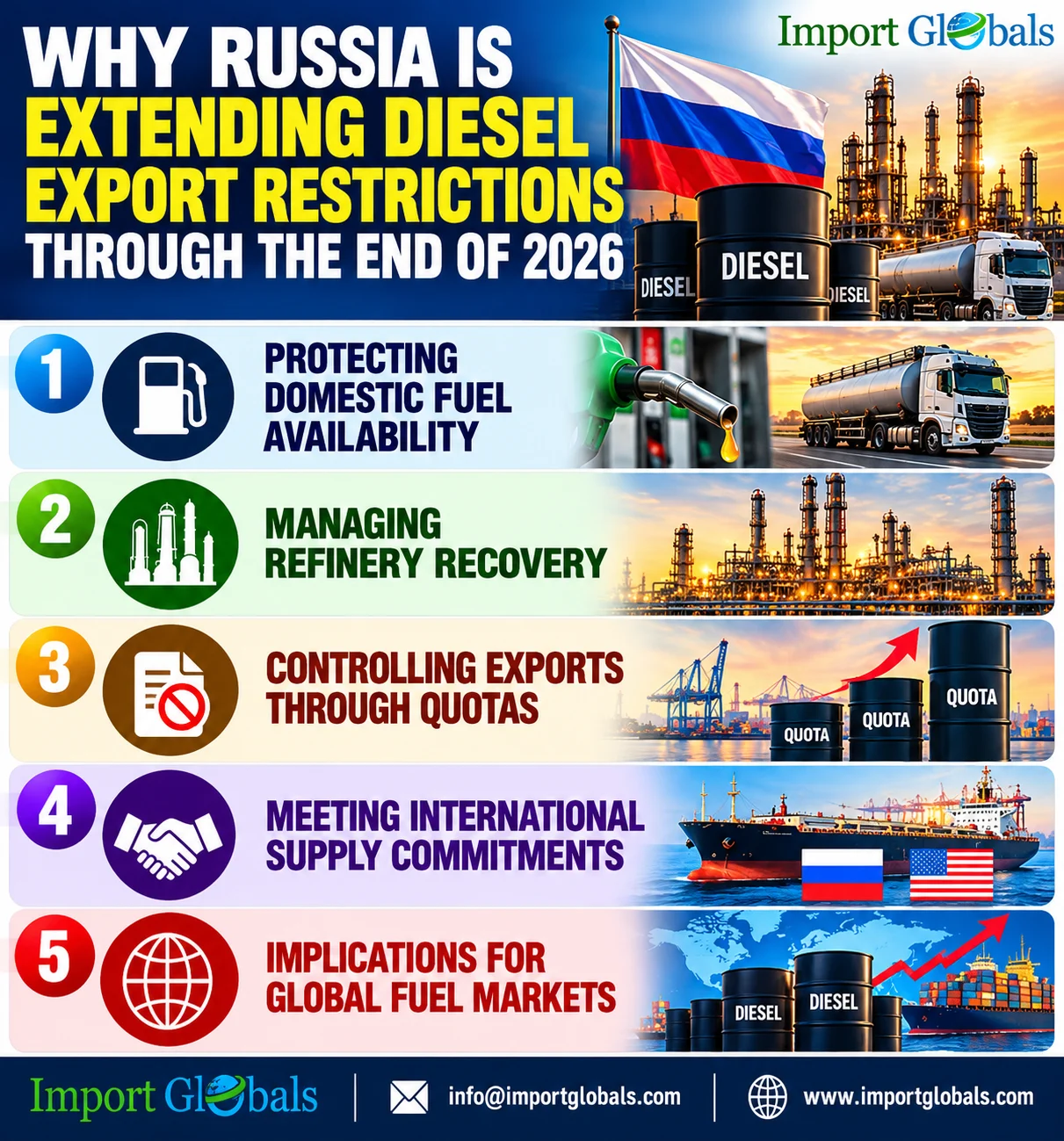
“Another sign of Russia’s efforts to secure domestic fuel supplies is the extension of the export restrictions on diesel to the end of 2026, as the country gradually restarts refinery operations while balancing international energy commitments. Moscow has ramped up oversight of overseas shipments of the fuel even with the country’s huge production capacity amid disruptions at refineries and past shortages.
1. Protecting Domestic Fuel Availability
Russia has implemented export restrictions following attacks on oil refineries, which have disrupted fuel production and caused domestic shortages. It is especially important to ensure adequate supplies of diesel for the agriculture, freight transport, industrial operations and regional fuel distribution. The government wants to avoid new shortages and a steep rise in the price of fuel at home.
2. Managing Refinery Recovery
Refinery operations improved in October 2026, but the government remains cautious about permitting free exports. Repairs were under way and attacks on facilities had eased, allowing refinery utilization to rise 25% from the start to the end of October, Reuters said. The present restrictions give authorities the tools to respond if the conditions for production or domestic supply deteriorate.
3. Controlling Exports Through Quotas
In Russia, there are no free shipments, the international sales are controlled by export quotas. November quotas are anticipated to rise to 2 million mt from 500,000 mt in October. It permits selected exporters to enter foreign markets but keeps the total level of exports under government control.
4. Meeting International Supply Commitments
Russia also wants to fulfilll its reported contract to supply diesel to the United States but wants to control export volumes. Not all restrictions are being removed but some shipments are being permitted through under quota-based exemptions. That would be a strategy that would allow Russia to maintain access to international markets and its export earnings.
5. Implications for Global Fuel Markets
The extension could have ramifications for the prices of diesel, shipping plans and sourcing decisions for countries that import goods. Buyers may have to find alternative suppliers, be alert to announcements emanating from the Russian government and keep an eye on fluctuating freight costs and delivery schedules. The extension referred to as for the end of the year is not a standing government order and the latest information is being held until such time as there is official action.
Russia’s Diesel Export Quotas: Shipment Limits, Allocation and Trade Regulations
The Russian government has struck an agreement on its policy of diesel exports for 2026, making provision for domestic consumption of the fuel but also some foreign trade. Moscow has kept in place export restrictions and exemptions on diesel introduced after refinery shutdowns and worries about fuel supplies. These enable the authorities to manage shipments to overseas markets in line with domestic demand, refinery recovery and supply commitments.
Russia’s Diesel Export Quotas and Shipment Limits
Quota allocations reported suggest there may be room for further diesel exports in November 2026. These figures are within Russia’s quota arrangements and should not be considered verified finished shipments.
Allocation Mechanism and Trade Regulations
Russia’s quota system allows some exporters to send diesel but the government controls the total volume exported. Allocation decisions would take into account refinery operating conditions, domestic fuel needs and the eligibility of individual producers. Exporters also need to comply with the destination’s applicable customs declarations, documentation requirements and trade restrictions.
Impact on International Diesel Trade
Russian export quota changes may impact global diesel availability, shipping costs, procurement times and fuel prices. With the rules changing importers might need to find new vendors and alter their delivery schedules. The volumes of shipments and the activity of trade partners can be monitored to track changes of the petroleum supply chain.
This knowledge of inbound flow of petroleum related trade and equipment can also provide added market context to companies that are researching Russia Import Data. Analysts can follow fuel shipments leaving the country through the Russia Export Data. Russia Customs Data is an important source for looking at shipping records, trade partners and evolving trade patterns.
US–Russia Diesel Supply Deal: Trade Agreements, Shipment Volumes and Market Implications
Shipment Volumes and Reported Commitments
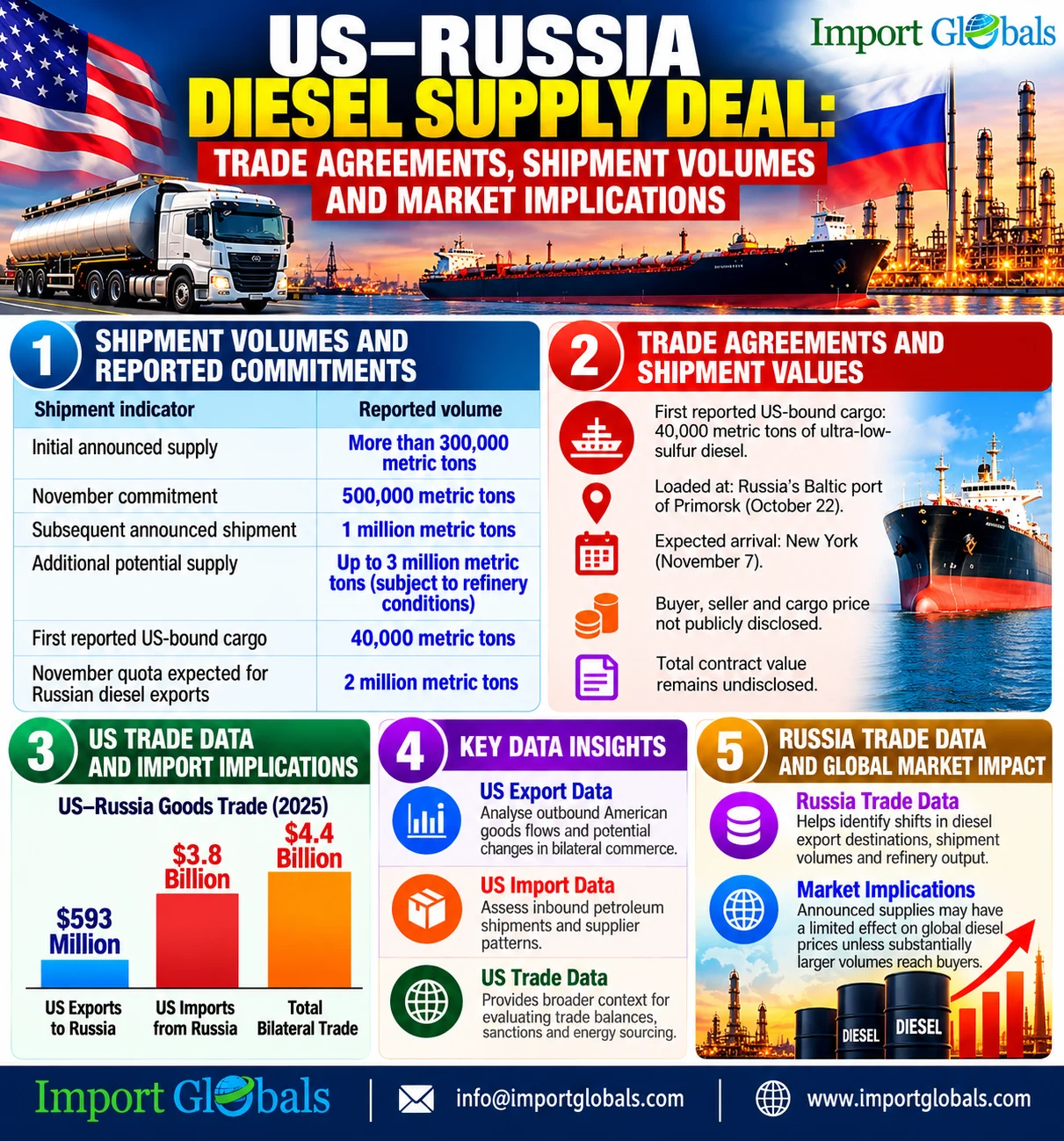
When diesel prices are high, the US-Russia diesel supply deal announced in October 2026 is meant to increase the availability of fuel. Russia will ship more than 300,000 metric tons to US and global markets initially, with more shipments to follow, US President Donald Trump said.
Trade Agreements and Shipment Values
The first cargo to the US was reported to be 40,000 mt of ultra-low-sulfur diesel loaded at Russia’s Baltic port of Primorsk on October 22. The tanker was scheduled to arrive in New York on Nov. 7. The buyer, seller and agreed cargo price were not publicly identified in reporting. The total dollar value of the contract is not disclosed.
US Trade Data and Import Implications
According to the Office of the United States Trade Representative, “In 2025, the United States exported $593 million in goods to Russia and imported $3.8 billion in goods from Russia, resulting in about $4.4 billion in total U.S.-Russia bilateral trade in goods. The numbers are for all commodities, not just diesel.
US Export Data ( Watch the flow of US goods overseas, which may see changes in bilateral trade. Researchers can use the US Import Data to analyze inbound petroleum shipments and supplier trends. The US Trade Data provides a broader context for the assessment of trade balance changes, sanctions and energy supply.
Russia Trade Data and Global Market Impact
By following Russia Trade Data, one can observe the shifts in diesel export destinations, volume of shipments, and refinery output. But analysts say the announced supplies will do little to affect global diesel prices unless much larger volumes reach buyers.
Refinery disruptions, government export restrictions and renewed shipments following the reported US-Russia supply arrangement have shaped Russia's diesel export market for 2026.
Russia’s Diesel Export Trade Data in 2026: Export Values, Volumes and Major Destinations
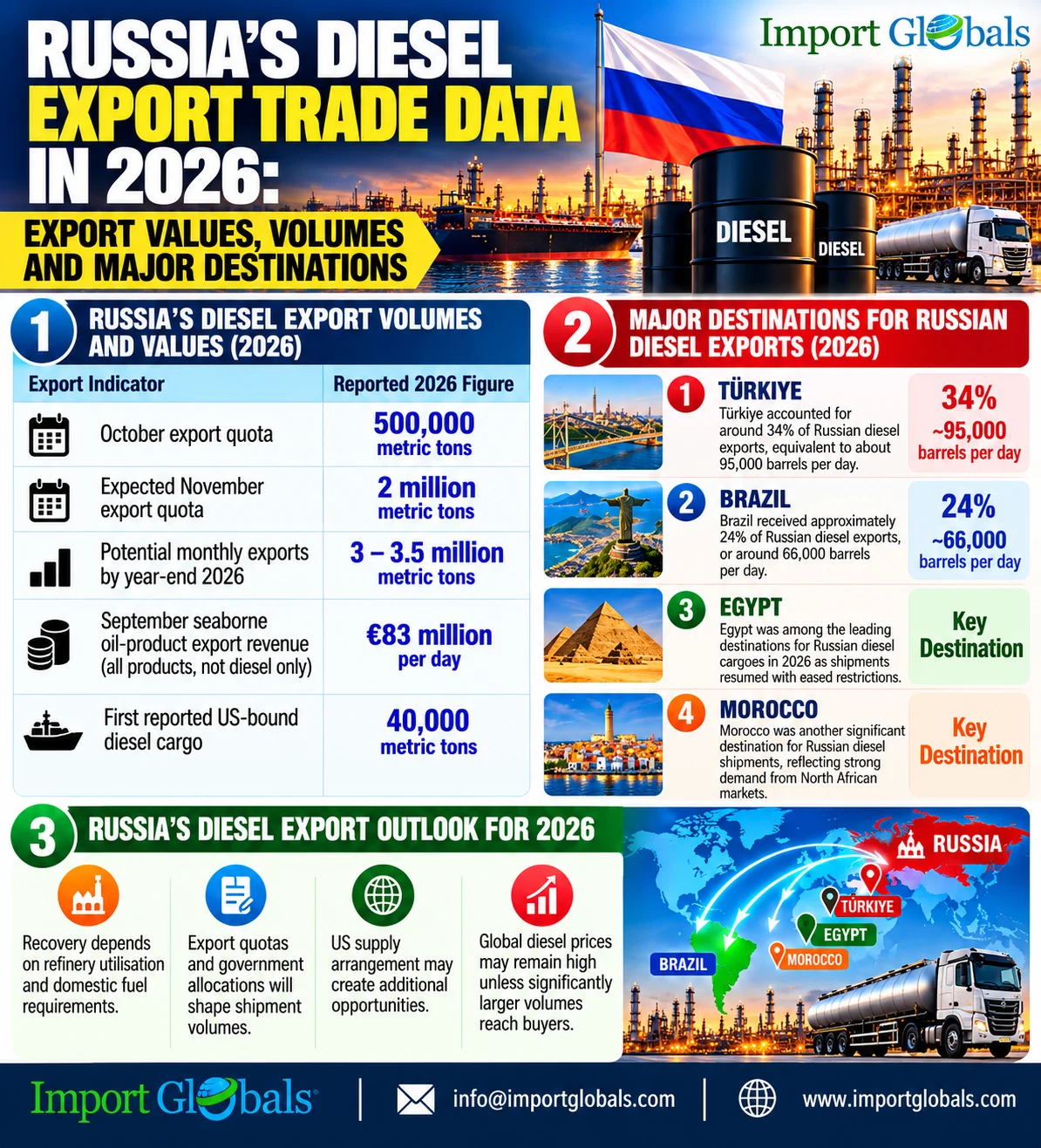
1. Russia’s Diesel Export Volumes and Values
2. Major Destinations for Russian Diesel Exports
1. Turkey
Turkey was around 34% of Russian diesel exports for 2026, or around 95,000 bpd. It is still a major destination for Russian refined fuels.
2. Brazil
The same reported dataset indicated that Brazil accounted for some 24% of Russian diesel exports, or some 66,000 barrels a day. Its demand has kept alive Russia’s trade with Latin America.
3. Egypt
Russian diesel cargoes in October were mostly bound for Egypt. Export restrictions were being relaxed and shipping data showed international shipments were returning to normal. No verification of annual valuation of diesel was done.
4. Morocco
Morocco was another major destination for Russian diesel in October. Its location points out the value of North African markets to Russia’s refined-fuel export network.
3. Export Outlook for 2026
Russia’s diesel exports will recover depending on refinery utilization rates, domestic fuel needs, quota allocations and international trade restrictions. More opportunities may arise from the US supply pact, but announced commitments should not be mistaken for already delivered deliveries.
Russian Export Trade Data is an invaluable resource for businesses looking to know the actual export values. Shipment records by destination, product classifications and customs declarations are important tools to know the actual export values. Import Globals enable trade professionals to analyze these flows and track developments in global petroleum markets.
Top Importing Countries of Russian Diesel and Changes in Global Trade Flows
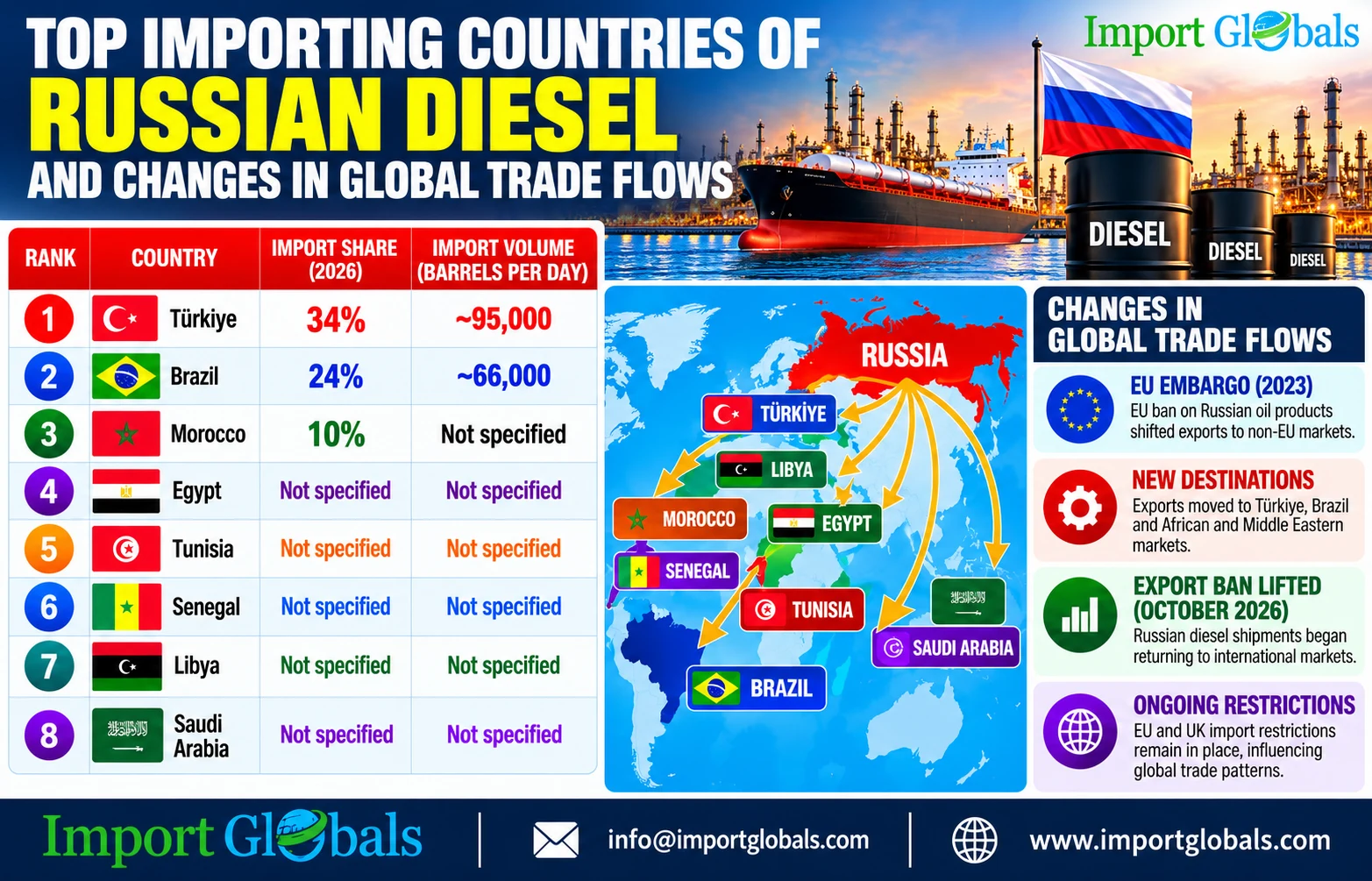
Sanctions imposed by the West and the reconfiguration of global petroleum trade routes have dramatically changed the destinations of Russia’s diesel exports. Russian diesel began flowing back to its traditional markets in October 2026 after Moscow lifted its self-imposed export ban on October 9. Shipping data reported by Reuters shows Turkey, Brazil and Morocco are among the main destinations.
Top Importing Countries of Russian Diesel in 2026
Turkey : 34% Received roughly 95,000 barrels per day of Russian diesel, higher than the reported 2026 data set.
Brazil : 24% Imports about 66,000 bpd. Major continuing buyer of Russian diesel.
Morocco : 10% Russian diesel imports resumed after reversing October export ban.
Egypt : It has become a destination for cargoes out of Russian ports but there was no confirmed market share for 2026.
Tunisia : Participated in Russian refined-fuel trade, with deliveries affected by changing supply conditions.
Senegal : Appeared as a destination for Russian diesel and gasoil in shipping data.
Libya : Part of Russia’s wider North Africa refined fuels trading network.
Saudi Arabia : In particular, in earlier post-2023 trade data, it became a major buyer after sanctions re-routed Russia’s petroleum-product exports.
The countries mentioned here are not a confirmed and complete ranking of all 2026 importers; individual shares and volumes may differ by reporting period.
Impact of Russia’s Diesel Export Restrictions on Global Fuel Prices and Supply Chains
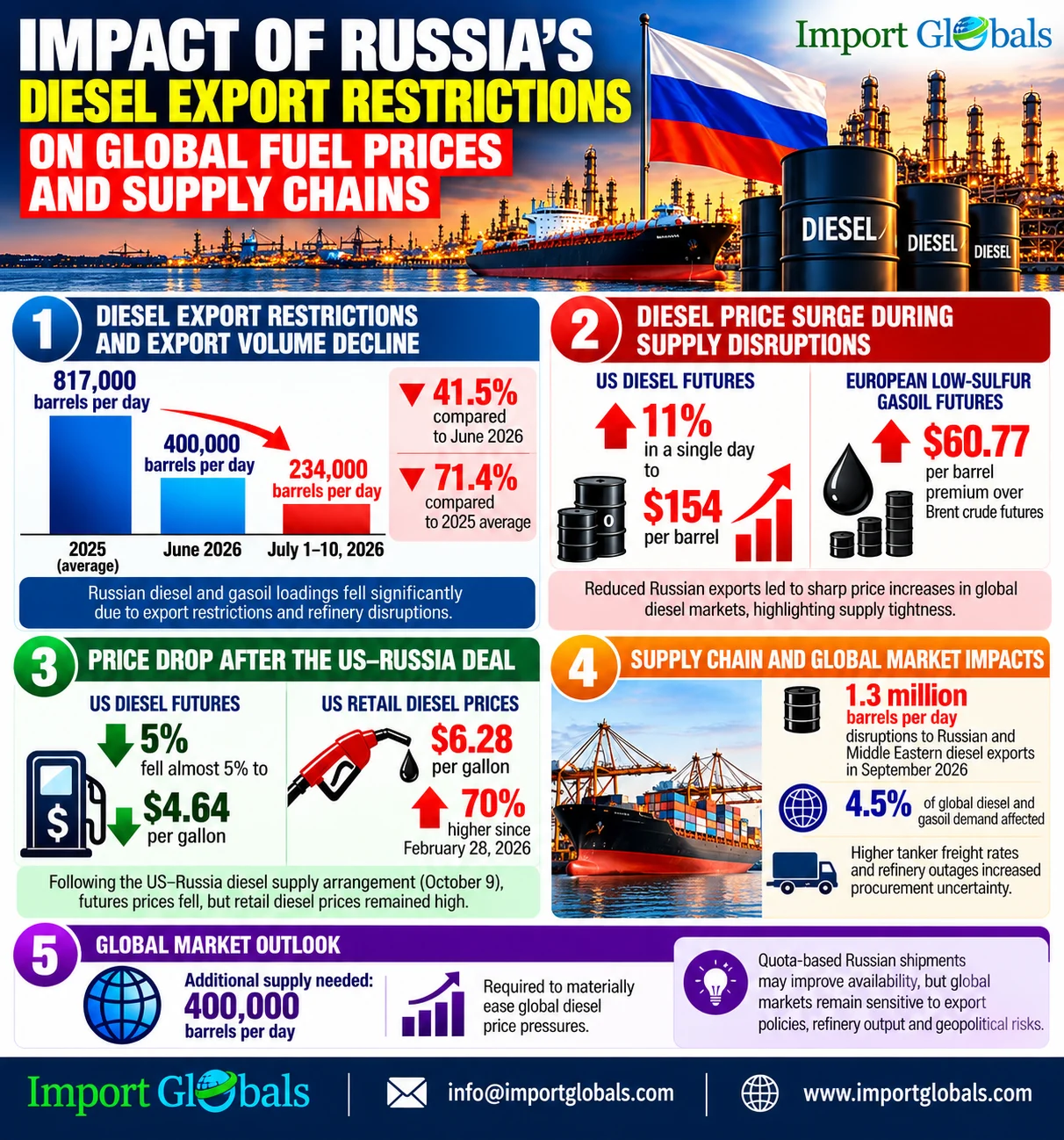
Russia’s curbs on diesel exports are hitting global fuel markets, with effects on prices, shipping routes and fuel availability in 2026. The limits come as supplies of diesel used in transport, farming, manufacturing and power generation are already being squeezed by geopolitical tensions and refinery woes.
1. Diesel Price Increases and Market Volatility
Russian diesel and gasoil loadings, however, fell to 234,000 barrels per day in the July 1-10 period, down from 400,000 barrels per day in June and an average of around 817,000 barrels per day in 2025, Reuters reported in July 2026. That’s down about 41.5% from June and down 71.4% from the 2025 average.
U.S. ultra-low sulfur diesel futures rose 11% in a day to $154 a barrel while European low-sulphur gasoil futures reached a record premium of $60.77 a barrel over Brent crude futures. The figures show how vulnerable the market is to sudden shocks in supply.
2. Price Drops After the US–Russia Deal
US diesel futures dropped nearly 5% to $4.64 a gallon on Oct. 9 following the announcement of the US-Russia diesel supply arrangement. But retail prices for diesel in the U.S. averaged $6.28 a gallon that day. retail prices have climbed about 70% since Feb. 28, 2026, according to Reuters. Therefore, consumers did not immediately see equivalent savings when futures fell.
3. Supply Chain and Shipping Impacts
Russian restrictions have led to buyers scrambling for other supplies from the United States and other exporting countries. Uncertainty in procurement has been compounded by higher tanker freight rates, refinery outages and geopolitical risks. Reuters said Russian and Middle Eastern exports of diesel were disrupted by 1.3 million barrels per day in September, or about 4.5 percent of the world’s demand for diesel and gasoil.
4. Global Market Outlook
Quota-based Russian shipments could help availability, but analysts say another 400,000 bpd would be needed to materially ease current price pressures. Importers should pay attention to export restrictions, freight fees and delivery times when buying.
These developments are important for businesses tracking Russia Export Statistics and international fuel flows because they show how export policies can affect prices well outside the countries directly involved. Import Globals provides business insights on changing trade flows and energy-market risks.
How Export Quotas Affect Russian Refineries, Domestic Fuel Supply and Petroleum Companies
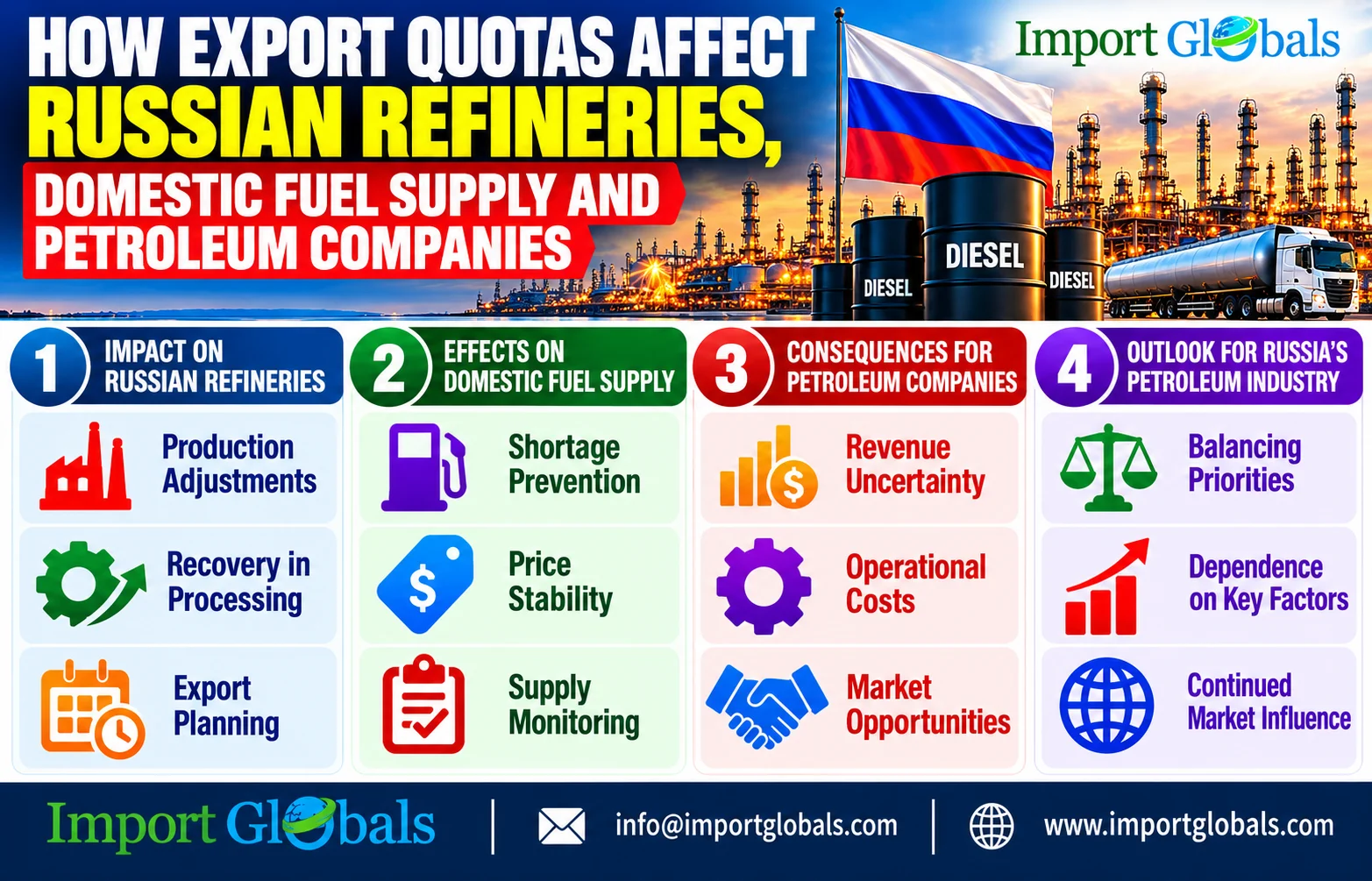
1. Impact on Russian Refineries
Production Adjustments: Diesel output fell to some 160,000 metric tons a day in the first half of October from 175,000 metric tons a day in September, according to the report.
Recovery in Processing: Production began to rise after export quotas were introduced. Reuters later reported that output hit about 225,000 metric tons per day in the second half of October, according to industry sources.
Export Planning: Quotas help refiners set output levels, determine when to ship abroad, and prevent them from building up too much inventory at home.
2. Effects on Domestic Fuel Supply
Shortage Prevention: Export controls reserve diesel for agriculture, freight, industrial machinery and regional distribution.
Price Stability: Also, domestic authorities can use export restrictions to control domestic fuel prices by reducing competition between domestic and foreign purchasers.
Supply Monitoring: “The government can regulate the quota allocation as per the recovery of the refinery, seasonal demand and availability of indigenous fuel.
3. Consequences for Petroleum Companies
Revenue Uncertainty: Export restrictions reduce the outlook for sales abroad, but quota exemptions allow some companies to resume overseas operations.
Operational Costs: Refinery repairs, production and shipping schedule changes can increase costs.
Market Opportunities: The new export licenses enable sales to foreign buyers, including under the reported US-Russia diesel deal.
4. Outlook for Russia’s Petroleum Industry
Russian oil companies have to balance export revenues and domestic supply obligations. Future performance will be driven by refinery reliability, government regulation, and worldwide demand for diesel.
Opportunities and Risks for Global Diesel Importers, Exporters and Energy Traders
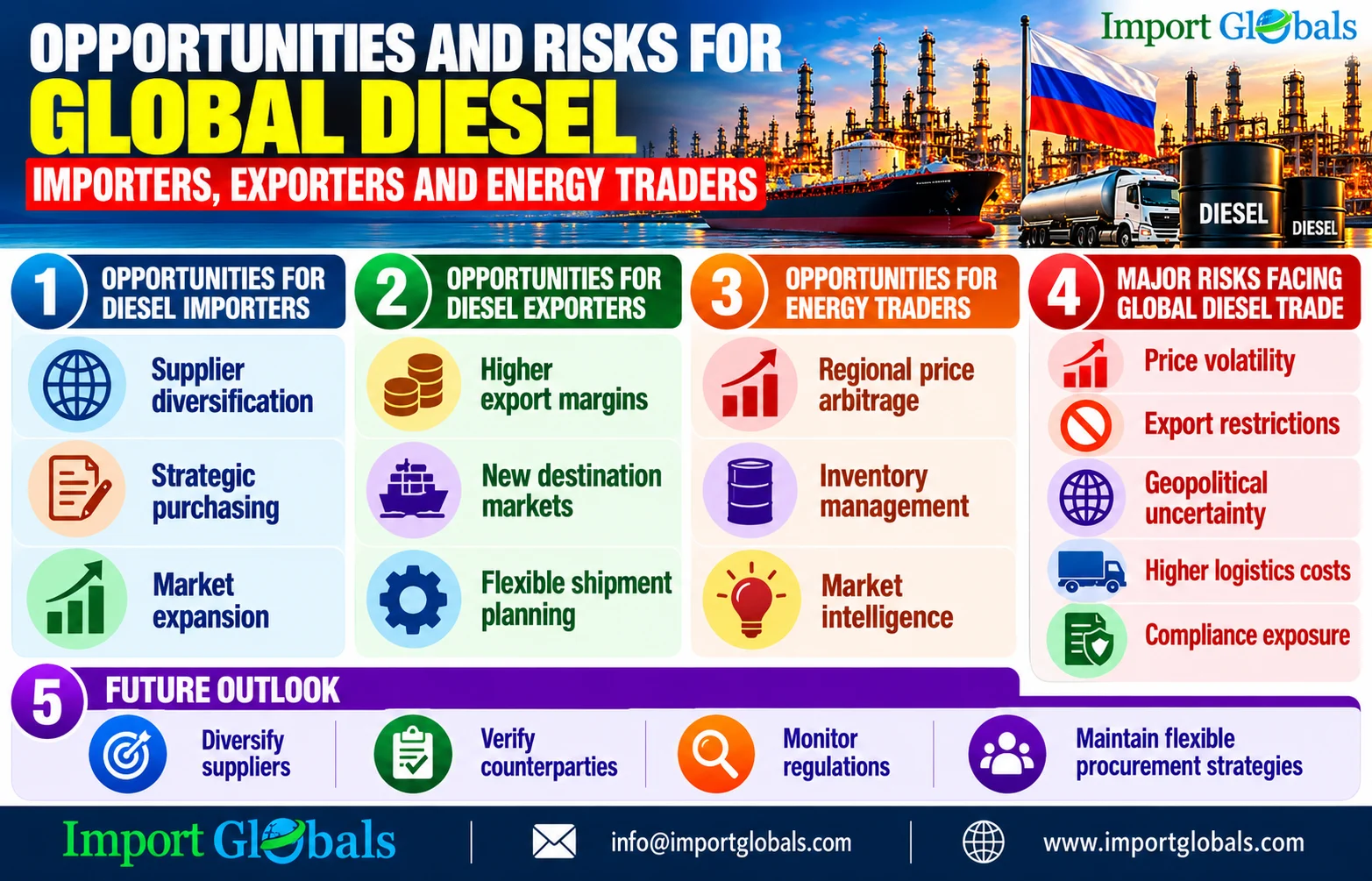
2026 has been a difficult year for the global diesel trade with geopolitical tensions, refinery issues, export bans and erratic price swings all having their impact. These developments offer opportunities for international traders, but also pose risks across energy supply chains. Diesel prices hit record highs in September globally because of supply disruptions from Russia and Middle East due to wars, Reuters said.
1. Opportunities for Diesel Importers
Supplier Diversification: Importers may turn to alternative markets such as the United States, India and South Korea to reduce dependence on individual suppliers.
Strategic Purchasing: Buyers can enter into longer supply contracts to protect themselves against sudden price increases.
Market Expansion: Fuel distributors can look for opportunities in emerging economies where the transportation, agriculture and industrial sectors are developing.
2. Opportunities for Diesel Exporters
Higher Export Margins: Shortages can create demand for cargoes from exporters with available refining capacity.
New Destination Markets: Opportunities abound for exporters in Latin America, Africa and the Mediterranean.
Flexible Shipment Planning: Companies with good logistics and warehousing capabilities can respond quickly to changes in international demand.
3. Opportunities for Energy Traders
Regional Price Arbitrage: Traders can spot price differences between markets as long as freight, insurance, taxes and compliance costs leave a margin worth having.
Inventory Management: The ability to store allows market participants to react to temporary supply disruptions and changing delivery schedules.
Market Intelligence: By monitoring export quotas, refinery operations and shipment movements, procurement and trading decisions can be improved.
4. Major Risks Facing Global Diesel Trade
Price Volatility: Diesel prices soared and traders lost money as supplies were suddenly cut.
Export Restrictions: Shipments of contracted volumes can be blocked or delayed by government bans and quotas.
Geopolitical Uncertainty: Conflicts & sanctions may interfere with established trade routes.
Higher Logistics Costs: Longer hauls, tight tanker supply and insurance costs can squeeze margins.”
Compliance Exposure: Weak sanctions screening and documentation can lead to penalties, delayed payments or rejected cargoes.
5. Future Outlook
Diesel traders need to diversify suppliers, check counterparties, watch regulations and keep procurement strategies flexible. Import Globals helps businesses to spot changing opportunities in the energy market and to analyze developments in global trade.
Future Outlook for Russia’s Diesel Exports: Trade Routes, Policy Risks and Market Trends
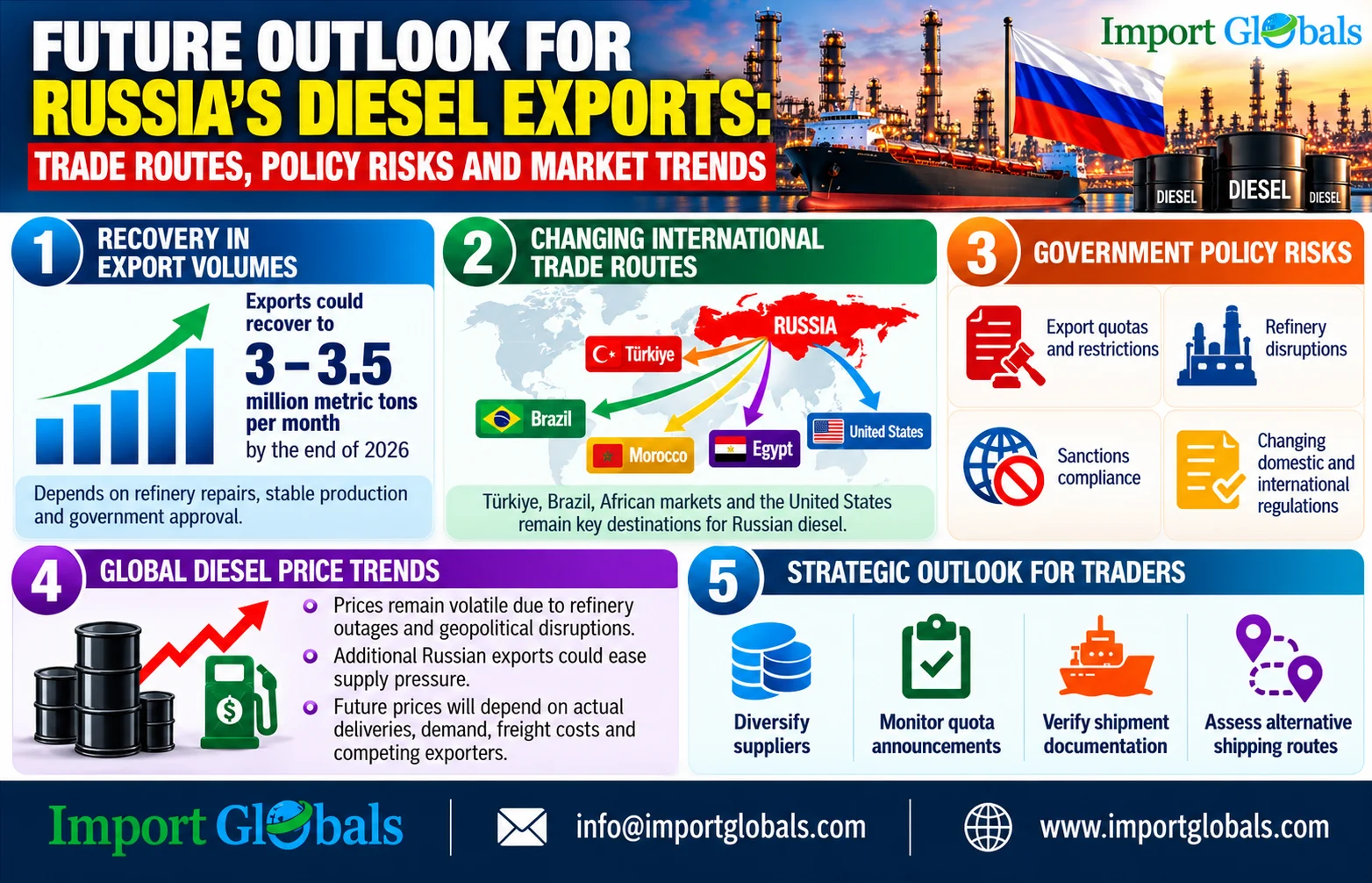
The outlook for Russian diesel exports for the rest of 2026 will depend on the pace of refinery recovery, government export quotas, international sanctions and global fuel demand. “Exports could recover to pre-disruption levels if refinery runs recover,” a source said. Moscow is still limiting shipments abroad to safeguard domestic supplies.
1. Recovery in Export Volumes
Russia’s Deputy Prime Minister Alexander Novak said diesel exports could return to 3-3.5 million metric tons per month by the end of 2026. How quickly it gets there will depend on refinery repairs, steady output and government approval for additional shipments.
2. Changing International Trade Routes
Turkey and Brazil: These markets are still important outlets for Russian diesel and gasoil.
African Markets: Other outlets for cargoes could be found in countries like Morocco, and Egypt.
United States: Reported diesel supply arrangements could open the door for more shipping opportunities, if volumes and rules permit.
Sanctions and restrictions on Russian-derived petroleum products remain in place to divert trade to other destinations.
3. Government Policy Risks
“Export restrictions, lack of fuel supply, refinery shutdowns and geo-political situations could limit shipping opportunities. Exporters also have to consider compliance issues, payment issues, insurance issues and importation requirements in the destination countries. The changes in the regulatory framework could create difficulties in terms of deliveries and commercial predictability.
4. Global Diesel Price Trends
Even with the threat to the refineries, there have been chronic shortages of diesel fuel. Russian exports could ease this shortage crisis, but the effect on prices will depend on supply and demand, shipping costs and competition among exporters.
5. Strategic Outlook for Traders
Importers and energy traders will have to look elsewhere, watch announcements on import quotas, scrutinize the transportation documents and think about different modes of transportation. By tracking Russian import/export data, destination and oil trading regulations, one would be able to anticipate any changes in supplies.
Conclusion
The fact that an export ban on Russian diesel has been decided for the year 2026 reflects the impact of government policies on the global trade of energy. The importers and traders must keep an eye on government policies and alternative suppliers of fuel and should use the information obtained from the trade.
CTA
Keep up to date with the changes in the global energy market. Get accurate import and export trade data Track diesel shipments Analyze export quotas Identify emerging trade opportunities Visit www.importglobals.com or Email at info@importglobals.com today to improve your market research, reduce your risks and make better international trade decisions.
FAQs
Que. Why did Russia extend its diesel export ban until 2026?
Ans. Russia may extend curbs to boost domestic fuel supplies, manage price volatility
Que. What are the restrictions on diesel exports?
Ans. Export quotas are limits the government places on how much diesel can be exported.
Que. What will the ban do to diesel prices globally?
Ans. Reduced export availability could lead to tighter supplies and higher prices in importing markets.
Que. Which countries import Russian diesel?
Ans. Under the current restrictions the main destinations have been Turkey, Brazil and a host of African markets.
Que. What effect will the US supply deal have on diesel trade?
Ans. It would depend upon the nature of the transaction, the specific products and the applicable sanctions and export control regulations.
Que. What will be the problems for diesel traders in 2026?
Ans. Traders face regulatory uncertainty, sanctions compliance, shipping disruptions and volatile fuel prices.
Que. What alternatives do importers have to lower the risk of diesel supply?
Ans. They can diversify their suppliers, monitor policy changes and seek alternative shipping routes.
Que. How import export data helps diesel traders?
Ans. Import Globals data helps companies analyze shipment trends, locate suppliers, evaluate markets, and make informed sourcing decisions.
Que. How frequently is the russia import-export trade data?
Ans. Russia import-export trade data is updated on a monthly basis.
Que. Where can you obtain detailed information on Russia import-export trade data?
Ans. Visit www.importglobals.com or drop an email at info@importglobals.com for detailed updates on Russia import-export trade data.
You Can Also Visit :-
- Russia Customs Data: A Comprehensive Guide for Progressive Importers and Exporters
- Information About Russia's Oil Exports, Such as How Much Oil Russia Makes and WHO Sells It
- Russia Top Exporting Product Of 2023-2024
- Introduction to the Fossil Fuels Export Market of Russia
- USA Import Data 2025: Latest Trade Statistics and Market Insights
- USA Economic Data and Trade Analysis
