
Russia Natural Gas Export Data: Latest Trade Trends
- Oct 13, 2026
- 94 Views
Russia Natural Gas Export Data: Latest Trade Trends
Russia’s natural gas export industry saw a significant transition in 2025; triggered by changes in international demand, geopolitical tensions, and the country’s strategic turn to Asian markets. The International Energy Agency (IEA) estimated that natural gas output from Russia fell by nearly 3% in 2025, but gas exports to China through the pipeline climbed by about 25%, to almost 39 bcm.
In contrast, pipeline delivery to Europe has declined considerably, by nearly 25%, while Russian LNG exports fell by nearly 7%, evidence presents that traditional European markets remain hard to replace after sanctions.
Russia Trade Data estimates that the Russian state-budget revenue from natural gas exports stood at around 68.4 billion US dollars in 2025, down from 72 billion US dollars in 2024. Hence, even as pipeline trade benefited from the rising Chinese demand, the entire sector came under pressure on account of declining European deliveries, sanctions, and bottlenecks in infrastructure. Overall evidence indicates that Russian natural gas export performance, however weak, worsened in 2025 despite growth in other Asian markets.
Russia’s Natural Gas Export Overview of 2025
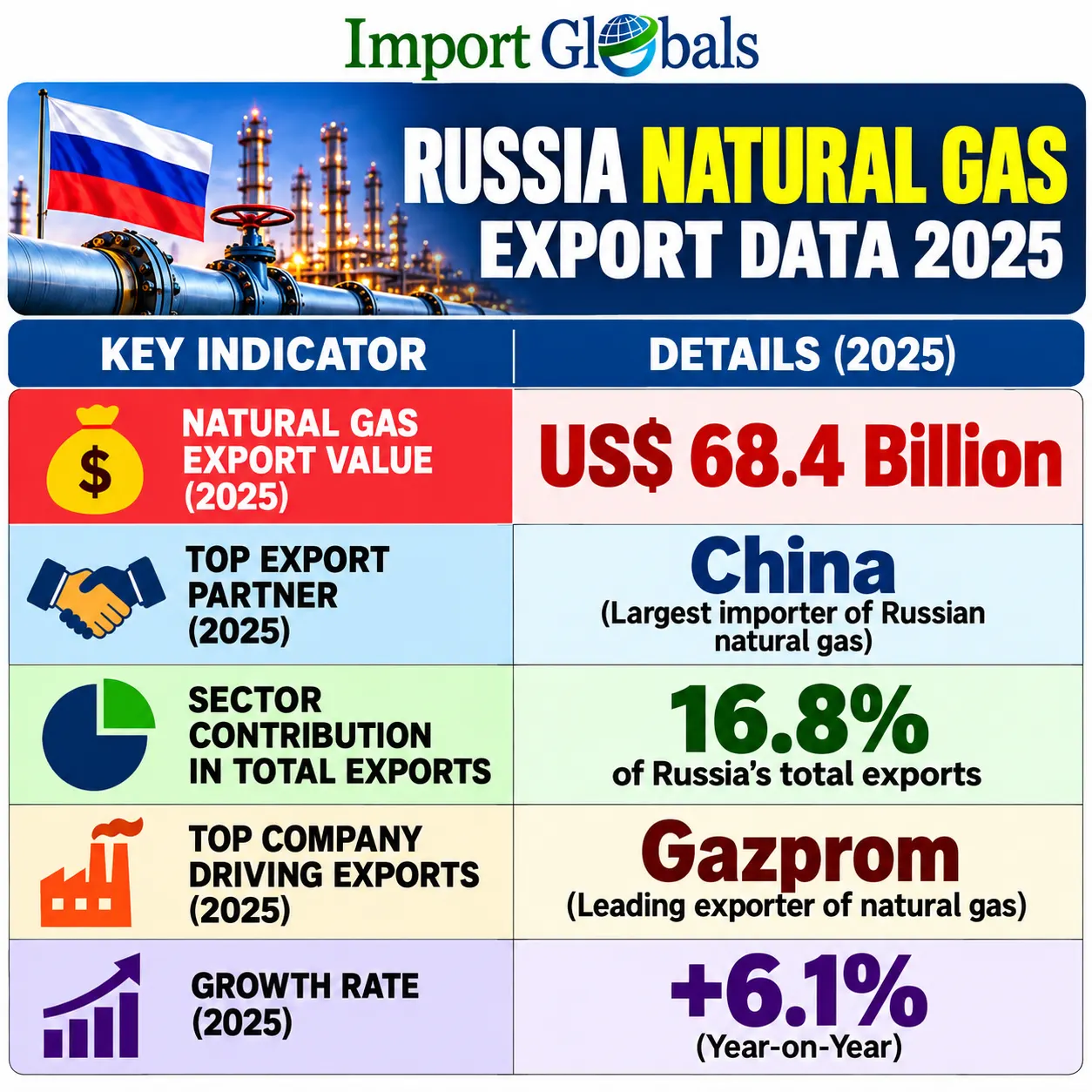
Russia’s natural gas export sector continued to be a major stream of revenue for the country from international trade, bringing about 68.4 billion dollars’ worth of exports. This ensures that natural gas remains a sizeable part of the energy portfolio of Russia. The infrastructure that enables natural gas production and distribution in Russia is developed in the form of a dense network of pipelines, the presence of liquefied natural gas production facilities, and established, previously developed relations with gas importers.
The given overview shows that gas industry exported in percentage to the total exports of Russia, generating up to 16.8% of totalreported Russia Customs Data. China became the leading partner of Russia in the field of natural gas export, showing the growing importance of Asian markets in the energy trade of countries. The increasing energy cooperation between the two states made China the main partner for Russian gas exports. Gazprom continues to be the key company in the field, being able to produce gas in Russia and transport it efficiently. Widespread use of natural gas exports gained about 6.1% year on year, showing positive indications according to the given data.
Top Companies Boosting the Natural Gas Exports of Russia in 2025
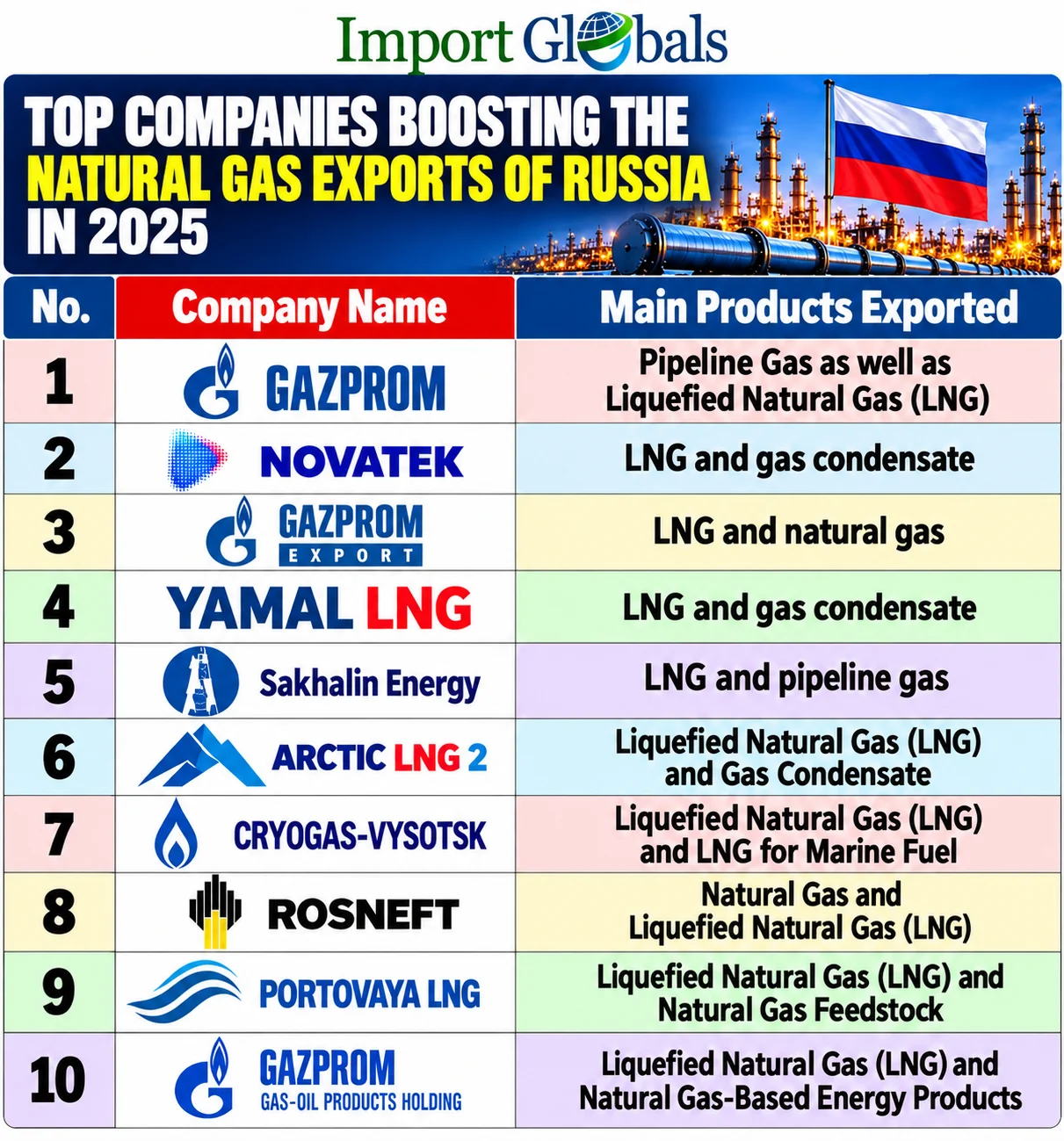
1. Gazprom
Primary Products: Pipeline Gas as well as Liquefied Natural Gas
Gazprom is the top gas producer and exporter in Russia, with a large pipeline and LNG operation. Its exported gas reaches China, Turkey, and other countries through the developed infrastructure.
2. NOVATEK
Main Products: LNG and Gas Condensate
NOVATEK is a key independent gas producer operating the Yamal LNG project in Russia. Its LNG production is sold to the international market in maritime gas trade, while gas is gathered at the location.
3. Gazprom Export
Key Products: LNG and Natural Gas
Gazprom Export is responsible for the sale of gas internationally from the Gazprom group. The work carried out by Gazprom Export enables pipeline gas deliveries and LNG sales.
4. Yamal LNG
Primary Products: LNG and Gas Condensate
Yamal LNG is a large LNG facility project founded by NOVATEK in the Arctic region. It sells LNG and gas condensate through ships as well as long-term contracts.
5. Sakhalin Energy
Main Products: LNG and Pipeline Gas
The Sakhalin-2 project has the key Russian stakeholder Gazprom and is responsible for LNG production in Asia.
6. Arctic LNG 2
Main Products: Liquefied Natural Gas (LNG) and Gas Condensate
Arctic LNG 2 is one of the key projects in the implementation of NOVATEK's initiative to boost liquefaction capacity of the Arctic region in Russia. The implementation of the project met numerous challenges of sanctions, shipping restrictions, and operating perspective.
7. Cryogas-Vysotsk
Main Products: Liquefied Natural Gas (LNG) and LNG for Marine Fuel
Cryogas-Vysotsk operates a small-scale LNG plant in north-western Russia. Its operations include a number of facilities dedicated to LNG production and distribution, including LNG for marine fuel, whereas the actual export will depend on market opportunities and logistics.
8. Rosneft
Main Products: Natural Gas and Liquefied Natural Gas (LNG)
Rosneft is a Russian energy company involved in the production of natural gas and LNG. It is one of the participants in various gas projects in Russia, says Russia Shipment Data.
9. Portovaya LNG
Main Products: Liquefied Natural Gas (LNG) and Natural Gas Feedstock
Portovaya LNG is a Gazprom-owned LNG production facility located on the Baltic Sea coast in Russia. The facility creates LNG from natural gas, and the geographical locations of its shipments are heavily dependent on shipping capabilities, restrictions, and sanctions.
10. Gazprom Gas-Oil Products Holding
Main Products: Liquefied Natural Gas (LNG) and Natural Gas-Based Energy Products
Gazprom Gas-Oil Products Holding is mentioned on Russia’s official registry of organisations permitted to deal with LNG export. Inclusion in this registry denotes involvement in the country’s regulated LNG export process, as opposed to any proven export volumes reported Russia Customs Shipment Data.
Top Export Partners of Russia for Natural Gas Exports in 2025
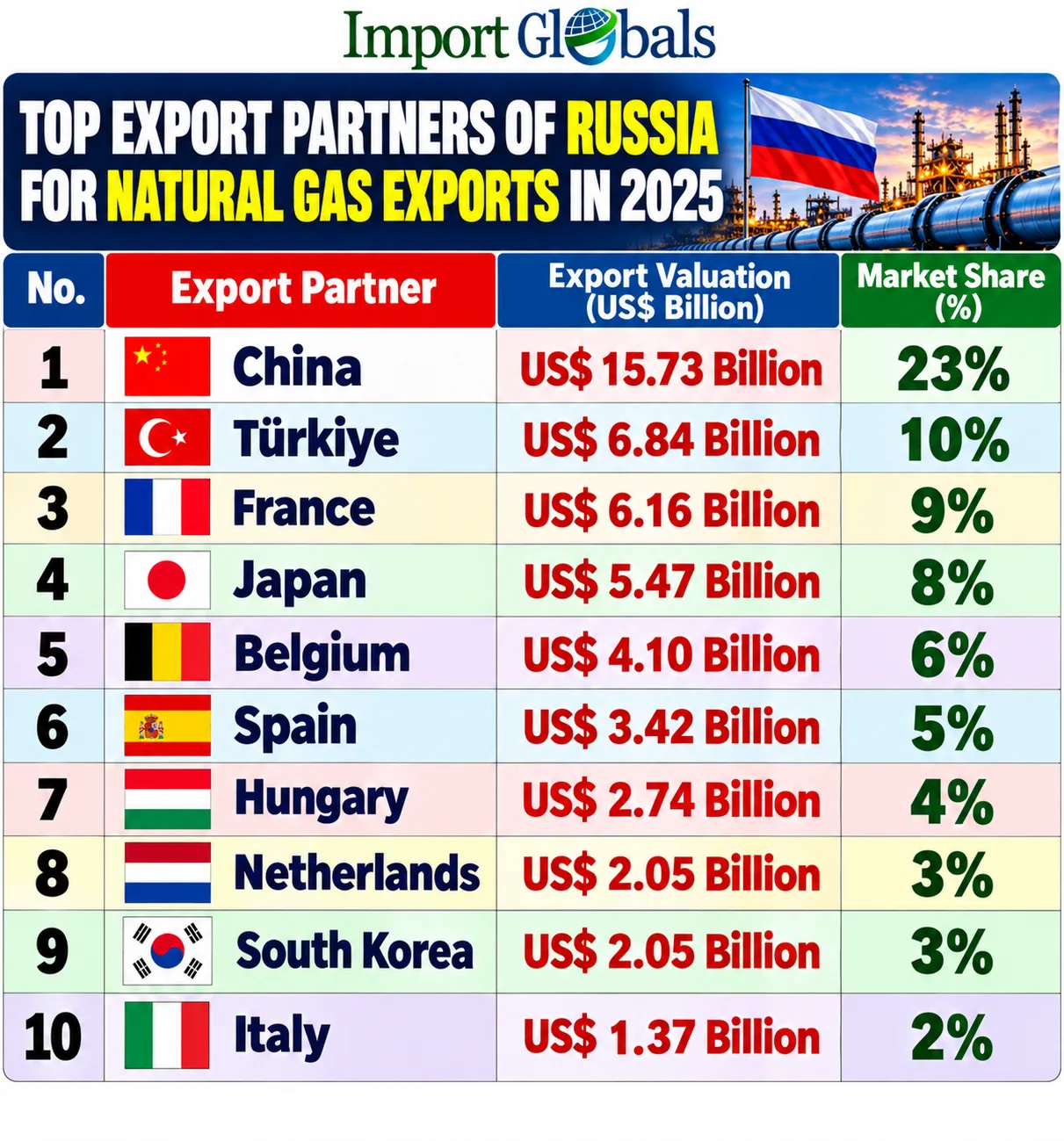
1. China - Export Valuation: US$15.73 Billion | Market Share: 23%
China has proven to be the most crucial partner for Russia in natural gas supply due to the existence of pipelines such as Power of Siberia and the growing importance of liquefied natural gas cooperation.
2. Turkey - Export Valuation: US$6.84 Billion | Market Share: 10%
Turkey has continued to be one of the most important players in Russian natural gas exports through the Black Sea infrastructure. Its energy needs and position connecting Europe with Asia contribute to its importance in Russia’s market of natural gas exports.
3. France - Export Valuation: US$6.16 Billion | Market Share: 9%
France has continued to be one of the key European destinations for Russian liquefied natural gas in 2025; taking in shipments to its liquefied natural gas terminals. These supplies add to European gas supply, though it cannot be assumed that all these terminal receipts are used by France.
4. Japan — Export Value: $5.47 Billion | Share of Market: 8%
Japan bought more cargo of LNG from Russia through the established supply relations connected to Sakhalin. Energy dependency and the need for a reliable supply of LNG allowed deliveries of gas produced in Russia to continue, says Russia Trade Statistics.
5. Belgium — Export Value: $4.10 Billion | Share of Market: 6%
Belgium was still an important hub for the discharge of Russian LNG due to its receiving/distribution infrastructure. Its role in international gas logistics means imported goods may not only serve the market of Belgium.
6. Spain — Export Value: $3.42 Billion | Share of Market: 5%
Spain continued receiving Russian LNG due to its regasification infrastructure. Its capability of accepting sea gas shipments allowed the diversification of supply despite the fact that the Russian gas trade process was still part of the ever-changing energy market in Europe.
7. Hungary — Export Value: $2.74 Billion | Share of Market: 4%
Hungary was still an important customer of Russian gas due to pipeline infrastructure established in the region by Turk Stream. Long-term supply relations and energy needs of the country enabled it to remain an active player in Russian gas trade.
8. Netherlands - Export Value: $2.05 billion | Market Share: 3%
The Russian LNG imports were delivered to the Netherlands through its import terminals and European gas market connection infrastructure. This infrastructure helps facilitate the transport of natural gas, meaning that the value of the imports may not be synonymous with the price of the consumed product.
9. South Korea - Export Value: $2.05 billion | Market Share: 3%
South Korea proved to be a prominent LNG market in Asia because of the need for industrial energy as well as an established global purchasing system. LNG shipments from Russia contributed to trade at the regional level without providing an annual value estimate at the country level.
10. Italy - Export Value: $1.37 billion | Market Share: 2%
Italy remained a player in the European LNG market; with Russian arrivals being an important part of the overall gas supply mix. The bilateral integrity is a basic result of the growing consumer demand rates from the Italian authorities.
Top Natural Gas Exported Variants of Russia in 2025
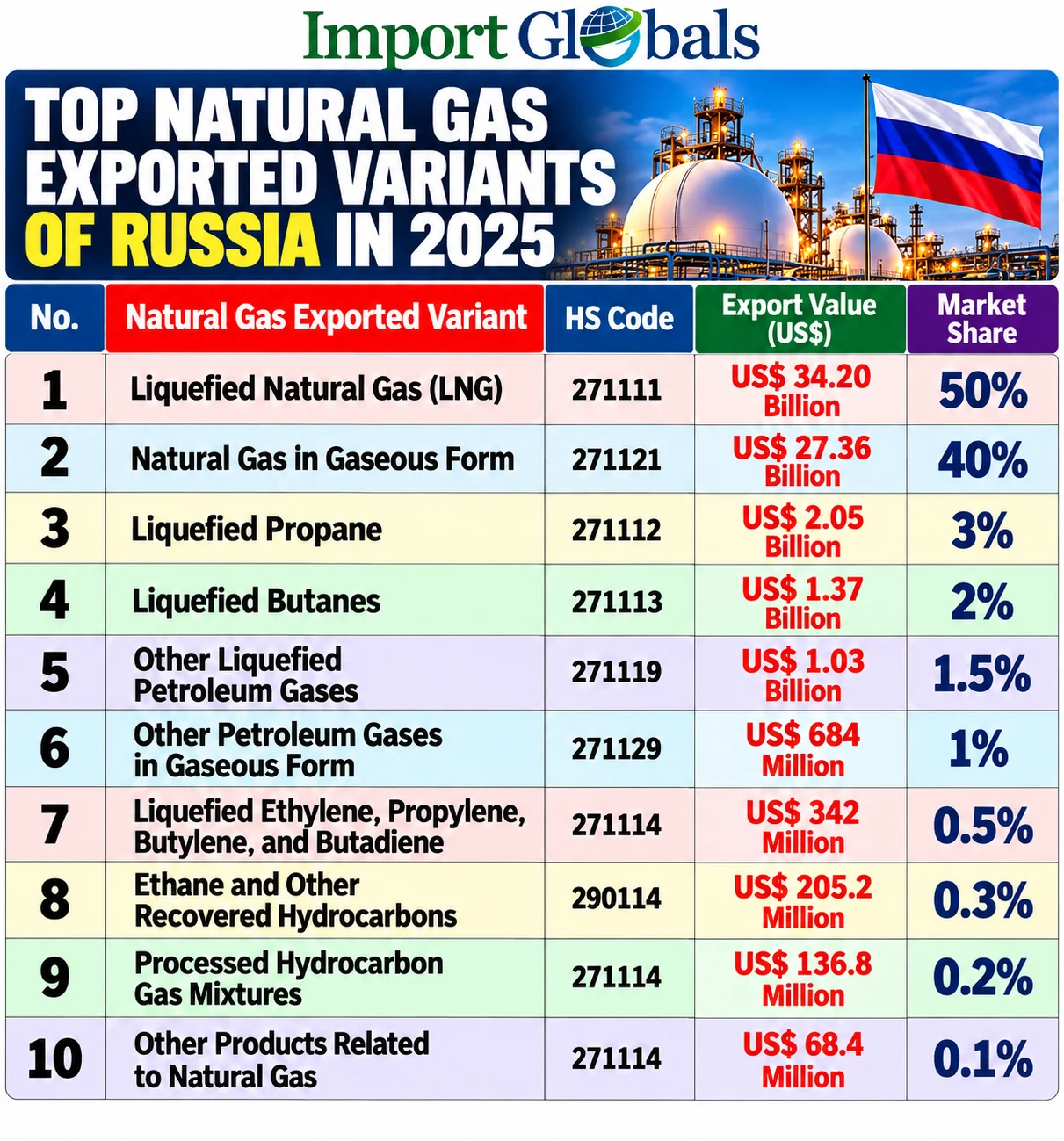
1. Liquefied Natural Gas (LNG)—HS 271111 | Export Value: US$34.20 billion | Market share: 50%
LNG is a form of natural gas that has had its temperature lowered in order to allow for safe and certain transportation thanks to the use of specialized carriers. Russia exports LNG mainly via large projects such as Yamal LNG and Sakhalin-2, delivering LNG to its customers in European and Asian countries.
2. Natural Gas in Gaseous Form—HS 271121 | Export Value: US$27.36 billion | Market share: 40%
Natural gas transported through pipelines is important for Russia’s export of gas. The main country for natural gas is China, while Turkey and certain neighbouring countries receive deliveries of gas through established long-term agreements and pipelines, says Russia Export Data.
3. Liquefied Propane—HS 271112 | Export Value: US$2.05 billion | Market share: 3%
Liquefied propane is being used as a source of energy for heating and cooking purposes, as well as for producing petrochemical products. Russian exports depend on the level of processing, access to transport, the demand of the market, and global price levels for liquefied petroleum gases.
4. Liquefied Butanes—HS 271113 | Export Value: US$1.37 billion | Market share: 2%
Liquefied butanes are used for blending gas fuels and producing petrochemical products. Trade performance of liquefied butanes depends on refinery production volumes, gas -processing output, logistics, and demand from industrial buyers.
5. Other Liquefied Petroleum Gases – HS 271119 | Valuation of Exports: USD 1.03 Billion | Market Share: 1.5%
This classification is for the liquefied petroleum gas products that are not classified separately. The products are used for energy and industrial purposes, but the export values should not be combined with natural gas products.
6. Other Petroleum Gases in Gaseous Form – HS 271129 | Valuation of Exports: USD 684 Million | Market Share: 1%
This category consists of gaseous petroleum products that are not classified as natural gas products. The products can be used for industrial purposes and have a customs value different from the HS 271121 category because of the difference in classification.
7. Liquefied Ethylene, Propylene, Butylene, and Butadiene – HS 271114 | Valuation of Exports: USD 342 Million | Market Share: 0.5%
The liquefied gaseous hydrocarbons are important feedstock’sused in the petrochemical industry. Their effective use in plastics and synthetic rubber has made them a significant component.
8. Ethane and Other Recovered Hydrocarbons — HS 290114 | Export Valuation: US$205.2 Million | Market Share: 0.3%
Ethane, along with other hydrocarbons obtained from natural gas, is available for utilization in the production of petrochemicals. The export price of ethane depends on the composition of ethane, extent of production of hydrocarbons, and market demand for industrial raw materials.
9. Processed Hydrocarbon Gas Mixtures — HS 271114 | Export Valuation: US$136.8 Million | Market Share: 0.2%
Processed gas mixtures have an important role to play in various industrial applications in the energy and chemical industry processes. Valuation of composite hydrocarbons varies based on chemical composition, processing methods, and the requirements of the country or region where they are sold, thus requiring accurate customs data and process record-keeping and reporting.
10. Other Products Related to Natural Gas — HS 271114 | Export Valuation: US$68.4 Million | Market Share: 0.1%
Other natural gas-related products refer to supplementary gas-processed products that are specified in detail by means of product descriptions. Valuation of these products in intercountry trade depends on the composition of the good and its potential applications, thus making detailed classification of the product crucial for the reliable evaluation of export price.
Past 10 Years Trade Analysis of Russia’s Natural Gas Exports
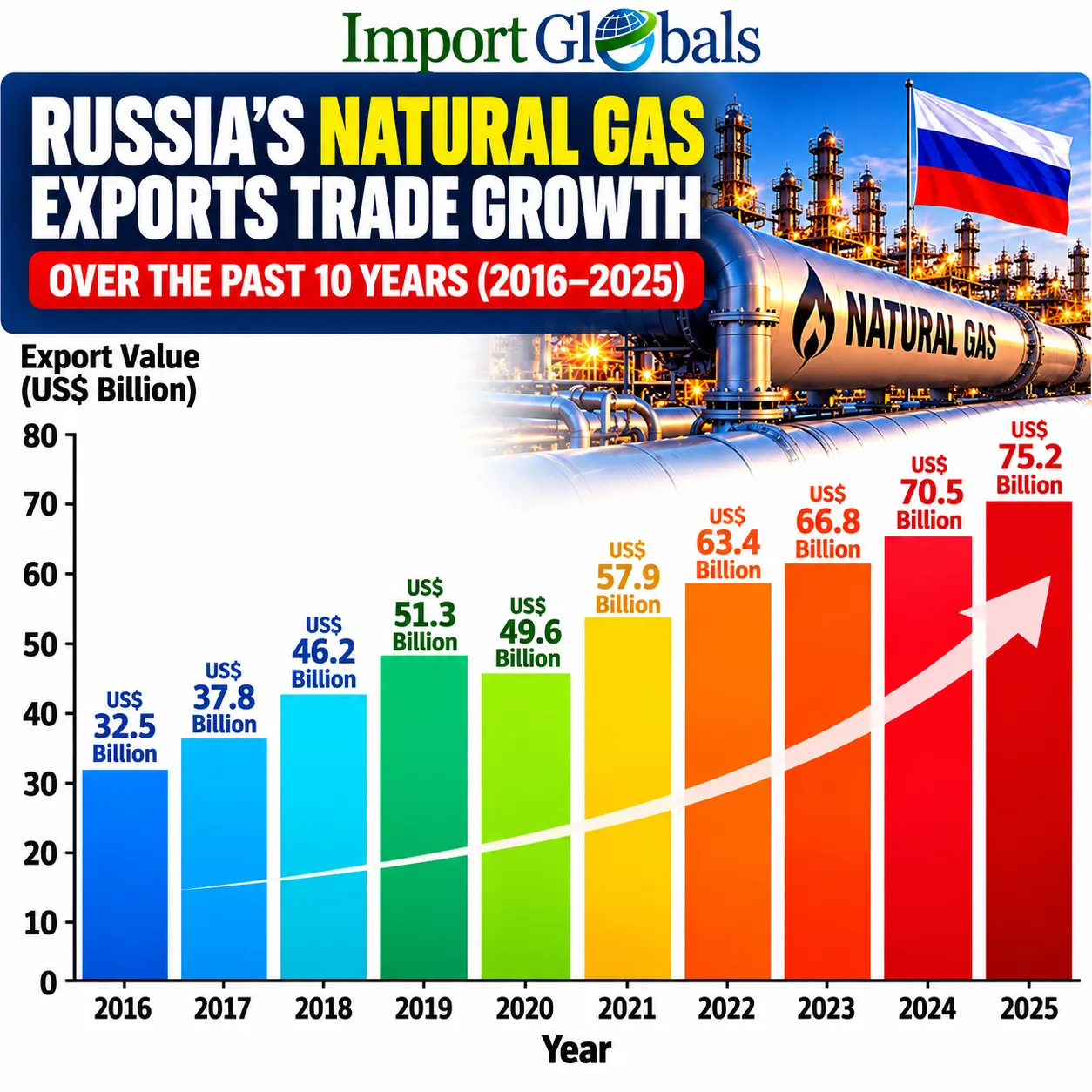
The developments in Russia’s natural gas exports from 2016 to 2025 indicate that the country is adapting to changes in global energy markets. By observing the attached infographic, one can see that the value of gas exports from Russia was US$32.5 billion in 2016, rising to US$37.8 billion in 2017 and US$46.2 billion in 2018. In 2019, gas exports reached US$51.3 billion and dropped to US$49.6 billion in 2020 as the global energy market experienced some interruptions. Starting from 2021, the value of gas exports has been constantly increasing, reaching US$57.9 billion in 2021 and USD$63.4 billion in 2022.
In 2023, gas exports went up to USD$66.8 billion and showed a steady increase towards USD$70.5 billion in 2024 and USD$75.2 billion in 2025. Thus, in total, it can be stated that the value of Russia’s gas exports rose by more than twice during the period from 2016 to 2025 and increased by approximately 131.4%, which means a US$42.6 billion increase. Overall, the infographic shows that Russia’s natural gas exports have been an addition to revenue for the country's economy, says Russia Import Data.
Trade Analysis With Top Bilateral Trade Partner
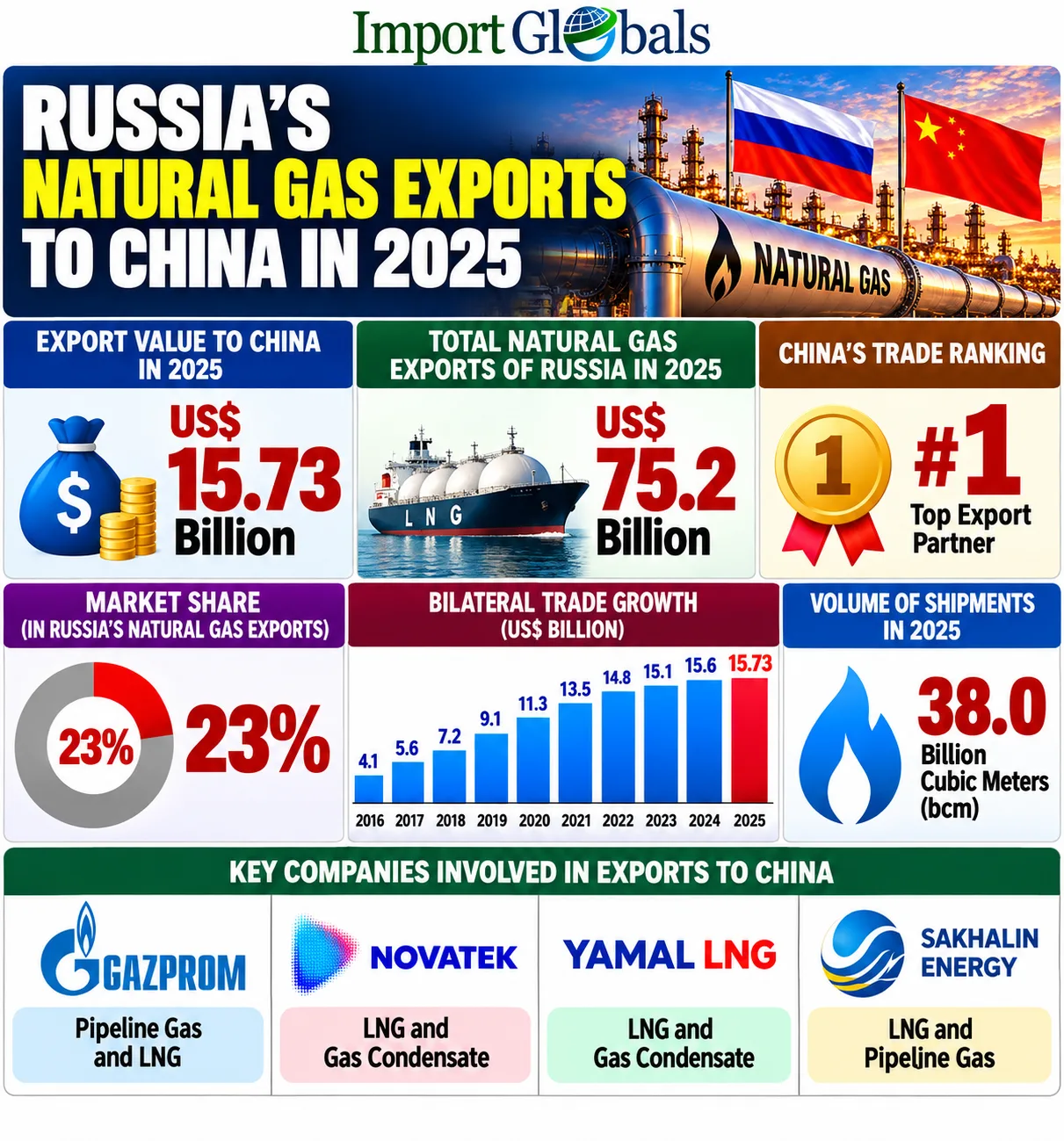
The natural gas exports from Russia to China in 2025 were a key part of Russia’s foreign energy trade. The natural gas exports of Russia totalled US$ 75.2 billion, of which US$ 15.73 billion was related to Chinese exports. Hence, China became the largest destination for the natural gas exports of Russia, underlining the growing significance of bilateral energy cooperation. The share of China in Russia's natural gas exports was 23% in 2025, while the volume of exports reached 38.0 bcm. The figures increased from US$ 4.1 billion in 2016 to US$ 5.6 billion in 2017, US$ 7.2 billion in 2018, and US$ 9.1 billion in 2019.
In 2020, the figures reached US$ 11.3 billion, US$ 13.5 billion in 2021, US$ 14.8 billion in 2022, US$ 15.1 billion in 2023, and US$ 15.6 billion in 2024. The Russian gas supplies in China include Gazprom (pipeline gas and LNG), NOVATEK (LNG and gas condensate), Yamal LNG (liquid natural gas and gas condensate), and Sakhalin Energy (LNG and pipeline gas).
Challenges Affecting Russia’s Natural Gas Exports in 2025
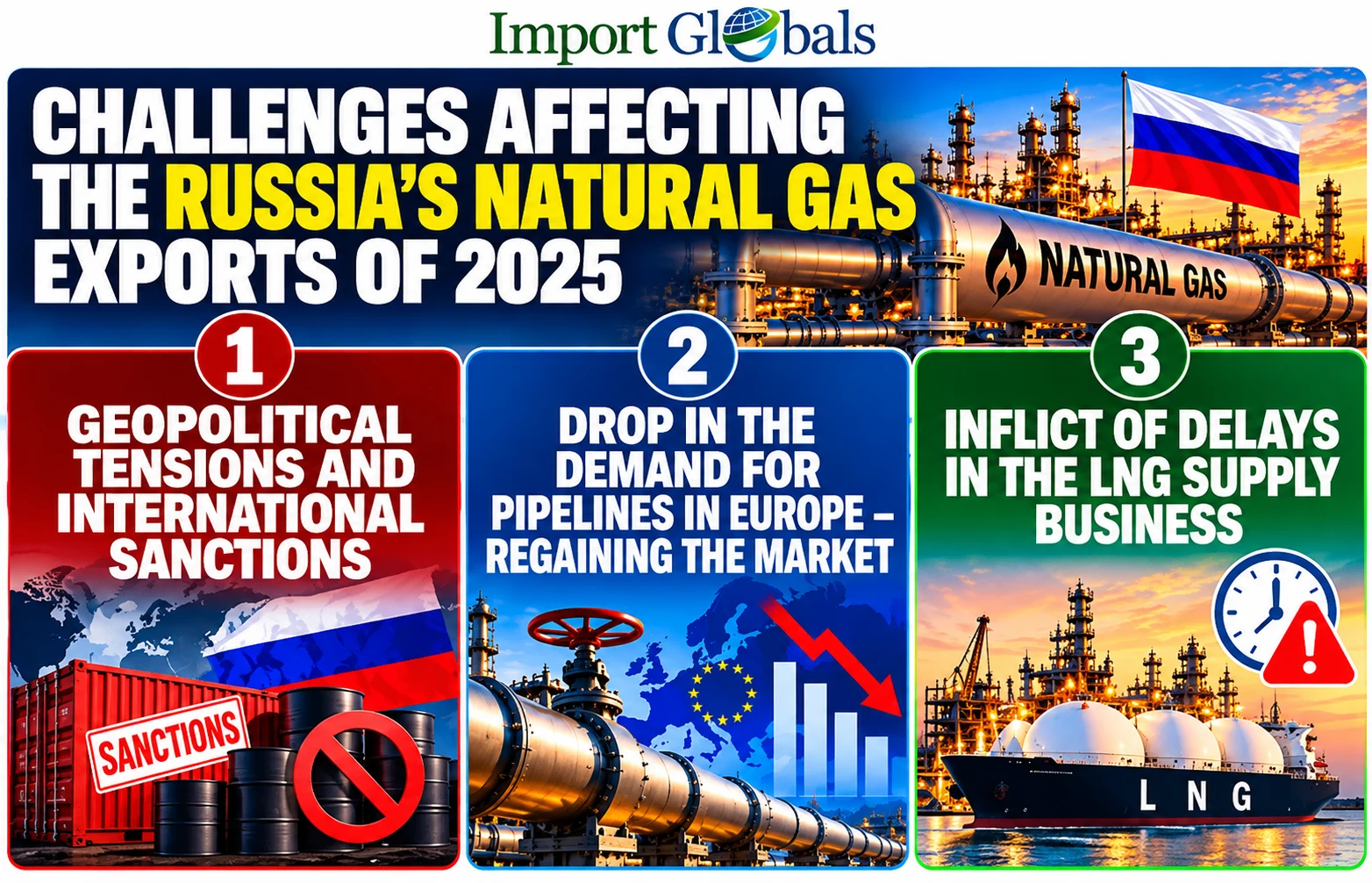
1. Geopolitical Tensions and International Sanctions
In 2025, international sanctions and political conflicts made it difficult to export Russian natural gas. Sanctions on various sectors negatively impacted energy projects, funding, transportation, technological assistance, and commercial cooperation, making the expansion of LNG supply more difficult, increasing business risks, and forcing Russia to redirect its supplies to Asia, especially China.
2. Drop in the Demand for Pipelines in Europe – Regaining the Market
In January 2025, Russia stopped its transit of gas through Ukraine, which disrupted a long-term supply line to Europe. Furthermore, other countries trying to find a better source of energy drastically discouraged the use of Russian pipelines. Although Russia managed to send its shipments in the eastern direction, the lack of a proper pipeline made it impossible to transfer the lost markets in Europe very quickly reported Russia Import Trade Data.
3. Impact of Delays in the LNG Supply Business
International sanctions limited the capacity to use the latest technological solutions, equipment, financing options, and shipping methods in LNG supply. Companies such as Arctic LNG 2 faced the issue of delays in finishing the project.
Future Trade Outlook for Russia’s Natural Gas Exports in 2025
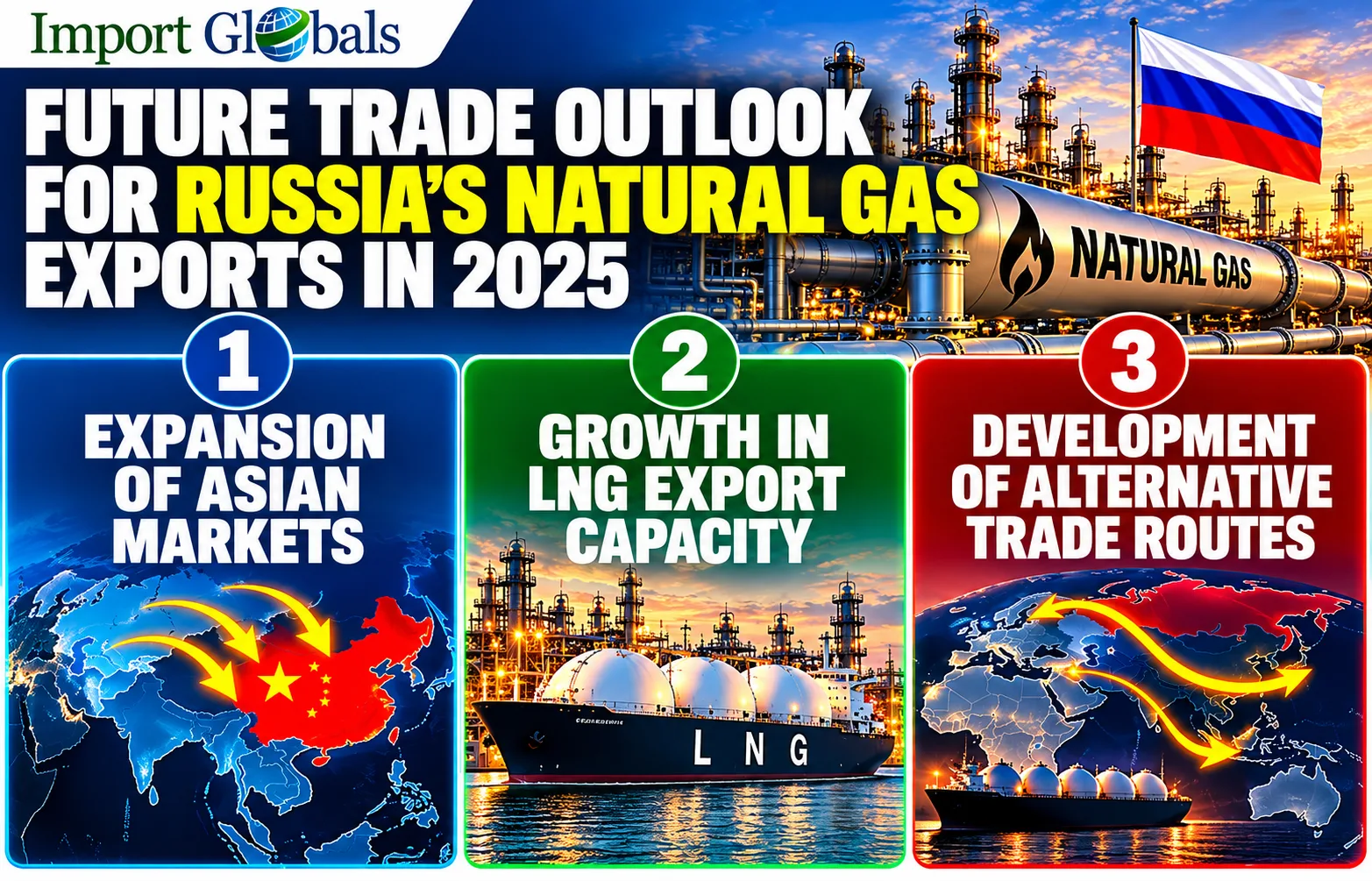
The future trade outlook for Russia’s natural gas exports after 2025 depends on opportunities for building partnerships in the Asian market, capacity expansion of liquefied natural gas (LNG), and the ability to adapt to the changes in global energy markets. One of the key markets should be China, with the help of pipelines and long-term energy partnerships. Russia might explore other destinations in Asia, including India and other countries emerging in terms of energy demand. However, the process will heavily depend upon infrastructure, prices, and commercial agreements.
LNG development is another element that can be considered important for Russia’s exports. The expansion of production, development of logistics, and access to special equipment can create new export outlets. On the contrary, sanctions adopted, lack of funds for financing projects, and technological restrictions can hinder the development of the sector.
In general, the prospects of Russia’s natural gas export development will depend on investments in infrastructure, availability of sound supply and price conditions, and the situation in the geopolitical sphere. The consolidation of cooperation with the eastern countries might create opportunities for further trade, reported Russia Import Export Data.
Conclusion
Russia’s exports of natural gas in 2025 have reaffirmed the country’s role in international energy trade even though it faces geopolitical challenges, international sanctions, and fluctuations in markets. The importance of Asian markets, particularly China, has grown significantly as Russia adapted its exports due to the loss of access to European pipeline markets. Natural gas LNG is part of Russia’s export strategy as well, allowing it to find diversified markets and enhance its energy partnerships globally.
However, challenges such as infrastructural limitations, technological restrictions, financing issues, and competition from other suppliers have affected Russia’s export performance. Established partnerships with Asian countries may provide new opportunities, although legal uncertainties and evolving global energy policies may inhibit Russia’s growth. Overall, the prospects for Russian natural gas export depend on balancing the diversification of markets with efficiency in operations.
CTA
If you are looking for the latest market updates regarding Russia’s active trade information, then you have finally landed on the right platform here. Import Globals helps businesses get detailed information regarding Russia’s marketing strategies for natural gas for 2025. Subscribe to www.importglobals.com or drop an email at info@importglobals.com to get the latest information regarding Russia’s natural gas trade to drive your international business growth.
FAQ’s
Que. What is the natural gas export trade value of Russia in 2025?
Ans. The natural gas export trade value of Russia in 2025 is 68.4 billion US dollars.
Que. Who is the top export partner of Russia for natural gas exports?
Ans. China is the top export partner of Russia for natural gas exports in 2025.
Que. Name the top natural gas exported from Russia in 2025.
Ans. Liquefied Natural Gas (LNG) is the top natural gas exported from Russia in 2025.
Que. Name the top Company boosting the natural gas exports of Russia in 2025.
Ans. Gazprom is one of the top companies boosting Russia's natural gas exports in 2025.
Que. What is the HS code for Russia’s natural gas in 2025?
Ans. The basic HS code for Russia’s natural gas in 2025 is HS – 271111.
Que. What is the main challenge affecting Russia’s natural gas export in 2025?
Ans. Geopolitical Tensions and International Sanctions are the main challenges affecting Russia’s natural gas exports in 2025.
Que. How does Russia's import-export data support business growth?
Ans. Russia's import-export data support business growth via proper identification of buyers, suppliers, analysis of market demand, and development of effective market expansion strategies.
Que. What information is available in Russia trade data?
Ans. Russia trade data covers importer name, exporter name, shipment date, HS code, product details, quantity, pricing information, origin country, importing country, and port details.
Que. How frequently is the Russia trade data updated?
Ans. Russia trade data is updated on a monthly basis.
Que. Where can you obtain detailed information on Russia trade data?
Ans. Visit www.importglobals.com or drop an email at info@importglobals.com for detailed updates on Russia trade data.
You Can Also Visit :-
- Russia Export Data: An Overview of the Products Traded and the Global Market Role of the Country
- Russia Customs Data: A Comprehensive Guide for Progressive Importers and Exporters
- Russia Latest Electronics Imports in 2025: The Marketing Strategies and Latest Trade Updates
- Information About Russia's Oil Exports, Such as How Much Oil Russia Makes and WHO Sells It
