
USA Mineral Fuels Export Overview: The Market Strategies of 2025

- Oct 23, 2026
- 25 Views
USA Mineral Fuels Export Overview: The Market Strategies of 2025
The United States remained a major global supplier of mineral fuels and petroleum products in 2025; supported by its extensive oil and gas production, refining capacity, and international energy infrastructure.
According to reported US Trade Statistics, US exports of mineral fuels, mineral oils, and products of their distillation reached US$308.91 billion in 2025; making this category one of the country’s most valuable export sectors.
When we look at the export earnings for the year 2024; which were roughly US$320.14 billion in total, there is a decrease of about 3.5% for the year 2025. The decrease is a proper representation of the trade fluctuations in the revenue rate. Mexico proved to be one of the major destinations for US mineral fuel exports, showing a strong demand for oil and energy. The Netherlands was also an important export destination for US oil exports; which were valued at about US$22.26 billion in 2025.
Mineral Fuels Export Significance: Trade Glance of 2025
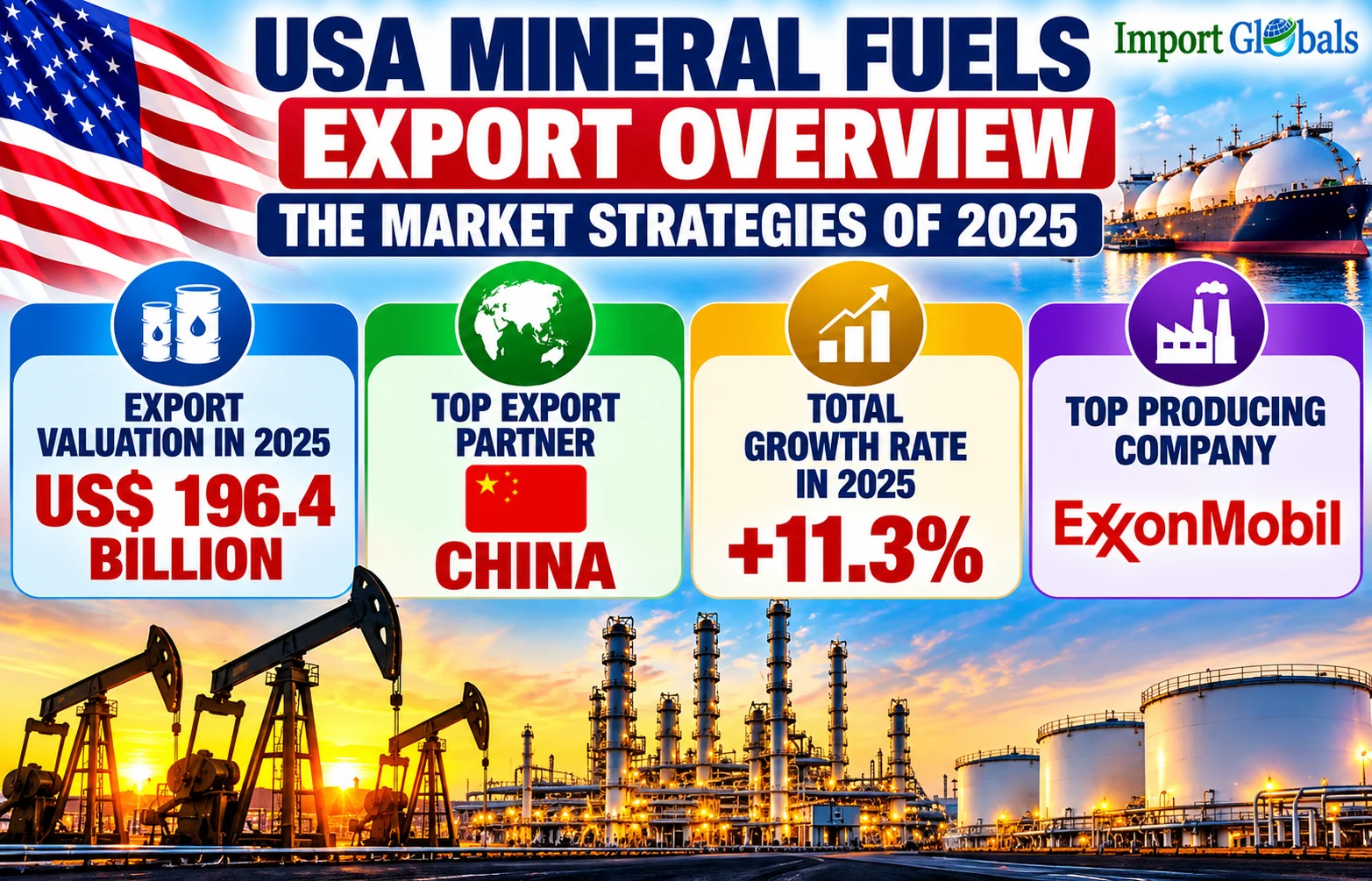
The USA continued to be an important player in the international energy market during the year 2025, with exports of mineral fuels boosting its foreign trade performance. This cemented the role of petroleum, natural gas, and other mineral fuels in the export mix of the USA. China was mentioned as the number one partner in export activities, which shows how international demand and cross-border trade in energy play a role in exports of mineral fuels from the USA.
The infographic shows the total growth in exports by 11.3 % in 2025, which indicates a good performance in the exports in the category visited. This performance shows the influence of global energy consumption, the needs of industries, and international trading relationships on export possibilities. Furthermore, the US Import Data highlights ExxonMobil as one of the major producers, which plays an important role in the mineral fuel industry in the USA. The vast system of oil fields, refineries, storage, and export facilities in the USA enables production and delivery of energy products to international markets.
Top 10 Mineral Fuels Exported Variants of Us in 2025
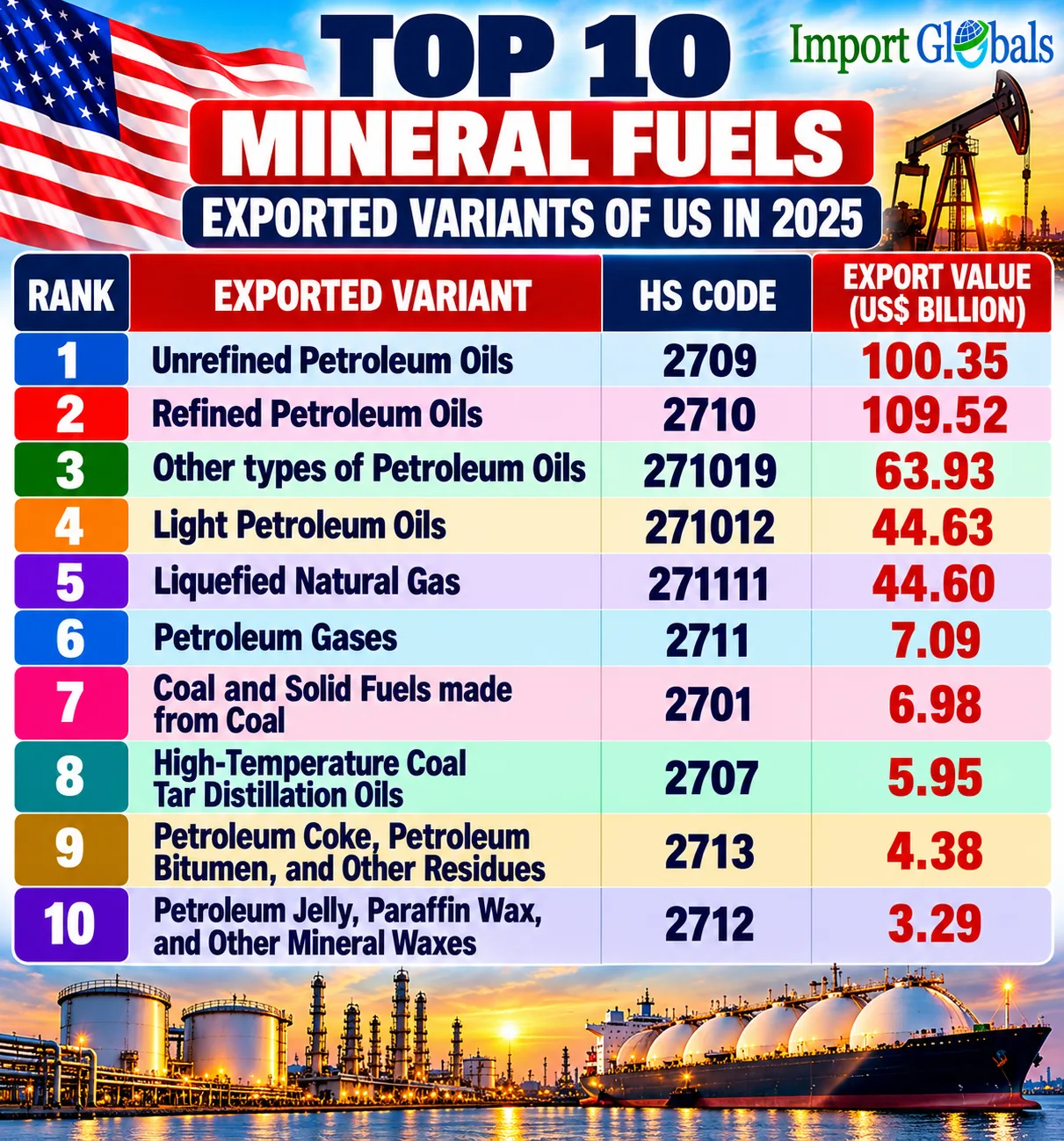
- Unrefined Petroleum Oils - HS Code 2709 - US$100.35 Billion
Unrefined oil was a key factor in US mineral fuel exports in 2025, with such deliveries being transferred as a source of various kinds of fuel such as gas, diesel, or even aviation fuel.
- Refined Petroleum Oils - HS Code 2710 - US$109.52 Billion
This subcategory absorbs all petroleum oils except for those that can be listed as crude titles. Refined oil is needed in transportation, manufacturing, energy production, and industrial energy supply in a number of countries.
- Other types of Petroleum Oils - HS Code 271019 - US$63.93 Billion
This category signifies certain petroleum oils and oils that cannot be classified as crude. All the products available in this category are used in the industrial, commercial, and transport fields, making it one of the significant aspects of US refined oil exports.
- Light Petroleum Oils - HS Code 271012 - US$44.63 Billion
Light petroleum oil is represented by such products as light distillates of oil and gasoline-type oil products, says US Export Data. These oils are widely used in transportation, blending, and power supply in other countries.
- Liquefied Natural Gas – HS Code 271111 – US$44.6 Billion
Liquefied natural gas has been cooled down into liquid form for easier storage and transportation in special ships. It is important for electricity generation, factories, and gas distribution systems in different parts of the world.
- Petroleum Gases – HS Code 2711 – US$7.09 Billion
Petroleum gases encompass natural gas, propane, butane, and other gaseous hydrocarbons. It plays a role in electricity production, heating systems, industrial manufacturing and other forms of energy distribution.
- Coal and Solid Fuels made from Coal – HS Code 2701 – US$6.98 Billion
Coal, as well as solid fuels made from coal, is mainly used in the steel industry, cement production, and industrial energy generation processes. In 2025, the amount for this category exported by the USA to France was around US$215.98 million.
- High-Temperature Coal Tar Distillation Oils - HS Code 2707 - US$5.95 Billion
The oils include aromatic compounds employed in chemical processing and manufacturing. The exports of such oils to France from the USA were roughly valued at about US$14.95 million in the year 2025.
- Petroleum Coke, Petroleum Bitumen, and Other Residues - HS Code 2713 - US$4.38 Billion
Petroleum coke is used in various industrial processes, while petroleum bitumen is used for constructing roads. The overall exports under this category made US$70.24 million.
- Petroleum Jelly, Paraffin Wax, and Other Mineral Waxes - HS Code 2712 - US$3.29 Billion
Petroleum jelly, paraffin wax, and other mineral waxes are highly demanded in packaging, candle-making, cosmetics creation, coatings, and various industries. Exports under this category to France amounted to roughly US$38.66 million in 2025.
Top 10 Strategic Export Partners of Us for Mineral Fuels in 2025
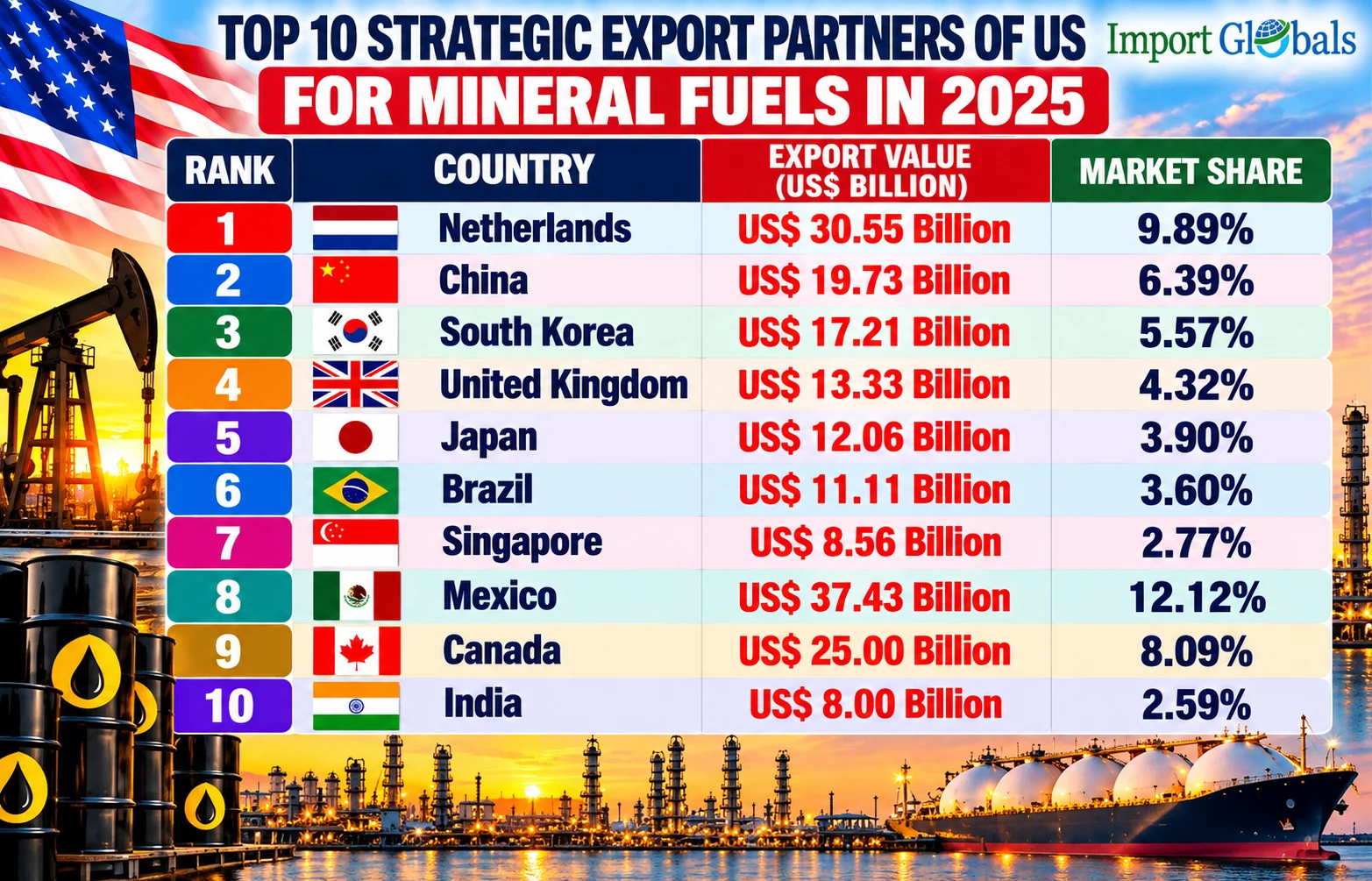
- Netherlands – US$30.55 Billion | 9.89% Market Share
The Netherlands is Western Europe’s key hub for the American mineral fuels market due to its effective energy infrastructure, enhanced refinery and storage capacities, and distribution role in the petroleum markets of Europe.
- China – US$19.73 Billion | 6.39% Market Share
China is one of the leading countries that purchase American mineral fuels and petroleum products. It has a big industrial base with multiple transportation systems, the level of importance of which in the energy trade indicates its essential meaning for commercial relationships.
- South Korea – US$17.21 Billion | 5.57% Market Share
The role of South Korea as a significant importer of American mineral fuels is to support its industrial production, refineries, and energy needs, says US Import Export Data. The advanced manufacturing processes, as well as good developments in maritime shipping, prove its importance for Asian countries.
- United Kingdom – US$13.33 Billion | 4.32% Market Share
The United Kingdom is an important destination for American mineral fuels and other energy commodities. The infrastructure and commercial relations of this country help to support trade in the field of oil and gas.
- Japan — US$12.06 Billion | 3.90% Market Share
Japan depends on imported energy, which leads to trade with American suppliers. Moreover, petroleum and other energy resources fulfil its industrial and transport requirements in addition to contributing to international energy sourcing.
- Brazil — US$11.11 Billion | 3.60% Market Share
In the region, Brazil is among the significant countries that import mineral fuels from the USA. The demands of Brazilian transportation, industry, and refineries favour the trade, although changes in particular products will depend on prices and competition.
- Singapore — US$8.56 Billion | 2.77% Market Share
Singapore acts as an important maritime base for energy supplies in Asia and helps to develop US mineral fuels trade with the USA. Its potential for storage, refinement, and distribution makes Singapore an important country in the supply chain of oil production.
- Mexico - US$37.43 billion | Market Share: 12.12%
Mexico is the top 8th export partner of US for its mineral fuels trade. The bilateral proximity and close trade ties due to consumer demand rates have been supporting the proper trade.
- Canada - US$25 billion | Market Share: 8.09%
Canada enjoys strong trade relations with the US; when it comes to energy trade thanks to pipelines, transport networks, and the refining business. Bilateral flow of mineral fuels benefits economic activity, fuel distribution, and North American energy-related companies.
- India: US$8 billion | Market Share: 2.59%
India is a relatively new but promising international market for US mineral fuels that is based on growing energy consumption, industrialization processes, and transport needs. The potential for bilateral trade will depend on international prices, demand for products, shipping costs, and competitiveness of suppliers.
Top 10 Companies Boosting the Mineral Fuels Export of Us in 2025
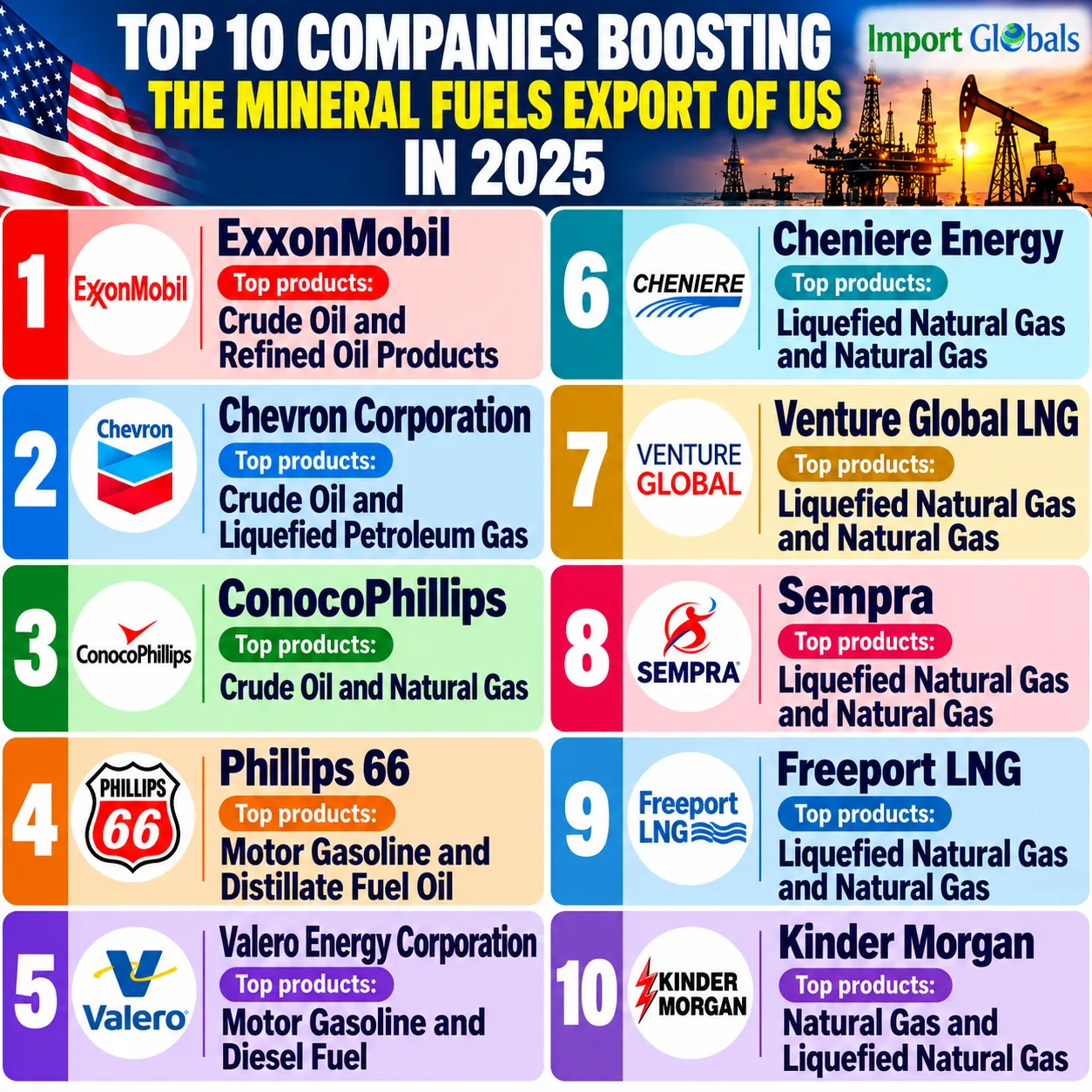
- ExxonMobil – Top products - Crude Oil and Refined Oil Products
ExxonMobil promotes exports of mineral fuels of the United States through ample operations in production, refining, and trade. United States integrated operations system connects energy production sources with the international market of crude oil and fuels, says US Trade Statistics.
- Chevron Corporation – Top products - Crude Oil and Liquefied Petroleum Gas
Chevron contributes to exports of energy between the United States and other countries through oil production and gas operations. Its operations and its trading system help supply international buyers with crude oil and petroleum-based fuels.
- ConocoPhillips – Top products: Crude Oil and Natural Gas
ConocoPhillips strengthens trade in the United States. It supplies its resources to international fuel supply systems and promotes US energy.
- Phillips 66 – Top products - Motor Gasoline and Distillate Fuel Oil
Phillips 66 contributes to refined fuel exports through refinery technology. The infrastructure of Phillips 66 is responsible for moving gasoline and oil to overseas customers.
- Valero Energy Corporation – Top products - Motor Gasoline and Diesel Fuel
Valero supports US exports of mineral fuels through ample refinery and fuel marketing operations toward foreign countries.
- Cheniere Energy – Top products - Liquefied Natural Gas and Natural Gas
Cheniere is a key player in LNG export terminals in the US, providing American natural gas supplies to clients across borders. Its facilities for liquefaction and partnerships with buyers are a hallmark of delivering more exports of American natural gas.
- Venture Global LNG – Top products - Liquefied Natural Gas and Natural Gas
Venture Global builds large-scale liquefaction plants to create more capacity for American LNG exports. Its Plaquemine’s facility has given additional opportunities for exports in the future.
- Sempra – Top products - Liquefied Natural Gas and Natural Gas
Sempra promotes international trade of gas through investments in energy infrastructure and LNG, reported US Import Customs Data. Its assets connected to Cameron LNG allow for linking the supply of American natural gas to clients abroad.
- Freeport LNG – Top products - Liquefied Natural Gas and Natural Gas
Freeport LNG provides the US with exports of LNG produced by processing the natural gas from pipelines. This allows the company to provide access to the international markets from its terminal located on the Gulf Coast of Texas.
- Kinder Morgan – Top products - Natural Gas and Liquefied Natural Gas
Kinder Morgan helps the export supply chain with its network of pipelines and terminals distributed all over the country, allowing for supply and sale.
Statistical Analysis of the Mineral Fuels Trade of USA: Past 10 Years
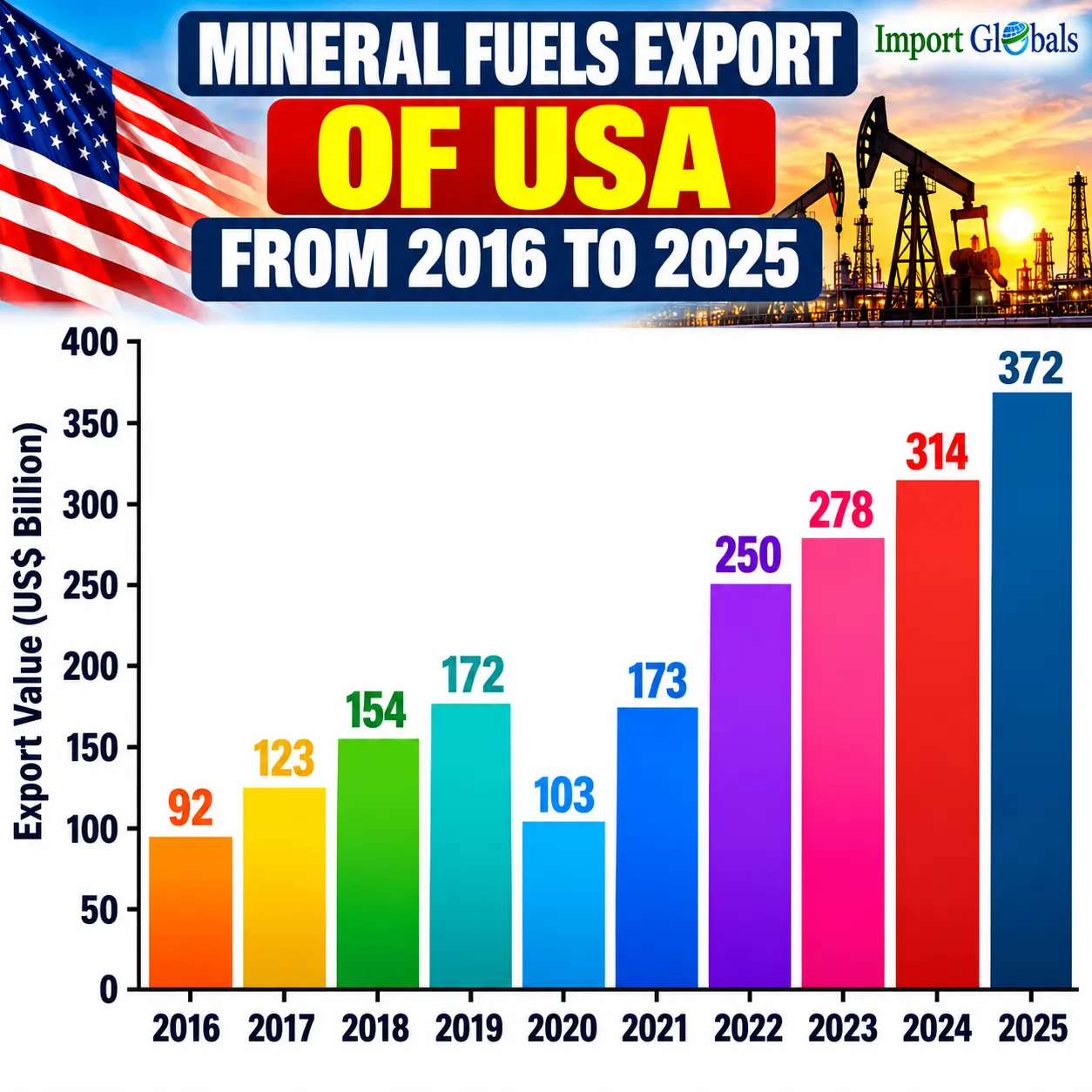
The mineral fuel export sector in the United States had very good growth in the long run between 2016 and 2025, reflecting the country’s increasing energy production and global market capability. From the chart, US mineral fuels exports amounted to US$92 billion in 2016 and rose to USD 123 billion in 2017 and USD 154 billion in 2018. The growth continued in 2019 when exports were USD 172 billion. Nevertheless, in 2020, exports decreased to USD 103 billion, which means a temporary fall in the long-term upward trend. Subsequently, the sector recovered, reaching the level of USD 173 billion in 2021 and USD 250 billion in 2022. This trend continued in 2023 with the expected amount of exports of USD 278 billion and USD 314 billion in 2024.
In 2025, US mineral fuels exports finished at USD 372 billion - the peak in the graph shows that international trade of mineral fuels has become bigger overall, as per US Export Trade Data. In total, in the period between 2016 and 2025; US mineral fuels exports increased by USD 280 billion, which indicates growth of about 304.3%. The unexpected strong recovery after 2020 highlights the importance of oil products and crude oil and gas for US exports.
Bilateral Trade Overview: The Significance of the Netherlands
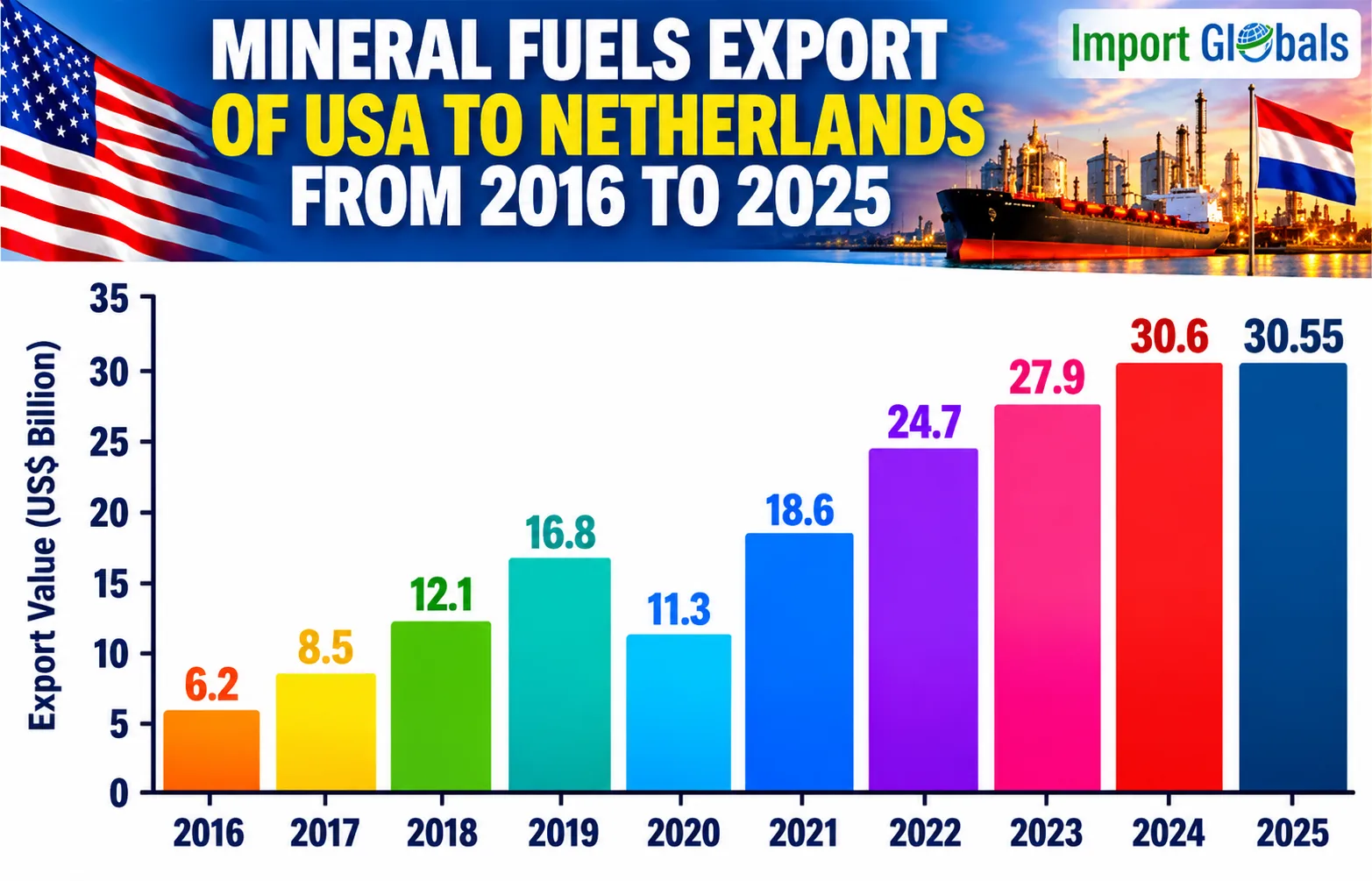
The mineral fuels export trade between the United States and the Netherlands experienced substantial growth between 2016 and 2025: highlighting the Netherlands’ importance as a European destination for American energy products. According to the US Customs Shipments Data, US mineral fuels exports to the Netherlands were valued at US$6.2 billion in 2016; increasing to US$8.5 billion in 2017 and US$12.1 billion in 2018.
However, the value declined to US$11.3 billion in 2020; reflecting a temporary interruption in the growth trajectory. Exports recovered strongly in 2021; reaching US$18.6 billion before rising to US$24.7 billion in 2022. The exports of the nation valued at US$27.9 billion followed by US$30.6 billion in 2024. Exports reached approximately US$30.55 billion in 2025.
Tariffs Promoting the Mineral Fuels Export of USA
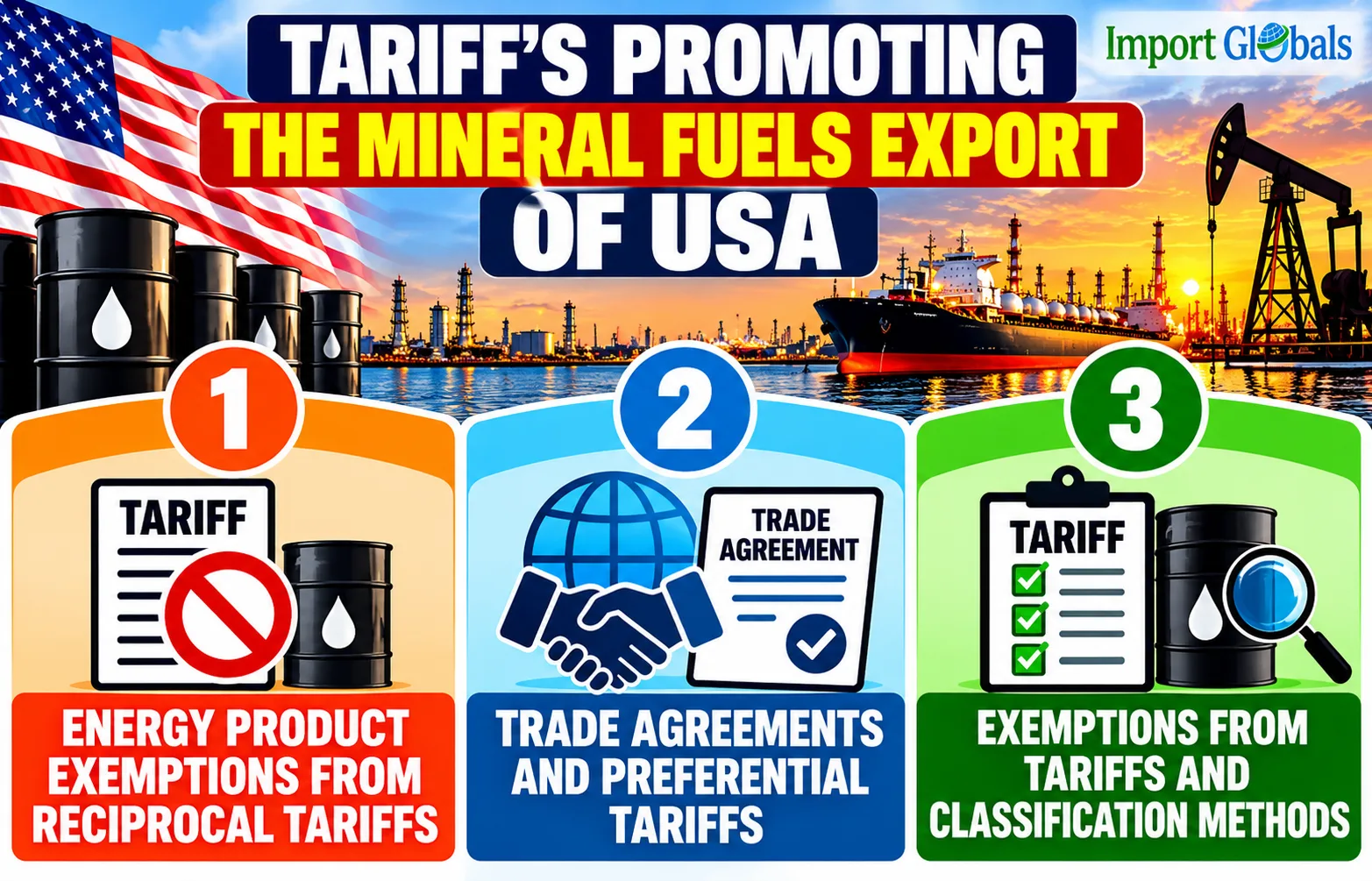
- Energy Product Exemptions from Reciprocal Tariffs
According to the US Trade Data, effective in 2025, the reciprocal tariffs as per the order published on April 2 were not imposed on the specific energy products. Therefore, the importers did not have to incur an extra levy on the imported goods. However, the exemption does not imply that the US became a favoured trader in other countries where its products were exempt.
- Trade Agreements and Preferential Tariffs
US mineral fuels are affected by trade agreements and preferential tariffs. It makes sense for the exporters to mean lower cost of product and wider market opportunities for the exporter. However, the extent of the benefit will depend on the tariff policy provided in the country of importation since every trade agreement should be treated separately.
- Exemptions from Tariffs and Classification Methods
Determining the applicable tariff measures depends on the classification of crude oil, petroleum products, natural gas, and liquefied natural gas. In 2025, the United States’ reciprocal tariff laws included exemptions for specified energy products within its tariff system, but these were governed by strict product classification laws and rules. Incorrect registration can lead to unnecessary delays, disputes, and costs for either exporters or importers says US Import Export Trade Data.
Future Outlook for Mineral Fuels Exports From United States
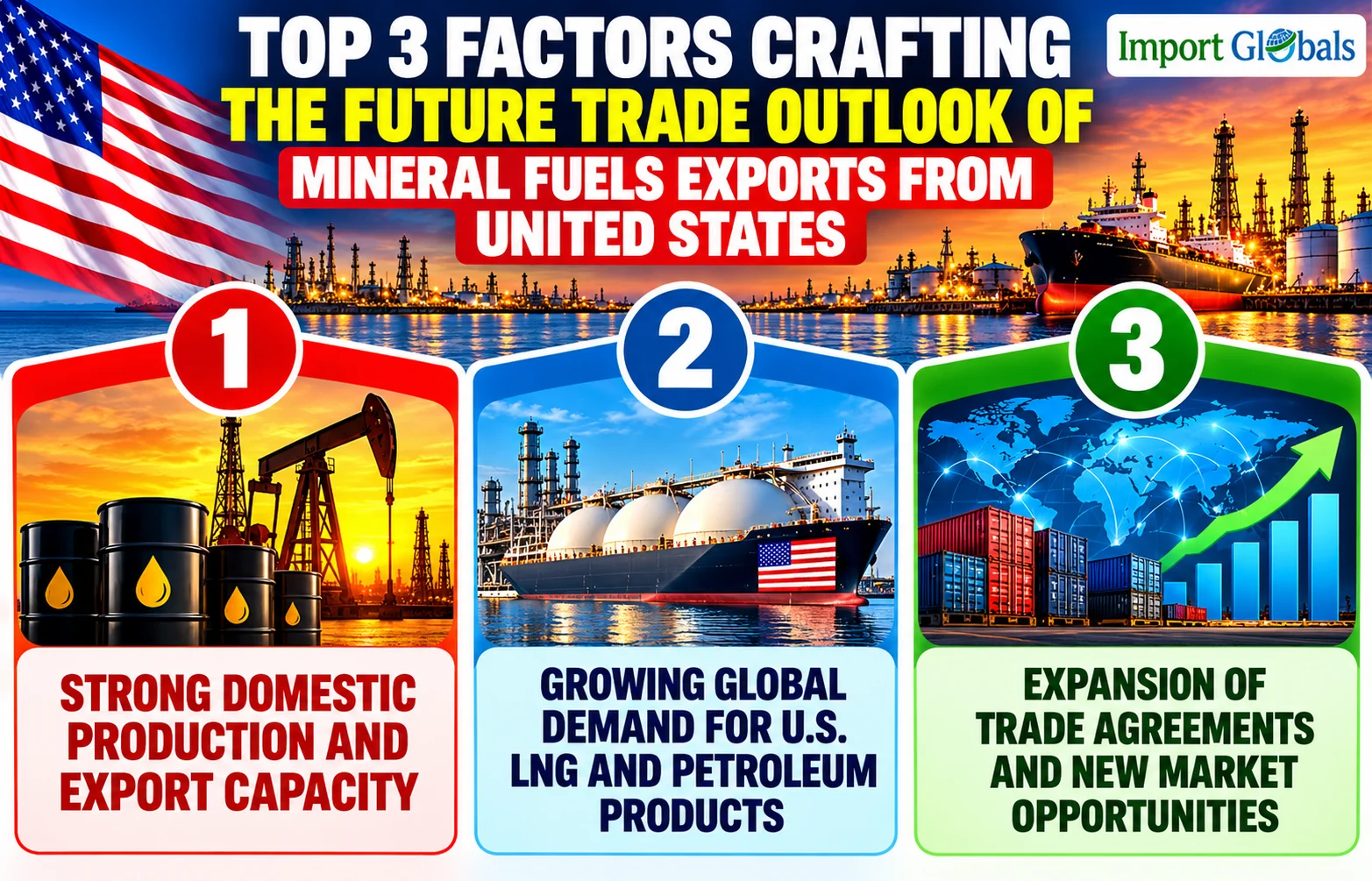
The prospects regarding the exports of mineral fuels from the United States are primarily dependent on global energy needs and demand, production capacity, prices on international markets, and trade policies. Thus, the USA enters this period with favourable figures implying its export potential, as the total energy exports reached 31 quadrillion British thermal units in 2025 while the natural gas exports exceeded 9 quadrillion Btu. Petroleum was the main component of the energy exports from the USA, holding 63% of its total volume.
One of the main actors in the success of this sector is LNG, as new export plants continue to be built and customers are eager to diversify their sources of energy supply.
It is crucial to keep track of Europe and Asia as the major targets for exports, while the Netherlands is expected to remain the key energy trading country in Europe. However, the possible success will depend on the market situation, shipping expenses, and tariffs applied in the countries where the products go, as per US Shipments Trade Data.
Conclusion
The mineral fuels export industry is one of the most significant parts of the United States' international trade. Its achievements are supported by high levels of oil production and processing, natural gas reserves, and export infrastructure. The figures used in the analysis of mineral fuels exports for the period from 2016 to 2025 indicate the growth of US mineral fuel exports and an increase in export shipments to the Netherlands. The Netherlands appears to be an energy importer and distributor, which denotes the significance of the European markets for US energy companies.
The most famous companies such as ExxonMobil, Chevron, Valero Energy, Phillips 66, and Cheniere Energy take part in the energy supply chain. In addition, tariff exemptions, trade agreements, and customs categorizations impact market access.In the future, the expansion of LNG capacities, international demand, and the proper delivery infrastructure are likely to promote exports, reports US Import Trade Data.
CTA
Trying to get the latest market updates regarding the mineral fuels exports of the USA. Import Globals is here to resolve all your complexities of trade with active market insights. Subscribe to www.importglobals.com or drop an email at info@importglobals.com to get up-to-date knowledge regarding accurate trade updates on USA mineral fuels to transform your global business growth.
FAQ’s
Que. What is the export trade value of mineral fuels from the USA in 2025?
Ans. The export trade value of mineral fuels from the USA in 2025 is US$308.91 billion in 2025.
Que. Who is the top export partner of the USA for mineral fuels in 2025?
Ans. The top export partner of the USA for mineral fuels in 2025 is the Netherlands.
Que. Name the top company boosting the mineral fuels export of the USA in 2025.
Ans. ExxonMobil is the top company boosting the mineral fuels export of the USA in 2025.
Que. Name the top products influencing the US mineral fuels export of 2025.
Ans. Unrefined petroleum oils are the top products influencing the US mineral fuels export in 2025.
Que. What is the top tariff influencing the US mineral fuels exports of 2025?
Ans. Energy Product Exemptions from Reciprocal Tariffs are the top tariff influencing the US mineral fuels exports of 2025.
Que. What is the accountability of mineral fuels in the US export revenue?
Ans. The contribution of mineral fuels to US export revenue is 11.3%.
Que. How does the USA’s import-export data support business growth?
Ans. USA’s import-export data supports business growth
via proper identification of buyers, suppliers, analysis of market demand, and development of effective market expansion strategies.
Que. What information is available in USA trade data?
Ans. USA trade data covers importer name, exporter name, shipment date, HS code, product details, quantity, pricing information, origin country, importing country, and port details.
Que. How frequently is the USA trade data updated?
Ans. USA trade data is updated on a monthly basis.
Que. Where can you obtain detailed information on USA trade data?
Ans. Visit www.importglobals.com or drop an email at info@importglobals.com for detailed updates on USA trade data.
You Can Also Visit :-
